

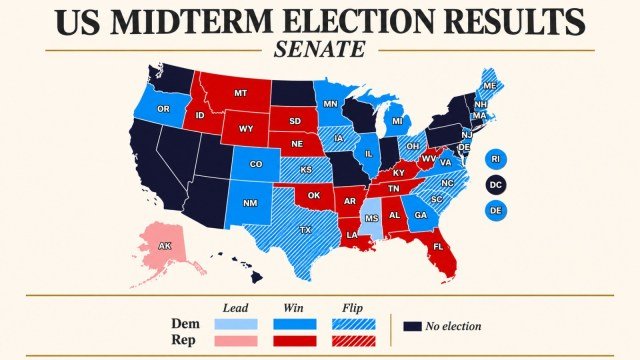
The 2026 United States midterm elections have delivered a major political setback to President Donald Trump and the Republican Party, with Democrats making significant gains and securing control of both chambers of Congress. The results, announced on November 3 and 4, mark a shift in the country’s political landscape and could significantly influence the remaining two years of Trump’s second presidential term.
The Democratic victories extended across several traditionally competitive states, with the party defeating Republican incumbents in key Senate races and gaining seats in the House of Representatives. Several gubernatorial contests also produced notable outcomes, including a historic victory in Ohio, where Democrat Amy Acton defeated Trump-backed Republican candidate Vivek Ramaswamy.
Democrats Secure Congressional Majority
The most significant outcome of the elections was the Democrats’ success in regaining control of Congress. According to reported results, Democrats secured at least 54 seats in the 100-member Senate, including two independents who caucus with the party, while Republicans held 44 seats. Some contests were still awaiting final results.
In the House of Representatives, Democrats crossed the 218-seat threshold required for a majority, with 228 seats reported against 139 for Republicans as counting continued.
The Senate victories included important Republican-held seats in Texas, Iowa, Kansas, Ohio, Maine, North Carolina and South Carolina. In Kansas, Democrat Adam Hamilton defeated Republican incumbent Roger Marshall, marking the first Democratic victory in a Kansas Senate race since 1932. In Texas, James Talarico defeated Republican Senator John Cornyn, while former Democratic senator Sherrod Brown reclaimed his Ohio seat by defeating Republican Jon Husted.
The results give Democrats greater influence over legislation, government spending, congressional investigations and oversight of the Trump administration.
Amy Acton Defeats Vivek Ramaswamy in Ohio
One of the most closely watched gubernatorial contests was in Ohio, where Democrat Amy Acton defeated Republican Vivek Ramaswamy to become the state’s first woman governor.
Acton, a physician who previously served as Ohio’s health director during the COVID-19 pandemic, campaigned on healthcare access, affordability and support for working families. Ramaswamy, an entrepreneur and former Republican presidential candidate, received Trump’s endorsement and campaigned on economic growth, tax reductions and public safety.
Acton’s victory is particularly significant because Ohio has increasingly leaned towards Republicans in recent presidential elections, including its support for Trump in 2024. Her win ends 16 years of Republican control of the state’s governorship and represents a major Democratic breakthrough.
Democrats Make Gains in Gubernatorial Races
The Democratic gains were also visible in state-level elections. In Georgia, former Atlanta mayor Keisha Lance Bottoms won the governorship, becoming the first Black woman elected governor in the United States.
Democrat Gina Hinojosa secured victory in Texas, becoming the state’s first Latina governor. In New Mexico, former US Interior Secretary Deb Haaland made history as the first Native American woman elected governor. David Crowley won in Wisconsin, becoming the state’s first Black governor, while Rob Sand secured victory in Iowa.
Democrats also registered victories in Nevada, where Aaron Ford defeated incumbent Republican governor Joe Lombardo, and Michigan, where Jocelyn Benson won the gubernatorial race.
Why Did Republicans Lose Ground?
Economic concerns, particularly inflation and the rising cost of living, emerged as important issues influencing voter sentiment. Healthcare, immigration, tariffs and the administration’s broader policy direction also featured prominently during the campaign.
The midterm elections traditionally serve as a referendum on the performance of the incumbent President. The party controlling the White House frequently faces electoral losses as voters use the opportunity to express dissatisfaction with the administration.
Trump actively campaigned for Republican candidates and urged voters to support his party. However, several candidates backed by him suffered defeats, suggesting that his endorsement was not enough to secure victories in key battlegrounds.
Trump’s Reaction and the Road Ahead
Responding to the results, Trump congratulated Democrats on their victories but rejected the suggestion that the outcome represented a personal setback. In comments reported by Fox News, he maintained that his first two years in office had been highly successful and suggested that Republican candidates had struggled to inspire voters.
The Democratic majority in Congress is expected to make the remainder of Trump’s presidency more challenging. The party will have greater control over congressional committees, legislative priorities, budget negotiations and investigations into administration policies.
The newly elected Congress is scheduled to convene on January 3, 2027. Democratic House leader Hakeem Jeffries is expected to emerge as a leading contender for the position of Speaker of the House.
The 2026 midterm elections have therefore reshaped the balance of power in Washington. For Democrats, the victory presents an opportunity to challenge the administration and advance their priorities. For Trump and the Republicans, it signals a difficult political phase ahead, with the results also likely to influence preparations for the 2028 presidential election.