

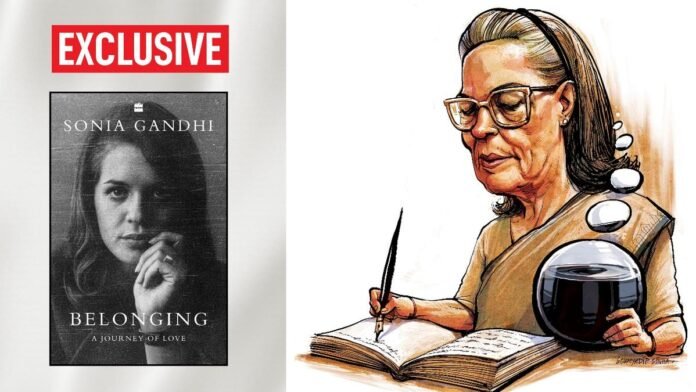
Sonia Gandhi’s memoir has become one of the most discussed political book releases of November 2026, attracting attention not only for its personal revelations but also for the controversies surrounding its publication, historical references and political interpretations. Titled Belonging: A Journey of Love, the book offers an account of Gandhi’s journey from her childhood in Italy to her marriage into the Nehru-Gandhi family and her eventual emergence as one of India’s most influential political figures. However, soon after its release, the memoir found itself at the centre of a debate over publishing freedom, historical accuracy and the interpretation of India’s political past.
Released on November 10, 2026, the memoir traces Gandhi’s personal and political journey, including her marriage to former Prime Minister Rajiv Gandhi, her experiences within the Nehru-Gandhi family, the assassinations of her mother-in-law Indira Gandhi and husband Rajiv Gandhi, and her eventual entry into active politics. It also revisits her years as Congress president, the challenges faced by the party and her decision to decline the Prime Minister’s position after the United Progressive Alliance (UPA) won the 2004 general elections, choosing Manmohan Singh for the post instead.
One of the first controversies surrounding the book emerged even before its release, when Penguin Random House India did not proceed with its publication. Reports suggested that disagreements arose over proposed editorial changes and deletions in certain sections of the manuscript, particularly those concerning Prime Minister Narendra Modi, the Rashtriya Swayamsevak Sangh (RSS), India’s political environment and relations with China. Gandhi’s team reportedly did not agree to the suggested changes, leading to the breakdown of the publishing arrangement.
The development triggered a wider debate about editorial independence and possible self-censorship in India’s publishing industry. Some Congress leaders alleged that politically sensitive content had become a reason for the publisher’s withdrawal. Penguin Random House India, however, maintained that fact-checking and editorial recommendations were part of its normal publishing responsibilities and denied suggestions of external pressure. HarperCollins India subsequently acquired the rights to publish the Indian edition, while the international edition was released through Alfred A. Knopf in the United States and William Collins in the United Kingdom.
The memoir also attracted attention for its political observations, particularly its references to Prime Minister Narendra Modi and the ideological differences between the two political leaders. Gandhi reflects on their contrasting visions of India, describing her understanding of the country through the framework of secularism and inclusiveness, while discussing the influence of the RSS on Modi’s political outlook. She also revisits her decision in 2004 to step aside from the Prime Minister’s post, explaining the circumstances and considerations behind her choice.
However, the most immediate criticism following the book’s release concerned several historical and factual inaccuracies identified by readers and media reports. Among the errors highlighted was the founding year of the RSS, which the memoir reportedly mentions as 1921, whereas the organisation was established by K.B. Hedgewar in 1925. Another discrepancy concerns the anti-corruption movement led by Anna Hazare, which the book places in 2012, although the movement gained national prominence in 2011.
The memoir also reportedly gives the year of death of senior Congress leader Ahmed Patel as 2022, whereas he passed away on November 25, 2020, following COVID-19-related complications. Other reported inaccuracies concern historical events, election figures and political timelines. These discrepancies have raised questions about the extent of fact-checking and editorial scrutiny undertaken before publication, particularly because the book discusses several significant events in India’s political history.
Political criticism has extended beyond these factual errors. Leaders associated with the Bharatiya Janata Party (BJP) and other political groups have accused Gandhi of presenting a selective account of contentious historical events, including the Emergency imposed in 1975 and the anti-Sikh violence of 1984. Critics have questioned whether the memoir adequately acknowledges the political responsibility and controversies associated with the Congress leadership during those periods.
Gandhi’s account of the 1984 anti-Sikh violence and the role of the political leadership has particularly attracted attention. While she describes the violence as a tragic and shameful chapter and acknowledges the failure to deliver timely justice, critics have questioned her defence of Rajiv Gandhi against allegations surrounding the events. Congress leaders, meanwhile, have rejected the criticism as politically motivated and argued that a personal memoir should also be understood in the context of the author’s experiences and recollections.
Another discussion surrounding the book concerns its treatment of former Prime Minister P.V. Narasimha Rao, whose contribution to India’s economic reforms and political history has been regarded as significant. Critics have pointed to his limited presence or omission from the narrative, questioning the selection of events and personalities included in Gandhi’s account.
Despite the controversies, Belonging: A Journey of Love has generated considerable public interest and opened discussions about the relationship between personal memory, political history and historical documentation. While supporters view it as an opportunity to understand the personal experiences of a leader who remained at the centre of Indian politics for decades, critics argue that its historical claims require closer examination.
The debate surrounding the memoir goes beyond one political leader or one publication. It raises important questions about the responsibility of public figures when documenting history, the role of publishers in verifying facts and the distinction between personal recollections and established historical records. Ultimately, the book has become as much a subject of political debate as a literary account of Sonia Gandhi’s life, demonstrating how memoirs by influential public figures can shape conversations about India’s past and its political present.