

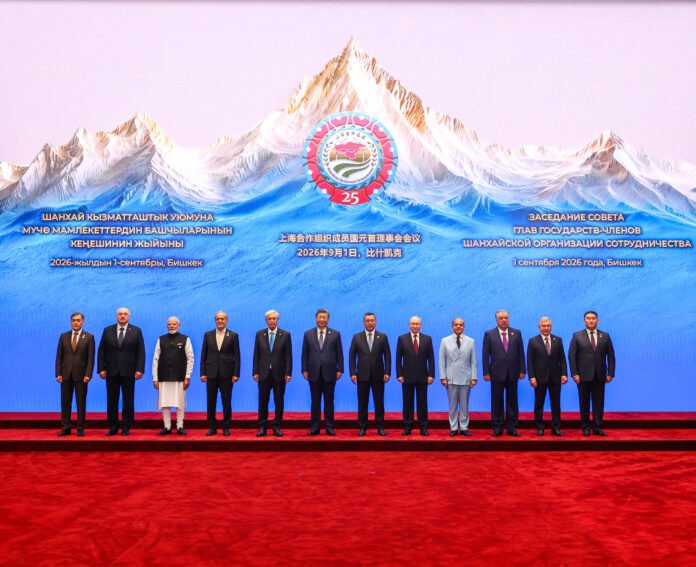
The 26th Meeting of the Council of Heads of State of the Shanghai Cooperation Organisation (SCO) was held in Bishkek, Kyrgyzstan, from August 31 to September 1, 2026, bringing together the leaders of the organisation’s member states at a significant moment in its history. The summit marked the 25th anniversary of the SCO and concluded Kyrgyzstan’s year-long chairmanship.
Held under the theme “25 Years of the SCO: Together for Sustainable Peace, Development and Prosperity,” the summit focused on regional security, counter-terrorism, economic cooperation, connectivity, energy, technology, environmental issues and the changing international order. Leaders also discussed ways to strengthen the organisation’s role in promoting peace, stability and development across the wider Eurasian region.
Bishkek Declaration and Major Decisions
The summit concluded with the adoption of the Bishkek Declaration, along with 28 other documents covering a wide range of areas of cooperation. These included amendments to the SCO Charter, assistance to states affected by emergencies and measures to strengthen cooperation against security and drug-related threats. The organisation also approved provisions concerning a proposed Universal Centre for Countering Challenges and Threats and an SCO Anti-Drug Centre.
The discussions reflected the SCO’s continuing attempt to present itself as a platform for dialogue and cooperation amid growing geopolitical tensions. Leaders stressed the importance of resolving conflicts through political and diplomatic means and called for greater respect for international cooperation and a more balanced global order.
Modi Focuses on Terrorism
For India, counter-terrorism remained one of the most important issues at the summit. Prime Minister Narendra Modi called for an uncompromising approach to terrorism and stressed that there could be no double standards in dealing with the menace.
Modi argued that terrorism cannot be treated as a strategic instrument and called for dismantling the broader ecosystem that supports terrorism, including financing and safe havens. His remarks carried particular significance as Pakistani Prime Minister Shehbaz Sharif was also present at the summit. India has consistently used SCO platforms to press for stronger collective action against terrorism and its financing.
The emphasis on security also fits into India’s broader approach to the SCO. Speaking at the summit, Modi highlighted the need to turn the organisation’s earlier vision of security, connectivity and opportunity into concrete outcomes during its next phase.
Pakistan Takes Over the SCO Chairmanship
A major outcome of the Bishkek summit was the transfer of the SCO’s rotating chairmanship from Kyrgyzstan to Pakistan for 2026–27. Pakistan has announced the theme of its chairmanship as “Turning Vision into Action: Connectivity, Innovation and Shared Prosperity.”
Prime Minister Shehbaz Sharif said Pakistan would seek to focus on information technology and artificial intelligence, energy, development, poverty reduction, disaster management, health, culture and sports. He also stressed that the organisation should produce tangible benefits for its people.
Pakistan’s chairmanship will be closely watched, particularly because India and Pakistan remain members of the same regional organisation despite their difficult bilateral relationship. The SCO’s consensus-based framework provides a platform where both countries can participate in wider regional discussions even when bilateral tensions remain unresolved.
Water and Regional Stability
Water security also emerged as an important issue. Addressing the summit, Shehbaz Sharif described water as the “lifeblood” of the region and said it should never be used as an instrument of political coercion or leverage. He also emphasised the importance of respecting agreements governing shared waters.
The remarks come against the backdrop of continuing tensions between India and Pakistan over water-sharing arrangements, giving the issue additional diplomatic significance.
Modi’s Bilateral Diplomacy
Alongside the main summit, Prime Minister Modi held several bilateral meetings with other participating leaders. His discussions with Russian President Vladimir Putin and Iranian President Masoud Pezeshkian were particularly significant given the changing geopolitical situation and conflicts affecting Eurasia and West Asia. Modi also met Kyrgyz President Sadyr Japarov and other leaders during his visit.
These engagements demonstrated India’s effort to use the SCO not merely as a multilateral forum but also as an opportunity for direct diplomatic engagement with key partners.
Looking Ahead
The Bishkek summit was more than an annual gathering. Coming 25 years after the SCO’s establishment, it provided an opportunity for member states to assess the organisation’s achievements and define its priorities for the coming decades.
The SCO now brings together a diverse group of Eurasian powers with different political systems, economic interests and foreign-policy priorities. Managing these differences while maintaining cooperation on common concerns such as terrorism, connectivity, trade, energy, technology and regional security will remain one of its biggest challenges.
As Pakistan begins its year as chair, the focus will now shift from declarations to implementation. Whether the organisation can translate its ambitious agenda into practical cooperation will determine how effectively the SCO can shape regional affairs in the next phase of its 25-year journey.