

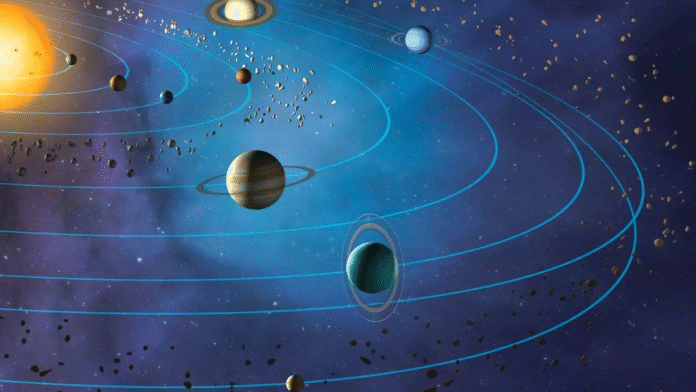
PC: (The Economic Time, Times Now)
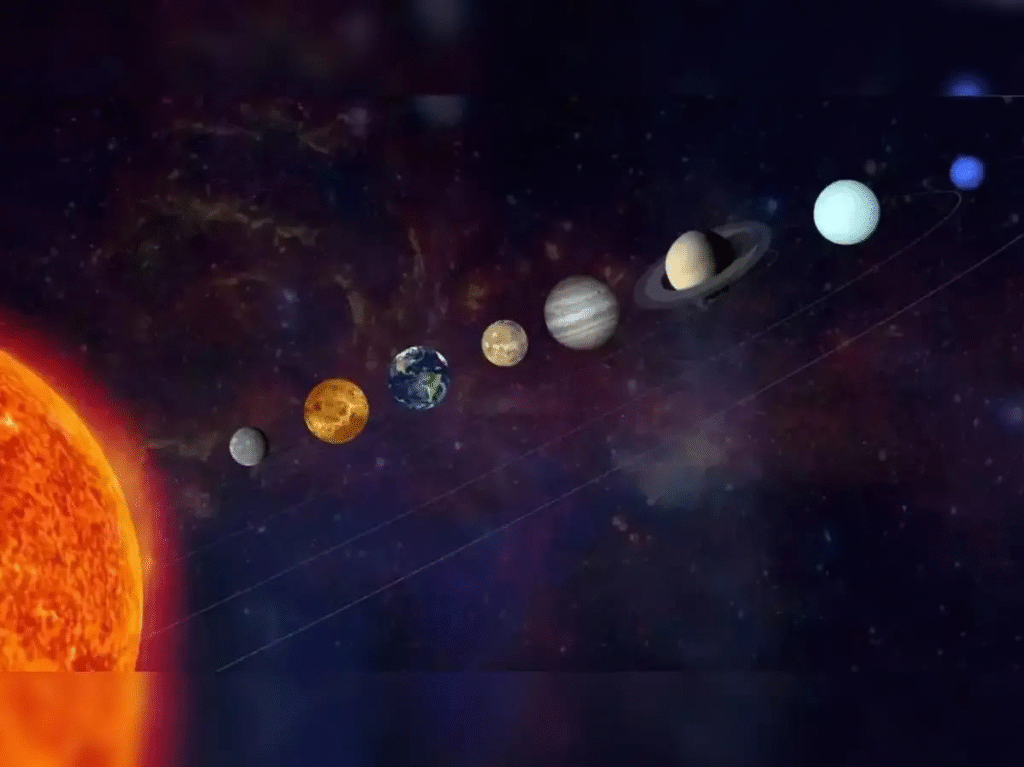
Get ready for a breathtaking cosmic show! On February 28, 2026, six planets in our solar system-Mercury, Venus, Jupiter, Saturn, Uranus, and Neptune -will align on one side of the Sun, appearing to form a graceful arc in the evening sky. This rare event, popularly known as a planetary parade or planetary alignment, promises to mesmerize stargazers worldwide, including those in India, weather permitting.
What is a Planetary Parade?
A planetary parade (also called a planetary alignment) occurs when multiple planets appear close together in the night sky from Earth’s perspective, creating the illusion of a straight line or arc. This happens because all planets orbit the Sun in roughly the same plane (the ecliptic), but at different speeds. Over time, their positions sync up visually.
While true perfect alignments in 3D space are extremely rare, these visual parades are more common-but still special when six or more planets participate. Bright inner planets like Venus and Jupiter often steal the show with naked-eye visibility, while distant ones like Uranus and Neptune require binoculars or telescopes.
These events don’t happen every year, making a six-planet lineup a noteworthy treat for astronomy enthusiasts.
The February 28, 2026, Planetary Parade: Key Details
This impressive six-planet alignment peaks shortly after sunset on February 28, 2026. The planets will form an arc across the western to southwestern sky:
Low near the horizon (west): Mercury, Venus, and Saturn (huddling close after sunset). Higher up: Jupiter shining brilliantly (often near the Moon for added drama). Along the arc: Fainter Uranus and Neptune (best with optical aids). Four planets-Mercury, Venus, Jupiter, and Saturn -should be visible to the naked eye under clear conditions, with Jupiter being the easiest and brightest to spot. Uranus and Neptune will need binoculars or a telescope, and patience is key for Mercury, which sets quickly.
Will It Be Visible in India?
Yes! Skywatchers in India can witness this mesmerizing event if the weather cooperates (clear skies are essential). The alignment will be visible across the country, though light pollution in cities may make fainter planets harder to see.
Best Time to Watch in India
Peak date: February 28, 2026. Optimal window: 30-60 minutes after local sunset (roughly 6:15 PM to 8:00 PM IST, varying slightly by city-check your local sunset time). Timing is critical, as some planets (especially Mercury and Venus) set soon after the Sun, giving only a short viewing window.
How to Watch the Rare Celestial Event
Find the right spot: Head to a rooftop, open field, or park with a clear, unobstructed view toward the western to southwestern horizon. Avoid city lights if possible-darker locations enhance visibility. Direction to look: Face west/southwest right after sunset. Scan for the bright “stars” that are actually planets. Tools to bring: Binoculars are highly recommended for a clearer view of the full lineup (especially Uranus and Neptune). A telescope will reveal even more detail. Tips for success: Arrive early, let your eyes adjust to the dark (about 20-30 minutes), and use apps like Stellarium or Sky safari for precise positions based on your location.
This planetary parade is a reminder of the dynamic beauty of our solar system-don’t miss your chance to witness it! Share your sightings and enjoy the cosmic wonder on February 28, 2026. Clear skies to all