

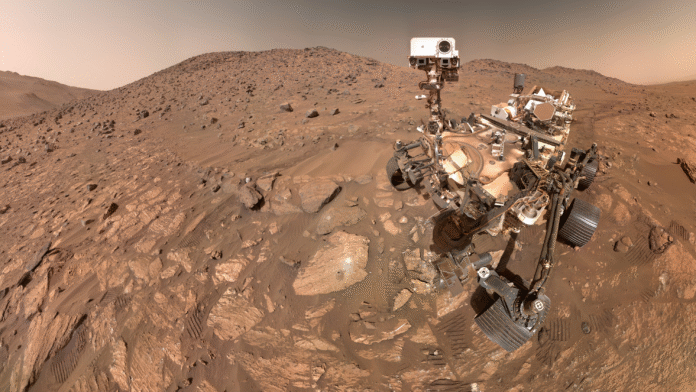
In a discovery that could reshape humanity’s understanding of life beyond Earth, NASA’s Perseverance rover has unearthed tantalizing clues of ancient microbial life on Mars. The six-wheeled robotic explorer, currently navigating the Jezero Crater—a once water-rich basin—has collected a reddish mudstone sample that scientists say may contain a “potential biosignature”.
The Rock That Could Rewrite History
Dubbed “Sapphire Canyon,” the sample was drilled from a rock formation named “Cheyava Falls” in July 2024. This fine-grained, rusty-red stone bears unusual ring-shaped features—nicknamed “leopard spots”—and dark specks resembling poppy seeds. These textures, scientists believe, may have formed through chemical reactions involving microbes billions of years ago when the crater was a lakebed.
What Makes This Sample Special?
The rock is rich in organic carbon, sulfur, phosphorus, and oxidized iron—elements that, on Earth, are often associated with biological activity. Two minerals detected in the sample, vivianite and greigite, typically form through microbial metabolism in muddy lake environments. While these minerals can also emerge through nonbiological processes, researchers say the absence of extreme heat or acidity in the Martian environment makes a biological origin more plausible.
NASA’s Verdict: Cautious Optimism
“This very well could be the clearest sign of life that we’ve ever found on Mars,” said Acting NASA Administrator Sean Duffy at a press briefing. However, NASA scientists are careful not to claim definitive proof. “It’s not life itself,” emphasized Nicky Fox, associate administrator for NASA’s Science Mission Directorate. “It’s a potential biosignature—something that could have been formed by life, but also could have formed without it”.
Peer-Reviewed and Published
The findings were published in the journal Nature after a year-long peer review, marking a major milestone in the Mars 2020 mission’s quest to determine whether the Red Planet ever supported life.
What’s Next?
The sample remains sealed inside Perseverance, awaiting a future Mars Sample Return mission that could bring it to Earth for deeper analysis. If confirmed, this discovery could be the first concrete evidence that life once existed beyond our planet.