

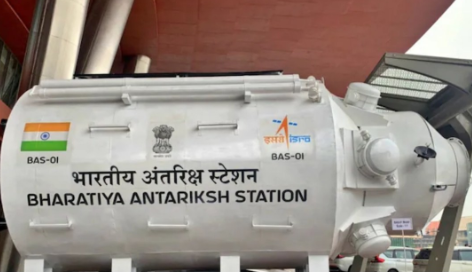
(PC:indiaToday)
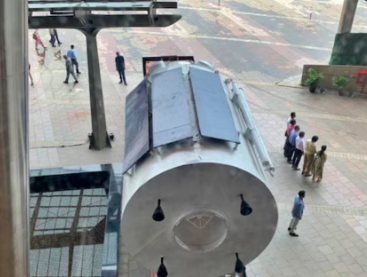
On National Space Day 2025, the Indian Space Research Organisation (ISRO) ignited the nation’s imagination by unveiling the prototype of the Bharatiya Antariksh Station (BAS)—India’s first fully indigenous space station. The reveal, held at Bharat Mandapam in New Delhi, marked a historic moment in India’s space journey, signaling its bold ambition to join the elite league of nations with permanent orbital laboratories.
A Vision Beyond Earth: What Is BAS?
The Bharatiya Antariksh Station is ISRO’s flagship project to establish a modular space station in low Earth orbit by 2035, with the first module, BAS-01, scheduled for launch in 2028. Once operational, India will become the third country—after the United States (ISS) and China (Tiangong)—to operate its own space station.
Key Features of BAS-01
The unveiled model, measuring 3.8 meters by 8 meters, showcased a futuristic design packed with indigenous technologies:
- Orbit Altitude: 450 km above Earth
- Weight: Approx. 10 tonnes
- Life Support: Environmental Control and Life Support System (ECLSS)
- Docking & Berthing: Bharat Docking System and Bharat Berthing Mechanism
- Crew Access: Automated hatch system, airlocks for spacewalks
- Research Capabilities: Platforms for microgravity experiments, scientific imaging, and crew recreation
- Safety Systems: Radiation shielding, MMOD (Micro Meteoroid Orbital Debris) protection
- Avionics: Plug-and-play integrated systems for rapid upgrades
Science, Sovereignty & Space Tourism
The BAS is more than a technological marvel—it’s a multi-purpose orbital lab designed to:
- Advance space medicine, life sciences, and interplanetary research
- Study microgravity’s effects on human physiology
- Serve as a testbed for long-duration human spaceflight
- Enable space tourism, opening commercial opportunities for India
- Foster international collaborations and joint missions
Symbolism & Strategy
The unveiling wasn’t just a technical showcase—it was a symbolic declaration of India’s space sovereignty. With a budget of ₹20,193 crore, the BAS project reflects India’s commitment to:
- Self-reliance in space infrastructure
- Global leadership in orbital science
- Inspiring future generations to pursue careers in space technology
A Celebration of Dreams
National Space Day, celebrated annually on August 23, commemorates the Chandrayaan-3 Moon landing in 2023. This year’s theme—centered on the Bharatiya Antariksh Station—highlighted India’s transition from lunar triumphs to orbital aspirations. Exhibitions, lectures, and interactive demos brought space science closer to students, researchers, and the public.
India’s Orbital Destiny
The Bharatiya Antariksh Station is not just a structure—it’s a living symbol of India’s cosmic ambition, scientific prowess, and cultural pride. As ISRO prepares to launch BAS-01 in 2028, the countdown begins for a new era where India doesn’t just reach for the stars—it builds among them.