

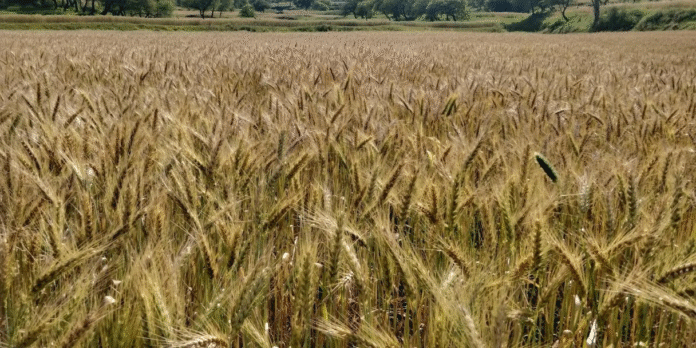
In a scientific breakthrough, researchers at the Central University of Rajasthan have successfully grown wheat in the arid sands of western Rajasthan using soilification technology. By transforming barren desert land into fertile soil, the innovation promises to check desertification and open new frontiers for sustainable farming in the Thar region.
The Central University of Rajasthan (CUoR) has achieved a major breakthrough in desert agriculture by successfully cultivating wheat in the arid zones of western Rajasthan. Using an indigenous bioformulation-based soilification technology, researchers converted loose desert sand into fertile, crop-supporting soil. Experts believe this innovation could not only boost food security but also slow the expansion of the Thar desert towards the National Capital Region.
Rising Threat of Desertification
The Thar desert continues to expand due to the degradation of the Aravalli ranges, erratic rainfall, and poorly planned plantation drives. Accelerated desertification has reduced cultivable land and severely impacted livelihoods, underlining the urgent need for sustainable agricultural solutions in Rajasthan.
How Soilification Works
Soilification involves treating desert sand with polymers and bioformulations to mimic fertile soil. The treatment increases water retention, binds sand particles, and supports microbial activity, creating conditions suitable for crop growth even under extreme aridity.
The Wheat Trial
In November 2024, CUoR scientists planted 13 kg of indigenous wheat-4079 seeds over 1,000 sq. metres in Banseli village near Pushkar. With soilification, irrigation was reduced to just three cycles during the crop season. By April 2025, the yield reached 26 kg per 100 sq. metres, achieving a seed-to-harvest ratio of 1:20—twice the output typically seen in arid wheat farming.
Institutional Support
The Krishi Vigyan Kendra (KVK) and the Rajasthan State Horticulture Department partnered in the project. KVK designed the experimental layout and supported scaling efforts under real desert conditions, showcasing how applied science can directly benefit farmers and communities.
Beyond Wheat: Future Crop Trials
Encouraged by success in wheat, CUoR also tested bajra, guar gum, and chickpea in polymer-treated sand, recording yields 54% higher than untreated plots. Plans are underway to extend the technology to millet, green gram, and other dryland crops across Rajasthan and similar semi-arid regions.
Water Conservation Impact
A key advantage of soilification is its efficiency in water use—cutting irrigation needs from five or six cycles to just three or four. In Rajasthan’s water-stressed desert ecosystem, this innovation could transform barren land into sustainable farmland, offering hope for both food security and ecological resilience.