

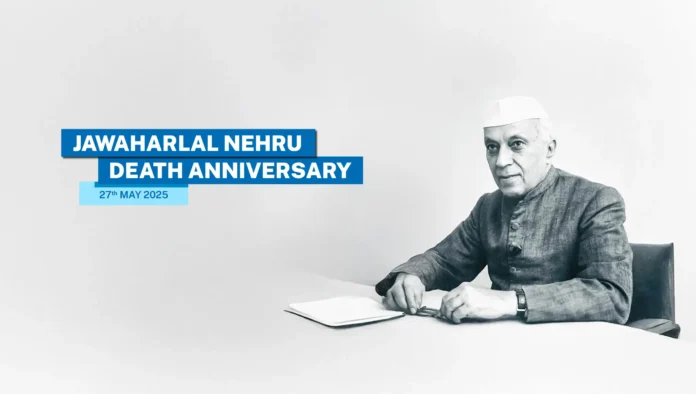
On May 27, India remembers its first Prime Minister, Jawaharlal Nehru, on his death anniversary — a day that marks the passing of one of the most influential architects of modern India. Fondly called “Pandit Nehru” and “Chacha Nehru,” he played a pivotal role in shaping the nation’s democratic foundations, economic vision and global identity after Independence.
Born on November 14, 1889, in Allahabad, Nehru emerged as a prominent leader of India’s freedom struggle under the guidance of Mahatma Gandhi. His commitment to nationalism, secularism and social progress made him one of the leading voices in the fight against British rule. After India gained independence in 1947, Nehru became the country’s first Prime Minister and remained in office until his death in 1964.
Nehru’s tenure laid the groundwork for modern India. He strongly believed in democracy, scientific temper and industrial growth. Under his leadership, India established major institutions such as the Indian Institutes of Technology (IITs), large public sector industries and important scientific and research centres. His vision of planned economic development led to the creation of dams, steel plants and infrastructure projects, which he famously called the “temples of modern India.”
On the global stage, Nehru championed the policy of non-alignment during the Cold War era, ensuring that India maintained an independent foreign policy rather than aligning with major power blocs.
Nehru was also deeply associated with children and education. His affection for children earned him the title “Chacha Nehru,” and his birthday is celebrated across India as Children’s Day.
However, his legacy remains a subject of both admiration and debate. While many credit him for building democratic institutions and a modern developmental framework, critics often point to challenges faced during his tenure, including the 1962 Sino-Indian War and economic limitations of the early decades after Independence.
Jawaharlal Nehru passed away on May 27, 1964, leaving behind a legacy deeply intertwined with India’s formative years as an independent nation. Decades later, his contributions continue to shape political discourse, governance and the idea of India itself.