

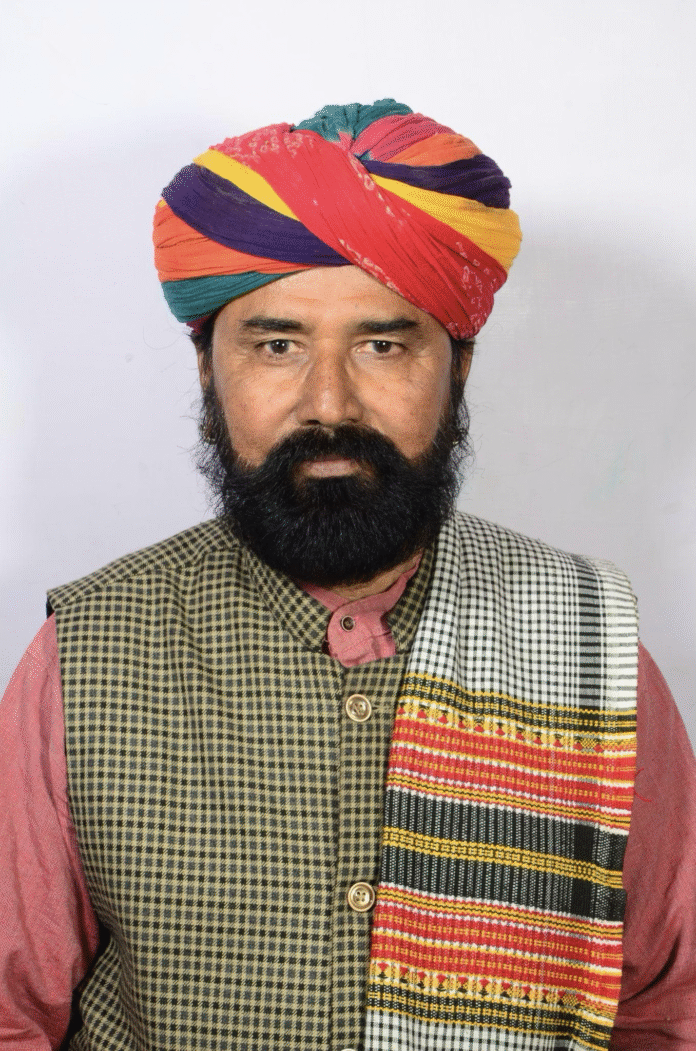
In the vast golden sands of Rajasthan’s Thar Desert, where the wind itself seems to sing ancient melodies, a young boy once spent his days grazing cattle with a handmade flute in his hands. Decades later, that same boy would carry the sound of Rajasthan’s desert folk music to international stages across Europe, America, and Asia.
That boy was Taga Ram Bheel, today celebrated as one of India’s finest traditional Algoza players and the founder-director of the Algoza Folk Music Institute in Moolsagar village near Jaisalmer.
Music Born in the Desert
Born on April 17, 1960, in Moolsagar village of Jaisalmer district, Taga Ram Bheel grew up surrounded by the raw beauty and hardships of desert life. His introduction to music came not through formal classrooms or grand institutions, but through the oral traditions of rural Rajasthan.
At the age of seven, he began learning the Algoza from his father while tending cattle in the desert. The Algoza, a rare dual-flute instrument crafted from dry sheesham and kair wood, requires extraordinary breath control, rhythm, and coordination. Played simultaneously using the mouth and throat, it produces haunting melodies deeply associated with the folk culture of western Rajasthan.
For years, the desert became his practice ground. With no stage, no audience, and no formal recognition, young Taga Ram continued refining his art solely through passion and persistence.
The Performance That Changed Everything
A turning point arrived in 1981 when noted musician Ustad Akbar Khan Rajdarbari Alamkhana and public relations officer Late Shambhudan Ratnoo visited his home and offered him an opportunity to perform at Gopa Chowk in Jaisalmer during India’s Independence Day celebrations.
The performance proved transformational.
His mesmerizing command over the Algoza captivated audiences and opened doors that once seemed unimaginable for a village artist from the Thar Desert. Soon, Taga Ram began receiving invitations to perform before Presidents of India, Prime Ministers, international dignitaries, and tourists from around the world.
Carrying Rajasthan’s Folk Soul Across the World
Under the guidance of Ustad Akbar Khan at the Ustad Arba Music Institute in Jaisalmer, Taga Ram further refined his craft. In 1986, he received a scholarship from the Centre for Cultural Resources and Training, New Delhi — an important recognition of his growing stature as a folk artist.
Over the years, he became a familiar face at some of Rajasthan’s most iconic cultural festivals, including the Desert Festival in Jaisalmer, Camel Festival in Bikaner, Pushkar Fair, Marwar Festival in Jodhpur, Jaipur’s Lok Rang Mahotsav, and the Shilpgram Festival in Udaipur.
But his music did not remain confined to Rajasthan.

6
As part of the Musafir Group and the Ustad Arba Music Group, Taga Ram carried the sounds of the Thar Desert to international folklore festivals in France, Spain, Italy, Germany, Holland, Portugal, Japan, Singapore, and the United States.
In France, he collaborated with renowned musician Manuel Aguilar Beseacon, blending Rajasthani folk traditions with global musical expressions. His performances at events such as the Diwali Mela in Dallas, international festivals in California, and the Cotton Bowl Festival in the United States introduced global audiences to the hypnotic rhythms of the Algoza.
A Life Dedicated to Preserving Folk Heritage
Despite international acclaim, Taga Ram Bheel has remained deeply connected to his roots. Through the Algoza Folk Music Institute in Moolsagar, he continues to train young artists and preserve Rajasthan’s fading folk traditions for future generations.
His contribution to folk music has earned him numerous honors, including the Maharawal Girdhar Award, Marudhara Award, Aadivasi Samman Rajasthan, Mahram Shri Sakar Khan Manganiyar Award, Amrit Ganga Award, and Gaurav Samman by Bhartiya Dalit Academy Rajasthan.
He has also received appreciation from institutions such as the West Zone Cultural Centre, South Zone Cultural Centre, Jawahar Kala Kendra Jaipur, Nehru Youth Centre Jaisalmer, and cultural organizations in the United States.
The Voice of the Desert
Today, Taga Ram Bheel’s journey stands as a powerful reminder that extraordinary talent can emerge from the humblest beginnings. From practicing melodies while grazing cattle in the desert to representing Indian folk culture on global stages, his life reflects dedication, resilience, and an unwavering commitment to preserving Rajasthan’s musical heritage.
In every note played through his Algoza echoes the soul of the Thar Desert — timeless, resilient, and deeply alive.