

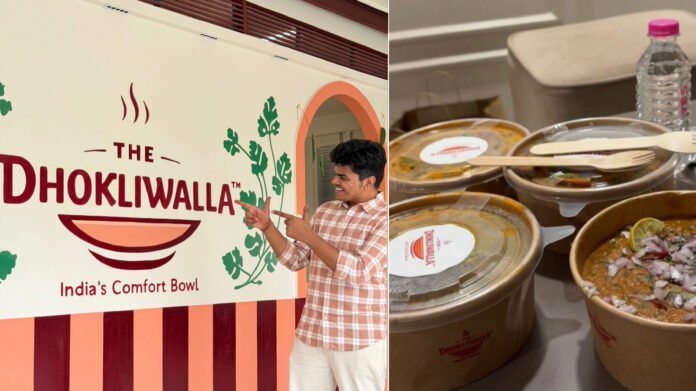
Founder Khush Dave on leaving a corporate career, discovering an untapped food opportunity, building a brand around Dal Dhokli and dreaming of taking a humble regional dish to the world
Some entrepreneurial journeys begin with a carefully drawn business plan. Others begin with a simple question. For Khush Dave, founder of Dhokliwalla, it was the latter. His journey has moved through experiments in content creation, an MBA, a corporate role at ITC, startup experience and nearly a year of research before taking shape as a food brand. What started as a thought around one of his favourite dishes, Dal Dhokli, eventually evolved from a stall into a cloud kitchen and then an outlet.
Today, Dave sees Dhokliwalla as much more than a food venture. With a vision to make it a global brand by 2030, he hopes to take Dal Dhokli beyond Udaipur, Rajasthan and eventually India. In this conversation, he reflects on the experiments, risks, lessons and ambitions that have shaped his journey.
Q. Take us back to the beginning. What were you doing before Dhokliwalla, and what first sparked your interest in content, food and entrepreneurship?
Khush Dave: Honestly, my journey has been full of experiments, failures and trying different things. I have explored quite a few different paths. I attempted CA Foundation, prepared for government exams, and even spent almost one and a half years preparing for the FTII entrance while pursuing my MBA. I didn’t clear FTII either.
At the same time, I was experimenting with content creation. I created content across different niches — roast and rant videos, relatable comedy, short web series, short films and a lot of different formats. But after failing the FTII entrance, I eventually gave up on the creative side and decided to focus on completing my MBA.
During my final semester, I got placed at ITC. I was actually the only student from my college to get placed there, so it was a great opportunity and a great package. But after joining, I realised that doing the same thing every day wasn’t for me. I couldn’t see the kind of skill and mindset growth I was looking for, so I left the job and joined a startup instead. I wanted to understand how businesses actually work and was simultaneously exploring different ideas for starting something of my own.
Then, one day, a very random thought came to me: Dal Dhokli was one of my favourite dishes, almost everyone around me loved it, but nobody seemed to be building a business around it.
That thought stayed with me.
I spent almost a year doing R&D around the idea, researching the product and the market, and eventually started food blogging as a way to understand the Food & Beverage industry more deeply. And that’s how Dhokliwalla started taking shape.
Q. You had an MBA and a corporate opportunity with ITC, but eventually chose a different path. What made you take that leap?
Khush Dave: The biggest reason was that I wasn’t feeling enough growth — either in terms of skills or mindset.
The job was a great opportunity, and I have a lot of respect for the organisation, but the work felt monotonous to me. I realised that I didn’t want to spend my life doing something where I couldn’t see myself constantly learning, solving new problems and growing.
So leaving wasn’t really about rejecting the corporate world. It was about understanding that that particular path wasn’t right for me.
I knew there was a risk in leaving a good package, but I was more worried about staying somewhere simply because it was considered a safe or successful career.
Q. You also worked with startups in Udaipur. What did that experience teach you about building a brand?
Khush Dave: Working with startups changed my mindset completely.
It taught me that there is no fixed ceiling. The sky is the limit.
In a startup environment, you are constantly solving problems. You can’t always wait for someone else to give you the answer. You have to figure things out yourself, experiment, fail, learn and find another way.
The biggest thing I learned was problem-solving.
That experience later became extremely useful with Dhokliwalla because building a food business comes with a new problem almost every day. You have to keep solving them instead of getting overwhelmed by them.
Q. What made you believe that Dal Dhokli could become a brand in itself?
Khush Dave: To be honest, initially it was just a random thought.
I wasn’t sitting there thinking, “I’m going to build a huge Dal Dhokli brand.”
I simply thought: If people love Dal Dhokli so much, why isn’t anyone building a proper business around it?
Then I spent almost a year doing R&D before we actually soft launched. The real belief came after the launch.
The audience response was much bigger than I expected, and that’s when I started thinking that this could actually become a crazy brand.
I also had a very simple thought: if dishes that are loved by some people and disliked by others can become successful food brands, then why can’t Dal Dhokli — a dish that is deeply loved by so many people — become one?
That gave me the confidence to take the idea seriously.
Q. Before launching Dhokliwalla, you were also food blogging and researching the food business. What did you discover about the Indian food market that shaped your approach?
Khush Dave: One thing I understood very clearly was that the more you get seen, the more opportunities you create to sell yourself and your product. My content background helped me understand that visibility and attention matter enormously in the food business.
But while food blogging and researching the market, I was also observing the mistakes many businesses were making. I tried to make sure we didn’t repeat them.
For example, I didn’t want to create a huge menu just to give customers more options. A long menu can increase complexity and wastage, especially in a small food business.
I also realised how important hygiene is. The more hygienic and transparent you are, the more trust you build with the audience.
So our approach has been very focused: make a product people genuinely love, keep the menu controlled, maintain hygiene, build visibility and listen closely to customers.
Q. Dhokliwalla began with a soft launch and quickly received an overwhelming response. When did you realise that you might have something bigger on your hands?
Khush Dave: The initial phase was basically about learning and implementing.
We were continuously watching what customers were saying, what they liked, what they didn’t like and what could be improved.
Interestingly, the cloud kitchen wasn’t even part of the original plan. The response to the soft launch made us realise that people were actually loving the product, so we decided to launch the cloud kitchen — and that performed really well too.
That was probably the point when I realised this could become something bigger.
But even today, our mindset hasn’t changed much. We value customer feedback enormously.
For me, feedback isn’t criticism. It is free R&D.
Q. From starting with a small stall to moving into a cloud kitchen and then an outlet, what have been the biggest challenges?
Khush Dave: Actually, the journey has now gone one step further. We started with a stall, then moved into a cloud kitchen, and now we have moved from the cloud kitchen model into an outlet as well.
The biggest challenge throughout this journey has been people — hiring the right staff at the right time.
A food business is highly dependent on its team. You can have the right product, the right location and the right marketing, but if the people executing it aren’t right, the customer experience suffers.
Finding people who fit the requirements, training them properly and making sure the quality remains consistent has been one of our biggest challenges.
And I think that is something that becomes even more important as we scale.
Q. You came into Dhokliwalla with a strong content and marketing background. How has that influenced the way you built the brand?
Khush Dave: It has had a huge impact.
I think my experience as a content creator played a major role in creating the initial hype around Dhokliwalla. I already understood how to create attention, how to communicate a story and how to make people curious about something. That helped us get noticed much faster.
But content can only get someone through the door once. After that, the product has to do the work.
In our case, I believe the content helped people discover Dhokliwalla, but the taste and experience are what helped us create repeat customers.
So I would say content brought the attention, but the product earned the loyalty.
Q. Dal Dhokli is deeply rooted in tradition and nostalgia. How do you balance its authenticity with the expectations of today’s younger audience?
Khush Dave: For us, the foundation has always been the homemade nature of Dal Dhokli. We never wanted to lose that.
The whole emotional connection with Dal Dhokli comes from its comfort and familiarity, so we have focused heavily on maintaining that homemade taste consistently.
We also pay a lot of attention to the ingredients we use. We try to use desi, original and pure raw materials because we believe the quality of the ingredients directly affects the final taste.
At the same time, we are presenting the product in a more modern and convenient format through our branding, packaging, experience and carefully developed variations.
So we’re not trying to change what Dal Dhokli is. We’re trying to make people experience something traditional in a way that feels relevant today.
Q. What has building Dhokliwalla taught you that an MBA, corporate job or food blogging could not?
Khush Dave: Honestly, everything.
An MBA can teach you frameworks. A corporate job can teach you discipline and processes. Food blogging can teach you about consumers and the market.
But actually running a food business teaches you things that you simply cannot learn from a classroom.
You understand what happens when a customer complains, when staff doesn’t show up, when a supplier creates a problem, when costs increase, when demand suddenly rises, when something goes wrong during service — and you have to solve it immediately.
Most importantly, I learned that entrepreneurship is not as glamorous as it looks from the outside.
You have to be involved in everything, especially in the beginning.
And every problem teaches you something.
Q. Looking back at your decision to leave the corporate path and return to this journey, how do you see that choice today?
Khush Dave: I have absolutely no regret.
And I think that itself says a lot.
Entrepreneurship has definitely been much harder and more unpredictable than I imagined, but it has also been far more rewarding from a learning perspective.
I still don’t consider myself a successful entrepreneur. In fact, I have a personal benchmark for that.
The day Dhokliwalla has multiple outlets and I have built something that can operate and grow beyond me, that’s when I’ll call myself an entrepreneur.
Until then, I consider myself a learner.
Q. Where do you see Dhokliwalla going from here?
Khush Dave: My vision for Dhokliwalla is much bigger than Udaipur.
I want to make Dhokliwalla a global brand by 2030.
The first step is to build a strong foundation here — get the product right, build the systems, create consistency, understand the economics and establish a model that can be replicated.
Then I want to take Dal Dhokli beyond Udaipur, beyond Rajasthan and eventually beyond India.
I believe regional Indian food has enormous potential globally. There are so many dishes that have incredible cultural stories and emotional value but have never been built into organised global brands.
For me, Dhokliwalla is the beginning of that journey.
The dream is simple: take something as humble and loved as Dal Dhokli and make the world know it.
A journey still in the making
Khush Dave’s story is, at its core, about experimentation and the willingness to start again. From preparing for competitive examinations and exploring filmmaking to corporate life, startups, content creation and finally entrepreneurship, each phase has contributed something to the making of Dhokliwalla. His journey also reflects a larger possibility for regional Indian food — that dishes deeply connected to everyday homes, memories and culture can find a new identity in the modern food landscape. For Dave, however, the journey is far from complete. He still sees himself as a learner, with a much larger road ahead and a simple ambition: to take Dal Dhokli from a beloved regional dish to a name known around the world.