

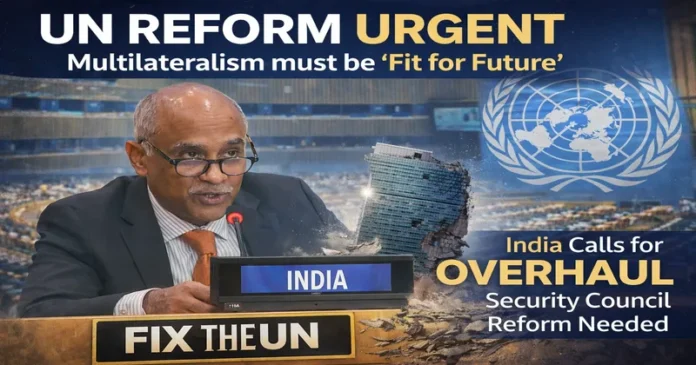
Established in 1945 in the aftermath of the Second World War, the United Nations (UN) was envisioned as a global institution that would prevent future wars, maintain international peace and promote cooperation among nations. Eight decades later, however, the organisation faces growing questions over its effectiveness, representation and ability to respond to an increasingly complex international order. India’s renewed demand for reform of the UN Security Council has once again brought these concerns into focus.
At the centre of the debate is the Security Council, the UN’s principal body responsible for maintaining international peace and security. It comprises 15 members, including five permanent members, the United States, Russia, China, the United Kingdom and France, and ten non-permanent members elected for two-year terms. The five permanent members enjoy veto power, allowing any one of them to block substantive resolutions regardless of the level of support among other members.
This arrangement, established at the end of the Second World War, continues to shape global decision-making. However, the geopolitical landscape has changed considerably since 1945. The emergence of new economic powers, shifting alliances and the growing influence of developing countries have transformed international relations, while the Council’s composition has remained largely unchanged. Its divisions over conflicts such as Ukraine and Gaza have further exposed the difficulties of achieving collective action when the interests of powerful nations collide.
India brought these concerns to the forefront on October 22, 2026, when its Permanent Representative to the UN, Ambassador Harish Parvathaneni, called for urgent reform during a debate at the UN General Assembly on equitable representation and expansion of the Security Council. He argued that the realities of 1945 should no longer determine the structure of an institution expected to address the challenges of the present.
“The authority derived from a victory eight decades ago cannot compensate for the deficit in legitimacy of an unrepresentative Security Council today.”
– Ambassador Harish Parvathaneni, Permanent Representative of India to the United Nations,
India’s position is rooted in its longstanding demand for expansion of both permanent and non-permanent membership. It has consistently argued that developing nations, particularly from Asia, Africa and Latin America, deserve a greater role in decisions affecting international peace and security. Ambassador Parvathaneni also highlighted the historical imbalance in representation, pointing out that the Asia-Pacific region, which accounts for more than 60 per cent of the world’s population, continues to have limited representation in the permanent membership of the Council.
India has also emphasised its historical contribution to the international order. During the Second World War, around 2.5 million Indians participated in the war, with approximately 90,000 losing their lives in military service. The country has since remained an active contributor to UN peacekeeping operations and multilateral initiatives. Its demand for a greater role in the Council is therefore closely linked to the question of whether contemporary global institutions adequately recognise the contributions and interests of their member nations.
The growing relevance of platforms such as BRICS and the G20 also reflects the changing nature of global cooperation. These groupings have emerged as important forums for economic coordination and geopolitical dialogue, giving developing and emerging economies greater opportunities to influence international discussions. However, they cannot replace the UN’s universal membership, peacekeeping responsibilities or humanitarian mandate.
Despite its institutional limitations, the UN continues to play an important role in humanitarian assistance, refugee support, international development and peacekeeping. Its relevance is not in question as much as its ability to fulfil its responsibilities within an outdated decision-making structure. Reforming the Security Council is therefore not simply about increasing membership but also about strengthening its accountability, transparency and capacity to respond to global crises.
The debate ultimately raises a larger question about the future of multilateralism. Can an institution created to represent the international community continue to command legitimacy when a significant part of that community remains underrepresented in its most powerful decision-making body?
For India and many other countries, Security Council reform is no longer merely an institutional demand but a question of fairness, representation and credibility. The world has moved far beyond the geopolitical circumstances of 1945, and its global institutions must evolve accordingly. The choice is not between preserving the United Nations and abandoning it, but between meaningful reform and continued stagnation. Without greater representation and the political will to act collectively, the organisation risks losing the confidence of the very nations it was established to serve.