

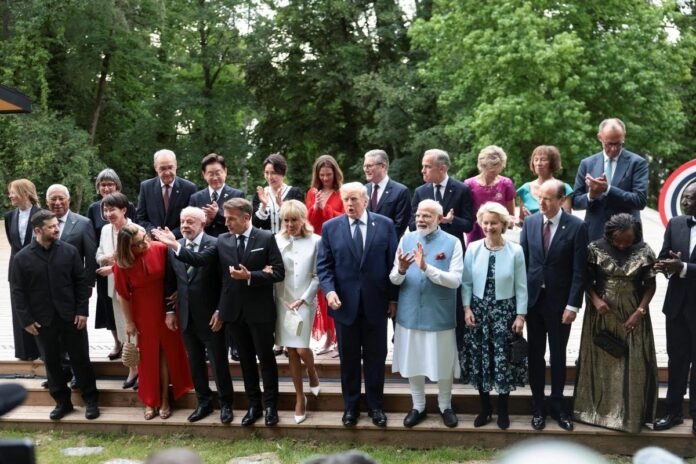
Prime Minister Narendra Modi used the 2026 G7 Summit in Évian-les-Bains, France, to deliver a strong message on the need for trust, international cooperation, maritime security and the concerns of the Global South, while also engaging in a series of high-level bilateral meetings with world leaders.
Held from June 15 to 17 in the French resort town of Évian, the 52nd G7 Summit brought together leaders of the world’s major advanced economies to discuss pressing global challenges, including conflicts in West Asia and Ukraine, economic stability, artificial intelligence, and international security. India participated as an invited partner nation, continuing its growing role in shaping global discussions beyond the G7 framework.
In his address at the Outreach Session, Prime Minister Modi remarked that the world today is not facing a shortage of resources but a “shortage of trust.” Stressing that trust is the most important strategic asset in international relations, he argued that global partnerships can succeed only when they are built on mutual respect, reliability and shared responsibility. His comments came at a time when geopolitical tensions, trade disputes and regional conflicts continue to test international cooperation.
A major focus of Modi’s intervention was maritime security. Referring to recent instability in West Asia and disruptions in key shipping routes, he emphasized that global sea lanes must remain secure and open. The Prime Minister stated that seafarers should be able to perform their duties without fear and called on the international community to collectively ensure their safety. His remarks carried particular significance following the deaths of three Indian crew members in recent U.S. strikes linked to tensions in the Gulf region.
Modi noted that disruptions in maritime trade affect not only regional economies but also global supply chains and energy security.
The summit also provided an important platform for India’s diplomatic outreach. Modi held bilateral discussions and informal interactions with several world leaders, including French President Emmanuel Macron, British Prime Minister Keir Starmer, Canadian Prime Minister Mark Carney, Italian Prime Minister Giorgia Meloni, and U.S. President Donald Trump.
These engagements focused on strengthening bilateral ties, expanding economic cooperation, and addressing regional and global developments.
One of the most closely watched interactions was between Modi and Trump, their first in-person meeting in more than a year. Discussions were expected to cover trade relations, energy security, developments in West Asia, and broader strategic cooperation between India and the United States. While no major agreements were announced immediately, the meeting underscored the importance both countries place on maintaining dialogue amid evolving geopolitical circumstances.
Ahead of the summit, Modi had stated that India would represent not only its own interests but also the aspirations of the Global South. This position was reflected in his interventions at Évian, where he highlighted the concerns of developing nations regarding equitable growth, secure supply chains, and inclusive global governance. India’s participation reinforced its role as a bridge between advanced economies and emerging nations at a time of significant global uncertainty.
The G7 Summit took place against the backdrop of continuing conflicts in Ukraine and West Asia, concerns over maritime disruptions in the Strait of Hormuz, and debates over the future of artificial intelligence and global economic recovery. Throughout the discussions, India emphasized dialogue, cooperation and collective responsibility as essential tools for addressing these challenges.
As global leaders grappled with an increasingly fragmented international environment, Modi’s message from Évian was clear: sustainable partnerships cannot be built solely on economic interests or strategic calculations. They must rest on trust, respect for international norms, and a shared commitment to peace and security. In highlighting both maritime safety and the concerns of developing nations, India sought to position itself as a constructive voice advocating cooperation in an era of growing geopolitical complexity.