

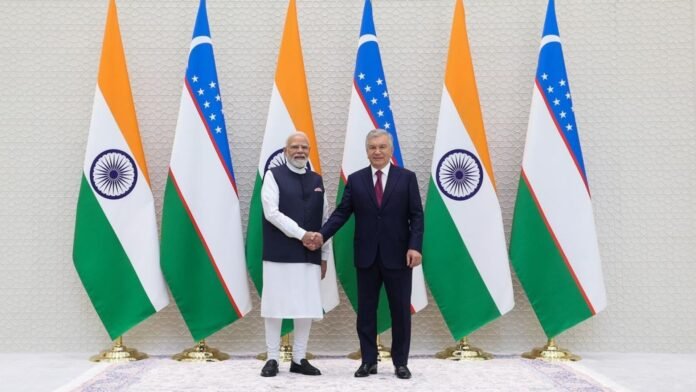
Prime Minister Narendra Modi’s two-day state visit to Uzbekistan on August 29 and 30, 2026, has marked a significant step forward in India’s engagement with Central Asia. During his visit to Tashkent, Prime Minister Modi held talks with Uzbek President Shavkat Mirziyoyev, with both leaders agreeing to elevate India-Uzbekistan relations to a Comprehensive Strategic Partnership. The decision provides a broader framework for cooperation across trade, investment, defence, technology, energy, education and culture.
The upgraded partnership builds on longstanding historical and cultural connections between the two countries. India and Uzbekistan have maintained close diplomatic relations and have increasingly expanded cooperation in areas ranging from security and pharmaceuticals to education and technology. The two leaders agreed that the new partnership should focus on practical cooperation while strengthening political dialogue and institutional mechanisms between the two countries.
Economic cooperation emerged as one of the major priorities of the visit. The two sides agreed to diversify bilateral trade, remove non-tariff barriers and encourage greater industrial collaboration. Particular potential was identified in electrical goods, engineering products, automobiles and pharmaceuticals. The leaders also welcomed discussions on a proposed Preferential Trade Agreement and agreed that the relevant ministries should explore the next steps on a time-bound basis. The broader objective is to strengthen two-way investment and build more connected supply chains.
Energy and critical minerals were another important area of cooperation. India and Uzbekistan agreed to explore collaboration in geology, mining, nuclear energy and strategic minerals, including mineral processing and the development of value-added products. Both countries also expressed interest in expanding cooperation in the peaceful uses of nuclear energy and renewable energy. These efforts are significant as India seeks to diversify and strengthen its strategic supply chains for critical resources.
The partnership also has an important security dimension. India and Uzbekistan reaffirmed their commitment to combating terrorism, cross-border terrorism, organised crime, drug trafficking and cyber threats. Defence cooperation will be strengthened through institutional exchanges, capacity building and joint activities. The leaders also welcomed the progress of the India-Uzbekistan Joint Military Exercise “Dustlik”, the latest edition of which was held in Uzbekistan in April 2026.
Technology and digital cooperation featured prominently in the discussions. The two countries agreed to expand partnerships between technology parks, companies, start-ups and educational institutions. Uzbekistan’s first IT Park in Tashkent, established in 2019 with support based on the Indian model and assistance from the Software Technology Parks of India, has already become an example of such cooperation. Both sides also agreed to deepen collaboration in artificial intelligence, digital transformation, cybersecurity and space applications.
The visit also highlighted India’s growing people-to-people engagement with Uzbekistan. Cooperation in education, healthcare, pharmaceuticals, traditional medicine, culture, sports and tourism is set to expand.
More than 2,700 Uzbek nationals have participated in the Indian Technical and Economic Cooperation programme, while more than 400 Uzbek students have received ICCR scholarships. A new Cultural Exchange Programme for 2026-2030 was also welcomed, alongside cooperation in preserving and restoring cultural heritage sites.
Environmental cooperation was another notable element. India and Uzbekistan agreed to cooperate in the ecological rehabilitation and greening of the Aral Sea region. India will provide assistance worth US$1 million, including technical support, under its Grant-in-Aid framework. The initiative reflects a shared emphasis on environmental restoration and sustainable development.
A symbolic highlight of the visit came when President Mirziyoyev conferred Uzbekistan’s highest state honour for foreign leaders, the Order of Oliy Darajali Do’stlik, on Prime Minister Modi. The honour recognised his contribution to strengthening India-Uzbekistan relations and cooperation. The visit resulted in 11 agreements covering a wide range of sectors, giving the newly elevated partnership a practical foundation.
The two countries also reaffirmed their commitment to greater cooperation in multilateral forums. Uzbekistan reiterated its support for India’s candidature for permanent membership of the United Nations Security Council. Both sides agreed to strengthen coordination within the Shanghai Cooperation Organisation and other international platforms, particularly on issues concerning the Global South.
Prime Minister Modi’s Uzbekistan visit thus represents an important expansion of India’s strategic engagement with Central Asia. By bringing together economic interests, security cooperation, critical resources, digital technology, education and cultural ties, the Comprehensive Strategic Partnership aims to give a new direction to India-Uzbekistan relations. With the two countries now seeking deeper and more structured cooperation, the partnership could become an important pillar of India’s wider Central Asian outreach.