

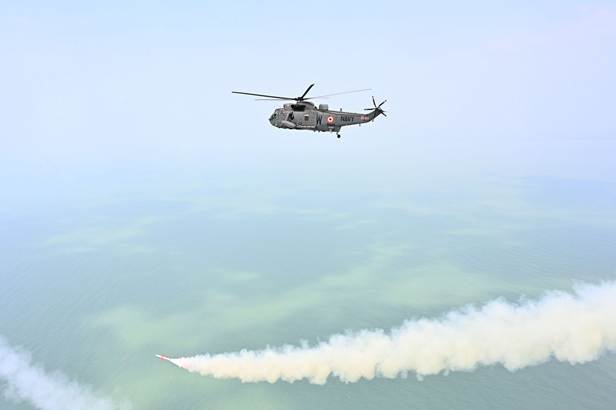
In a significant boost to India’s defence capabilities and indigenous military technology, the Defence Research and Development Organisation (DRDO) and the Indian Navy have successfully carried out the maiden salvo launch of the Naval Anti-Ship Missile – Short Range (NASM-SR). This landmark test marks a major step forward in strengthening India’s maritime strike power and self-reliance in defence production.
A Historic First: Salvo Launch Capability
The test was conducted off the coast of the Bay of Bengal near Odisha, where two missiles were launched in quick succession from a naval helicopter platform. This was the first-ever salvo launch of an advanced air-launched anti-ship missile system by India.
A “salvo launch” refers to firing multiple missiles rapidly from a single platform, significantly increasing strike effectiveness and overwhelming enemy defences. The successful execution of this capability demonstrates a new level of operational readiness for India’s naval forces.
Precision and Performance: Key Highlights
The test achieved all its intended objectives, with data verified through advanced tracking systems such as radar, electro-optical instruments, and telemetry deployed at the Integrated Test Range (ITR), Chandipur.
One of the standout achievements was the missile’s “waterline hit capability”, meaning it can strike ships at or near the water surface—maximizing damage and effectiveness in naval warfare.
Advanced Indigenous Technology
The NASM-SR missile represents a culmination of cutting-edge technologies developed within India. Key features include:
●Solid propulsion booster and long-burn sustainer for enhanced range and stability
●Advanced seeker and avionics systems for precision targeting
●Fibre-optic gyroscope-based inertial navigation system
●Radio altimeter for accurate altitude measurement
●High-bandwidth two-way data link for real-time communication
●Jet-vane control system for superior maneuverability
All these subsystems have been developed indigenously by DRDO laboratories in collaboration with Indian industry partners, highlighting the country’s growing defence manufacturing ecosystem.
Strategic Importance for India
This successful test significantly enhances India’s maritime combat capabilities. Anti-ship missiles are crucial in modern naval warfare, enabling forces to neutralize enemy vessels from a distance with high precision.
The NASM-SR’s helicopter-launch capability adds flexibility, allowing deployment from airborne platforms rather than relying solely on ships or submarines. This expands operational reach and tactical options for the Indian Navy.
Leadership Reactions
India’s Defence Minister, Rajnath Singh, congratulated the DRDO, Indian Navy, Indian Air Force, and industry partners for the achievement. He emphasized that the development of such advanced systems will greatly strengthen the capabilities of India’s armed forces.
Dr. Samir V. Kamat, Secretary of Defence R&D and Chairman of DRDO, also praised the teams involved, acknowledging their role in achieving this technological milestone.
Towards Aatmanirbhar Bharat in Defence
This development aligns with India’s broader vision of Aatmanirbhar Bharat (self-reliant India), particularly in the defence sector. By designing and producing advanced weapon systems domestically, India reduces dependence on foreign imports and strengthens its strategic autonomy.
Conclusion
The successful maiden salvo launch of the NASM-SR missile is not just a technological achievement—it is a symbol of India’s growing strength in defence innovation. As the nation continues to invest in indigenous research and development, such milestones pave the way for a more secure and self-reliant future.
In an increasingly complex global security environment, advancements like these ensure that India remains prepared, capable, and resilient on the high seas.