

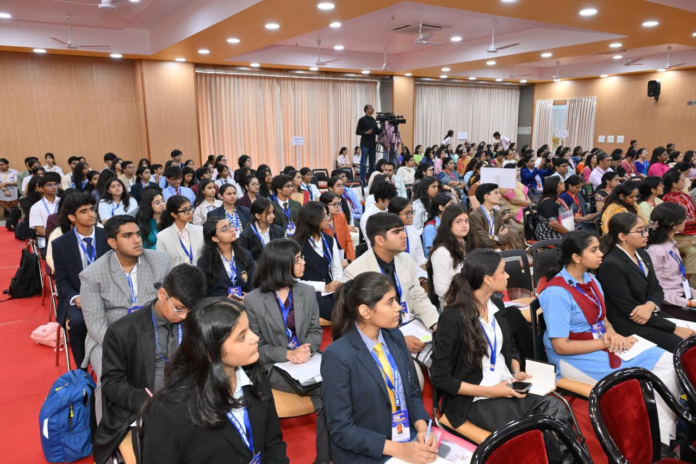
What happens when teenagers are asked to debate the biggest questions facing India and the world, not for grades, but for ideas? At Maharaja Sawai Man Singh Vidyalaya’s two-day youth conclave, “Push the Envelope,” the answers were anything but predictable. Seventy students from schools across the country came together on Friday to argue, question, disagree and defend their perspectives on issues ranging from education reforms and artificial intelligence to democracy, the United Nations and the politics of welfare.
The preliminary round of the conclave turned classrooms into arenas of ideas, where students displayed not only confidence but also a willingness to engage with complex public issues.
Questioning the National Education Policy
One of the most animated sessions revolved around the motion that the National Education Policy (NEP) has created more confusion than reform.
While participants acknowledged the policy’s ambitious vision, many argued that its implementation has failed to match its promise. Students questioned whether the policy has translated into meaningful classroom changes and expressed concern that learners are being burdened by reforms without adequate clarity.
Several speakers also argued that curriculum changes should be driven by educational priorities rather than political considerations, calling for teachers, educationists and other stakeholders to play a larger role in shaping education policy.
The session was moderated by Preeti Sangwan, Principal of Bharatiya Bhavan’s Vidyashram.
Is the United Nations Losing Relevance?
The debate on the relevance of the United Nations reflected the students’ awareness of global affairs. Participants questioned the organisation’s ability to prevent or resolve ongoing international conflicts, with many pointing to the concentration of power among the five permanent members of the UN Security Council and the limitations created by the veto system.
At the same time, students recognised the continued contributions of agencies such as UNICEF, UNESCO, the International Court of Justice, and the UN Human Rights system, suggesting that while the UN’s political influence may be debated, its humanitarian institutions continue to play an important role. The discussion was moderated by Sanjay Datta, Principal of Satguru International School, Ajmer.
Democracy Needs a Strong Opposition
Another session explored whether democracy can truly flourish without an effective opposition. Participants argued that a healthy democracy depends not only on those in power but also on a vigilant opposition capable of questioning government decisions. They stressed that informed voters are essential to creating such a political environment. At the same time, students rejected the idea of opposing every policy merely for political gain, saying constructive criticism, not constant confrontation, is what strengthens democratic institutions. The session was moderated by Jahanvi Sharma.
Freebies or Welfare?
Government welfare schemes and election promises sparked another lively discussion. Students distinguished between welfare measures aimed at supporting vulnerable sections of society and “freebies” designed primarily to influence voters during elections. While acknowledging the government’s responsibility to reduce inequality, many argued that economic sustainability must remain a priority.
Several participants observed that voting based solely on short-term benefits rather than governance or competence could weaken democratic decision-making. The session was moderated by senior journalist Archana Sharma.
AI: Partner or Threat?
Artificial Intelligence emerged as one of the conclave’s most future-focused themes. Most participants agreed that AI is no passing trend but a transformative technology likely to remain central to everyday life. Comparing it to the transition from landlines to the internet, students argued that AI has already simplified many aspects of work and communication. However, they also cautioned that excessive dependence on AI could reduce critical thinking and creativity, raising important questions about the balance between technological convenience and human intelligence. The discussion was moderated by Himantika Rathore.
Faith, Influence and Accountability
Another thought-provoking session examined the growing influence of religious preachers in public life. Participants discussed how some religious leaders shape public opinion beyond matters of faith, with several speakers expressing concern about blind devotion, superstition and the increasing intersection of religion and politics. Students argued that while spirituality and religious teaching have an important place in society, critical thinking and accountability must remain equally important. The session was moderated by Ruchita Mathur.
A Platform for Dialogue
The conclave will continue with additional sessions addressing other contemporary issues, with one outstanding speaker from each session receiving recognition for their performance. More than a competition, “Push the Envelope” demonstrated that today’s students are eager to engage with difficult questions rather than shy away from them. Whether debating education, democracy, technology or global governance, the participants showed that meaningful dialogue begins with the willingness to question—and to listen.