

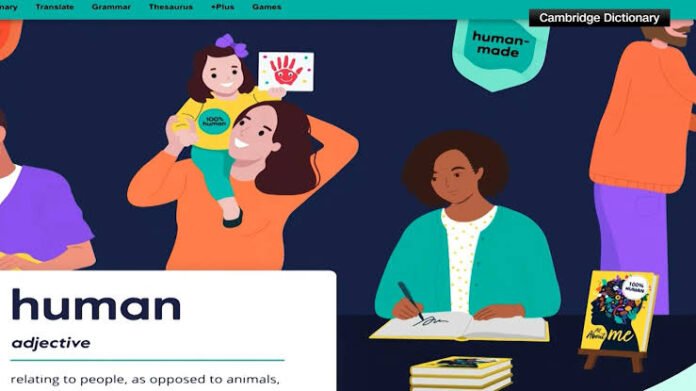
In a year marked by rapid advances in artificial intelligence and growing discussions about the relationship between humans and machines, the Cambridge Dictionary has selected ‘human’ as its Word of the Year for 2026. Announced on November 18, the choice reflects a renewed global focus on human identity, creativity and the qualities that distinguish people from artificial intelligence.
Cambridge Dictionary defines ‘human’ as having the qualities, faults and feelings that people have, as opposed to gods, animals or machines. According to the dictionary, the word gained significance this year as AI increasingly became part of everyday life, raising questions about the role of human thinking, originality and emotional connection in an increasingly automated world.
The selection reflects debates around what makes people unique at a time when artificial intelligence can generate text, images, music and other forms of creative content. Terms such as ‘human-made’, ‘human-written’ and ‘human-driven’ have become increasingly relevant as people seek to distinguish work created by individuals from AI-generated output.
Several public figures and experts have contributed to these discussions. Microsoft co-founder Bill Gates has argued that certain roles, particularly those involving caregiving and personal connection, should remain centred on humans. He has also emphasised that the success of AI should be measured by how much it improves human lives. Nobel laureate and AI researcher Geoffrey Hinton has also raised concerns about the growing capabilities of artificial intelligence and the need to prioritise human interests.
Concerns over the impact of AI on creative industries have also gained attention. Actors, musicians and writers, including Scarlett Johansson, Cate Blanchett, Billie Eilish and Jodi Picoult, have been associated with campaigns raising questions about the use of human-created work to train AI systems and the unauthorised digital reproduction of artists’ voices and likenesses.
The Authors Guild has also introduced a ‘Human Authored’ label to help identify books written by people.
Cambridge lexicographer Colin McIntosh explained that increasing reliance on AI has encouraged people to reconsider what they might lose when they outsource their thinking and creative work to machines. The renewed interest in the meaning of being human, he noted, played a significant role in the selection.
Other words considered for the 2026 title included ‘agent’, referring to an artificial intelligence system capable of operating with limited human control, ‘analogue’, associated with activities and objects that do not involve digital technology, and ‘wholesome’, describing something that is beneficial or positive.
The dictionary also added several popular expressions to its vocabulary this year, including ‘aura farming’, ‘looksmaxxing’ and ‘air jail’, reflecting changing trends in internet culture and everyday communication.
The choice of ‘human’ goes beyond a dictionary announcement. It captures a wider conversation about the place of people in a technology-driven society.
While artificial intelligence offers opportunities in education, healthcare, research and communication, questions about accountability, originality, privacy and human judgement remain important.
As technology continues to evolve, the word ‘human’ serves as a reminder that progress is not only about what machines can achieve, but also about the values, relationships and creativity that people wish to preserve.