

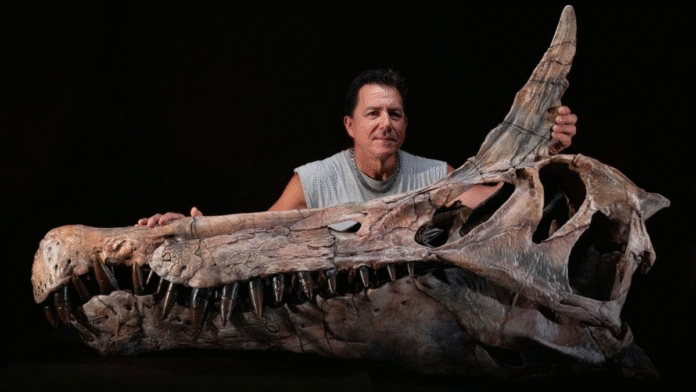
PC (Science Alert, Reuters)
Spinosaurus mirabilis: The “Hell Heron” Giant That Redefines Fish-Eating Dinosaurs
In a groundbreaking find announced in February 2026, paleontologists have revealed a remarkable new species of fish-eating dinosaur named Spinosaurus mirabilis, meaning “astonishing spine lizard.” This marks the first unequivocal new large carnivorous dinosaur species identified in more than 100 years-and the first new Spinosaurus species since the genus was named over a century ago.
Led by University of Chicago paleontologist Professor Paul Sereno, an international team discovered the fossils in the remote Jenguebi site deep in Niger’s central Sahara Desert. The region, now a barren expanse, was once a lush, forested inland habitat crisscrossed by rivers-hundreds of kilometers from the ancient Tethys Sea coastline.
The most striking feature of Spinosaurus mirabilis is its massive, scimitar-shaped bony crest atop the skull, which likely extended even further in life with a keratin sheath, similar to modern crested birds. This “sabre” or blade-like crest, standing about 20 inches tall, may have served for visual display, attracting mates, or signaling rivals-making the dinosaur’s silhouette truly dramatic alongside its famous sail-like back structure.
Experts describe the creature as a specialized piscivore (fish-eater) with an elongated snout and interlocking, interdigitating teeth that formed a natural “fish trap” for snaring slippery prey like large coelacanths. It waded into rivers to hunt, much like modern herons or the so-called “hell heron” analogy -striding through shallow waters rather than swimming fully aquatically. This inland lifestyle challenges earlier views of spinosaurids as primarily coastal dwellers and highlights a late evolutionary phase where these giants adapted to riparian (riverine) environments.
Measuring around 40 feet (about 10-14 meters) long -roughly the size of a school bus-this semi-aquatic predator lived approximately 95 million years ago during the Late Cretaceous period. The fossils include a remarkably complete skull, jaw fragments, teeth, and crest elements, reconstructed digitally even in the field using solar-powered laptops amid the desert camp.
“This find was so sudden and amazing, it was really emotional for our team,” Professor Sereno said. “I’ll forever cherish the moment in camp when we crowded around a laptop to look at the new species for the first time. Discovery adds vital insights into spinosaurid evolution, revealing three distinct phases over 50 million years-from early fish-snaring forms to dominant predators,culminating in massive inland specialists like S.mirabilis just before their extinction. This “astonishing” addition not only expands our understanding of dinosaur diversity in ancient Africa but also underscores the ongoing surprises hidden in the Sahara’s sands.