

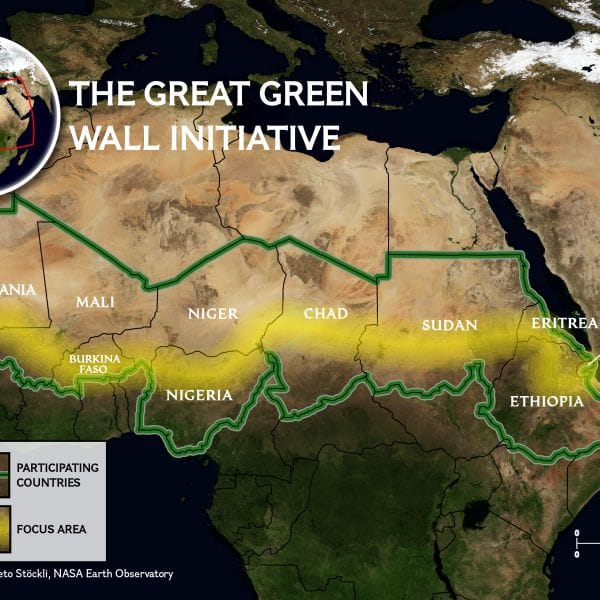
PC( National Geographics)
The Great Green Wall is one of Africa’s most ambitious environmental initiatives. Launched in 2007 by the African Union, it aims to create a vast mosaic of restored land and vegetation stretching across the Sahel region from Senegal in the west to Djibouti in the east. Spanning approximately 8,000 kilometers, the project involves 22 countries and seeks to restore 100 million hectares of degraded land, sequester 250 million tonnes of carbon dioxide, and create 10 million green jobs by 2030.
Beyond simply planting trees, the initiative promotes sustainable land use practices that enhance food security, generate livelihoods, and build resilience against climate change. It addresses desertification, soil degradation, and the southward expansion of the Sahara Desert while improving living conditions for local communities.
In its initial years, the Great Green Wall faced significant hurdles. Insufficient funding and inadequate monitoring made it a low priority for some governments. War and political instability in parts of the Sahel further hampered implementation, as member countries struggled to execute the planned strategies effectively. As a result, progress remained slow for many years. While the project attracted international attention and pledges, actual on-ground restoration lagged behind targets.
The Great Green Wall Accelerator (2021) to address these bottlenecks, leaders from the United Nations Convention to Combat Desertification (UNCCD), including Gilles Amadou Ouédraogo, introduced the Great Green Wall Accelerator in 2021. This new plan focuses on establishing a robust monitoring system to track progress toward the 2030 goals analyzing which projects deliver the best results. Strengthening cooperation and participation among the 22 participating countries. Improving transparency in how funds are used with Donors have committed significant resources billions pledged and a portion already disbursed and project leaders now closely track spending to ensure alignment with targets. The Accelerator has also helped expand participation, with more governments in the Sahel committing to the initiative.
Modest Successes and Community-Driven Impact. Despite the challenges, the project has recorded notable achievements. Approximately 30% of the restoration target has been reached in recent estimates, with millions of hectares of degraded land brought back to productivity. Communities along the wall report improvements in agriculture, water availability, and local livelihoods.
Countries that have demonstrated strong commitment, particularly Senegal, have shown relatively better results. Experts attribute Senegal’s progress to empowering local communities, giving them a sense of ownership over the projects. This community involvement has not only supported tree planting and land restoration but has also improved living conditions through job creation, sustainable farming, and access to non-timber forest products. Gilles Amadou Ouédraogo, a UNCCD Programme Management Officer and native of Burkina Faso, remains optimistic. He believes the Accelerator’s focus on better monitoring, data-driven decisions, and cross-country collaboration is key to future success. Countries are also forming stakeholder organizations to improve communication and coordination at national and regional levels.
The Great Green Wall still has substantial work ahead to meet its 2030 ambitions. Issues like funding gaps, conflict in some regions, and the need for stronger ecological outcomes persist. However, the combination of community participation, improved monitoring, and sustained international support offers a path forward. If successful, the initiative could transform vast areas of the Sahel into productive, resilient landscapes -fighting climate change, reducing poverty, and creating sustainable opportunities for millions of people. This landmark project demonstrates both the immense challenges of large-scale environmental restoration in fragile regions and the potential rewards when local communities, governments, and global partners work together.