

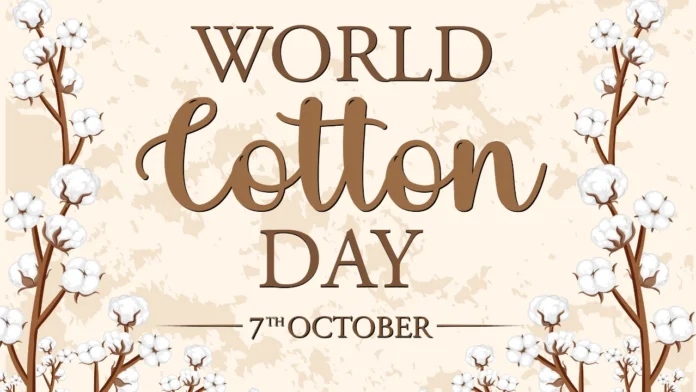
From the fields where it is cultivated to the clothes we wear every day, cotton has a place in both the global economy and everyday life. World Cotton Day, observed on October 7, highlights the importance of cotton and the millions of people whose livelihoods are connected to its production, processing and trade.
Cotton is one of the world’s most widely used natural fibres. Its importance, however, goes far beyond clothing. The crop supports farmers, workers, traders, manufacturers and entire textile industries across different countries.
The United Nations officially recognised the importance of cotton through World Cotton Day, with the first official observance held on October 7, 2019. The initiative was promoted by the World Trade Organization in collaboration with the Food and Agriculture Organization, the United Nations Conference on Trade and Development, the International Trade Centre and the International Cotton Advisory Committee.
For India, cotton has a particularly significant place in history and culture.
India is one of the world’s major cotton-producing countries and has a textile tradition that stretches back thousands of years. Archaeological evidence shows that cotton was being cultivated and used in the Indian subcontinent in ancient times. Over centuries, cotton became closely connected with India’s weaving traditions, from handloom fabrics to regional textiles and intricate crafts.
Cotton also carries an important place in India’s modern history. Mahatma Gandhi’s promotion of khadi and the spinning wheel turned hand-spun cotton into a symbol of self-reliance and resistance during the freedom movement. Even today, khadi remains closely associated with India’s heritage of handloom and indigenous textile production.
Across the country, cotton takes different forms through regional craftsmanship. From handwoven khadi and Bengal’s traditional textiles to Rajasthan’s block-printed cotton fabrics and Gujarat’s distinctive weaving traditions, the fibre has become an important part of India’s diverse textile culture.
Behind these fabrics, however, is the work of farmers.
Cotton cultivation is dependent on factors such as rainfall, soil conditions, irrigation, pest management and market prices. Farmers can also face challenges arising from unpredictable weather, rising input costs and fluctuations in demand. Supporting sustainable and economically viable cotton production is therefore important not only for the textile industry but also for rural livelihoods.
Environmental sustainability has become another major part of the global cotton conversation. Conventional cotton cultivation can require significant quantities of water and agricultural inputs, depending on the region and farming practices. Organic cotton, efficient irrigation, responsible pest management and improved farming techniques are among the approaches being explored to reduce environmental pressures.
The discussion also extends to the fashion industry. As consumers become more conscious of how their clothes are produced, questions about sourcing, water use, working conditions, textile waste and the lifespan of garments are increasingly influencing the conversation around cotton.
Yet cotton’s relevance extends beyond fashion. It is used in household textiles, medical products, personal care items and several industrial applications. Its versatility has allowed it to remain an important natural fibre even as synthetic alternatives have expanded.
World Cotton Day is therefore an opportunity to look beyond the finished fabric. A cotton shirt represents a long chain involving cultivation, harvesting, processing, spinning, weaving, dyeing, manufacturing and retail.
Each stage connects different people, skills and economies.
As the world looks towards more sustainable production and consumption, the future of cotton will depend on balancing the needs of farmers, industries, consumers and the environment.
On World Cotton Day, the humble fibre offers a reminder of how closely agriculture, craftsmanship, culture and commerce are connected. From a cotton field to a piece of fabric, its journey carries not only economic value but also generations of knowledge, labour and tradition.