

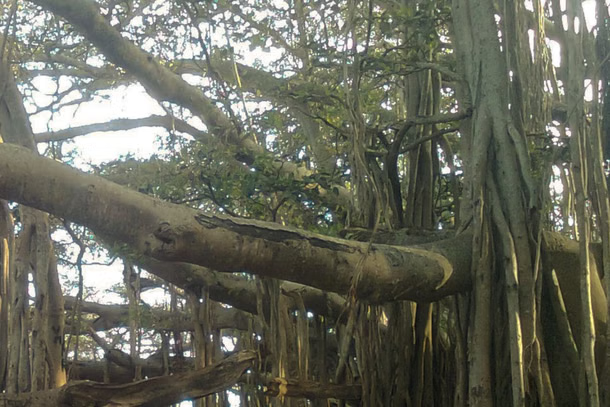
A banyan tree in Bihar’s Munger district has been identified as the world’s oldest accurately dated banyan tree, with scientists estimating its age at around 700 years using high-precision radiocarbon dating.
The tree, a Ficus benghalensis (banyan), is located on the campus of the Indian Tobacco Company (ITC) in Munger and is believed to predate the historic Burra Bunglow in the area by several centuries.
Advanced Radiocarbon Dating Used
The age of the tree was determined through radiocarbon dating of alpha-cellulose extracted from wood samples. Radiocarbon dating measures the decay of carbon-14 in organic material and is widely used in archaeology, geology and palaeosciences to determine age.
Unlike temperate trees, tropical broadleaf species such as banyans generally do not produce distinct annual growth rings, making conventional tree-ring dating (dendrochronology) unreliable. Researchers therefore used alpha-cellulose, a stable component of wood that provides greater accuracy in radiocarbon analysis of long-lived trees.
Study Led by Birbal Sahni Institute
The research was led by Dr. Trina Bose of the Birbal Sahni Institute of Palaeosciences (BSIP), Lucknow, an autonomous institute under the Department of Science and Technology (DST).
The study was co-authored by Dr. Mayank Shekhar and Dr. Akhilesh K. Yadava.
The findings were published in April 2026 in the international peer-reviewed journal Quaternary Research, which focuses on studies related to the Quaternary Period, covering the last 2.58 million years of Earth’s history.
Remnant of an Ancient Forest
According to the researchers, the scientific dating suggests the banyan tree is much older than the nearby Burra Bunglow, which had previously been associated with its origin.
The researchers believe the tree is likely a surviving remnant of a natural forest that once covered parts of the Munger region.
India’s National Tree
The banyan tree (Ficus benghalensis) is India’s national tree and belongs to the Moraceae family, which also includes figs and mulberries.
Known for its aerial roots, the banyan expands as these roots descend to the ground and develop into additional trunks, allowing a single tree to spread across a vast area over centuries.
The discovery is significant because it provides one of the most accurately dated records of an ancient tropical banyan tree, offering valuable insights into the longevity and ecological history of one of India’s most iconic tree species.