

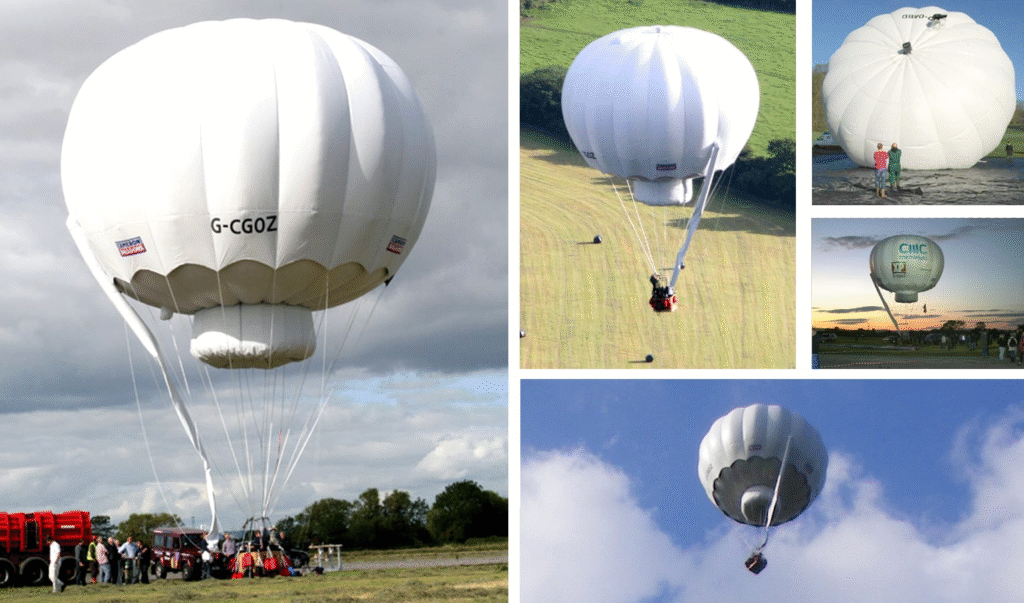
PC: (Cameron Balloons, Fresh Fruits Basket)

Hydrogen balloons marked one of the earliest triumphs in human flight, offering superior lift compared to hot air alternatives. Yet their extreme flammability led to their eventual replacement by safer gases like helium in most applications.
Why Hydrogen Balloons Explode
Hydrogen gas is highly flammable and reacts vigorously with oxygen to form water (H2O). When a hydrogen-filled balloon bursts, the escaping gas mixes rapidly with surrounding air, creating a highly explosive mixture. Even a tiny spark-such as from static electricity, friction between balloons, or a nearby flame-can ignite it, resulting in a sudden fireball or explosion.
Hydrogen’s dangers stem from several key properties:
High reactivity — With only one electron in its outer shell, hydrogen atoms eagerly bond with oxygen.
Low activation energy — The reaction requires roughly one-tenth the energy needed for natural gas, making it easy to trigger.
Wide flammability range – Hydrogen ignites in
air at concentrations between 4% and 75%, allowing explosive conditions even in partially confined spaces like rooms or elevators.
These factors make hydrogen far more hazardous than inert gases.
The Invention of Hydrogen Balloons in 1783
Hydrogen balloons emerged as a direct improvement over the Montgolfier brothers’ hot-air balloons, which relied on continuous fires and were bulky, limited in range, and altitude.Hydrogen, discovered as “inflammable air” and recognized as the lightest element, provided dramatically better lifting power. This enabled smaller, lighter, and more durable balloons capable of longer flights and higher altitudes.The breakthrough required new material technology: airtight, lightweight envelopes. The Robert brothers developed a solution using silk coated with rubber dissolved in turpentine.
First unmanned launch (August 27, 1783):
Jacques Charles and the Robert brothers released a 35-cubic-meter hydrogen balloon from Paris’s Champ de Mars. Filled using hydrogen generated by reacting sulfuric acid with iron filings, it traveled 21 km before landing and being destroyed by frightened locals.
being destroyed by frightened locals.
First manned flight (December 1, 1783): Just 10 days after the Montgolfiers’ hot-air manned ascent, Jacques Charles and Nicolas-Louis Robert piloted a hydrogen balloon for over two hours, reaching about 550 meters (some accounts note up to 3,500 meters) and covering roughly 36 km. These flights sparked “balloonomania,” driving scientific exploration of the atmosphere with instruments like barometers and thermometers.
Key Historical Milestones and Technological Advances
Early hydrogen balloons used silk envelopes, later improved with goldbeater’s skin (thin animal membrane) for superior gas retention.
Innovations enhanced safety and control:
Drag rope (1830s) For gradual descent and stability. Rip panel (1839) – Allowed quick gas release for emergency landings. Throughout the 19th and 20th centuries, hydrogen balloons supported exploration, research, and military uses, including surveillance in World War II.
Hydrogen vs. Helium: Why the Switch Happened
The switch from hydrogen to helium occurred primarily because of safety. Hydrogen is highly flammable and explosive, as tragically shown by the 1937 Hindenburg disaster where the hydrogen-filled airship caught fire and burned rapidly, killing dozens and ending the era of hydrogen airships. Helium, being an inert noble gas, is completely non-flammable and chemically stable, eliminating the risk of fire or explosion. Although hydrogen provides slightly better lift (about 7-10% more buoyancy) and is cheaper to produce, the overwhelming priority became public safety, leading modern applications-blimps, weather balloons, and party balloons-to use helium despite its higher cost and minor reduction in lifting power.
Cheaper coal gas sometimes substituted for hydrogen in non-critical applications.
Hydrogen’s flammability led to infamous disasters, such as the 1937 Hindenburg airship fire, where hydrogen accelerated a rapid blaze (though debates persist on the exact ignition source, often linked to static electricity or the airship’s flammable outer coating).
Helium became the standard for party balloons, public events, and most commercial uses due to its non-explosive nature-no fireball if popped near a flame. Hydrogen remains in specialized applications like some weather balloons for cost and lift advantages, but helium dominates everyday and safety-critical scenarios.
Hydrogen balloons revolutionized aviation in the late 18th century by overcoming hot-air limitations, but their explosive potential ultimately paved the way for helium’s safer reign in modern ballooning.