

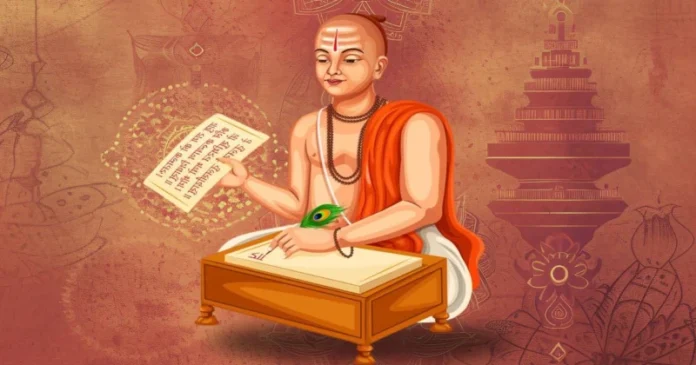
Goswami Tulsidas was one of the most celebrated poet-saints of the Bhakti tradition and one of the most influential figures in medieval Hindi literature. Best known as the author of Ramcharitmanas, his retelling of the Ramayana in Awadhi, Tulsidas played a significant role in bringing the story and ideals of Lord Rama closer to ordinary people.
His poetry combined devotion, philosophy and storytelling, creating works that continue to be recited in homes and temples across India. His birth anniversary, Tulsidas Jayanti, is observed every year during Shukla Paksha Saptami of the month of Shravana.
Early Life of Tulsidas
Tulsidas is traditionally believed to have been born in Rajapur in present-day Uttar Pradesh. His exact date and year of birth remain subjects of historical debate, although traditional accounts place his birth in the 16th century.
He is believed to have been born as Rambola Dubey. Numerous legends surround his childhood and early years, reflecting the strong place he occupies in India’s religious tradition.
According to popular accounts, Tulsidas developed a deep devotion to Lord Rama and eventually dedicated his life to spiritual practice, learning and literary expression.
The Transformation of a Devotee into a Poet
One of the most famous stories associated with Tulsidas concerns his attachment to his wife, Ratnavali. Traditional accounts say that her words about his excessive worldly attachment inspired him to turn his devotion towards God. Following this transformation, Tulsidas devoted himself increasingly to the worship of Lord Rama.
While details of this episode belong largely to traditional biographies and cannot all be established historically, the story has become an important part of the popular narrative surrounding his spiritual journey.
Tulsidas travelled to several important religious centres and is particularly associated with Ayodhya, Chitrakoot and Varanasi.
Ramcharitmanas: His Greatest Work
Tulsidas’ most famous creation is Ramcharitmanas, an epic retelling of the Ramayana composed in Awadhi.
Unlike Sanskrit texts that were primarily accessible to learned audiences, Ramcharitmanas was written in a language widely understood by ordinary people in North India. This helped the story of Lord Rama become an even more deeply rooted part of popular religious and cultural life.
The work is divided into seven kandas, or books, and narrates the life of Rama, from his birth and childhood to his exile, the abduction of Sita, the battle with Ravana and his return to Ayodhya.
Beyond its narrative, Ramcharitmanas explores ideals such as dharma, devotion, duty, compassion, loyalty and righteousness.
Its verses have influenced folk theatre, music, religious performances and storytelling traditions across generations.
The Hanuman Chalisa
Another work traditionally attributed to Tulsidas is the Hanuman Chalisa, a devotional composition dedicated to Lord Hanuman.
Written in the Awadhi language, the Chalisa consists of forty verses praising Hanuman’s strength, wisdom, devotion and service to Lord Rama. It remains one of the most widely recited devotional compositions in India.
The popularity of the Hanuman Chalisa has extended far beyond literary circles, becoming a familiar part of daily prayer and religious observances for millions of devotees.
Other Famous Works
Tulsidas is traditionally credited with several other important compositions. These include:
●Vinaya Patrika – a collection of devotional prayers and supplications addressed to various deities, particularly Lord Rama.
●Dohavali – a collection of devotional and philosophical couplets expressing ideas about morality, devotion and human conduct.
●Kavitavali – a poetic work centred largely on the story and character of Lord Rama.
●Gitavali – devotional songs describing episodes from the life of Rama.
●Krishna Gitavali – verses devoted to Lord Krishna.
●Barvai Ramayan – another poetic retelling of the Ramayana tradition.
Together, these works demonstrate the breadth of Tulsidas’ literary contribution and his ability to express complex spiritual ideas through accessible poetry.
Tulsidas and Lord Hanuman
Tulsidas’ devotion to Lord Rama was closely connected with his reverence for Lord Hanuman. Traditional accounts associate him with the establishment of the Sankat Mochan Temple in Varanasi, which is dedicated to Hanuman.
Several legends also describe Tulsidas’ spiritual encounters with Hanuman and his eventual vision of Lord Rama. These stories are an important part of the devotional tradition surrounding his life, although they belong to religious and hagiographical accounts rather than firmly established historical records.
His Influence on Indian Culture
Tulsidas’ importance goes beyond the religious sphere. His writings had a profound influence on Hindi literature, North Indian culture, theatre, music and oral storytelling.
The language of Ramcharitmanas helped establish Awadhi as an important literary medium, while its narrative became deeply embedded in popular traditions such as Ramlila, the theatrical enactment of the Ramayana.
His work also demonstrated the power of vernacular literature in making spiritual ideas accessible to wider communities.
A Legacy That Lives On
Goswami Tulsidas occupies a unique place in India’s literary and spiritual history. Through his poetry, he transformed an ancient epic into a living tradition that could be read, sung, performed and passed from one generation to another.
For devotees, he remains a great saint of Lord Rama. For literature, he remains one of the most important poets of medieval North India. And for Indian cultural history, his Ramcharitmanas continues to be one of the most influential works ever written in a vernacular Indian language.
Centuries after his lifetime, Tulsidas’ verses continue to be recited across homes, temples and public spaces, a testament to the enduring power of his words and his devotion to Lord Rama.