

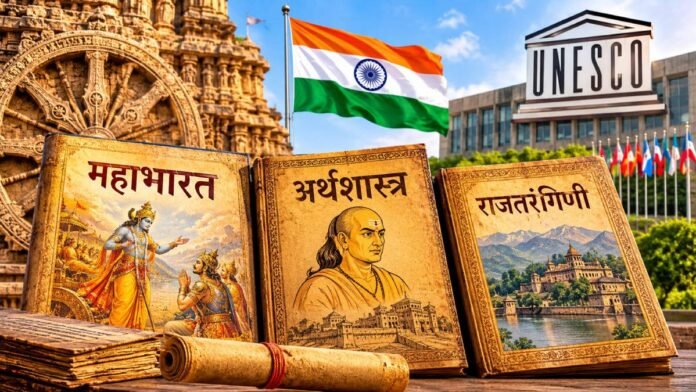
India’s rich literary, historical and intellectual heritage has received international recognition with three of its significant ancient works, the Mahabharata, Arthashastra and Rajatarangini, being inscribed on UNESCO’s Memory of the World Committee for Asia and the Pacific (MOWCAP) Regional Register. The announcement was made during the 11th session of MOWCAP, held in Jakarta, Indonesia, on November 5 and 6, 2026. The recognition highlights the historical, philosophical and cultural significance of these works and their contribution to the intellectual traditions of the Indian subcontinent.
The Mahabharata, traditionally attributed to sage Ved Vyasa, is one of the world’s longest epic narratives and an important part of India’s literary and philosophical heritage. While its central narrative revolves around the conflict between the Pandavas and Kauravas, the epic goes far beyond a story of war and family rivalry. It explores complex questions of duty, justice, morality, relationships, governance and human responsibilities. The Bhagavad Gita, which forms part of the Mahabharata, offers philosophical teachings on life, action, duty and spirituality. The epic also reflects the four central pursuits of human life in Indian philosophy: Dharma (righteousness), Artha (prosperity), Kama (desire) and Moksha (liberation).
Among the important manuscripts associated with this recognition is a 307-year-old palm-leaf manuscript of the Karna Parva, one of the 18 sections of the Mahabharata, preserved at Visva-Bharati University in Santiniketan, West Bengal. Comprising 221 folios, the manuscript was transcribed by Haricharan Sharma and is part of the university’s Lipika manuscript repository. Another significant manuscript is a nearly 400-year-old birch-bark copy of the Mahabharata, written in the Sharada script and preserved at the Bhandarkar Oriental Research Institute in Pune. These manuscripts reflect the long tradition of preserving and transmitting India’s ancient knowledge through different materials, languages and scripts.
The Arthashastra, traditionally attributed to Kautilya, also known as Chanakya or Vishnugupta, is another major work included in the regional register. Composed around two thousand years ago, it is an important Sanskrit treatise on statecraft, economics, administration, diplomacy, law and military strategy. The text provides detailed insights into the functioning of ancient Indian states, including taxation, public administration, intelligence systems, foreign policy and governance. Its systematic approach to political and economic organisation makes it an important source for understanding ancient Indian political thought. A significant palm-leaf manuscript of the Arthashastra, written in the Grantha script, is preserved at the Oriental Research Institute in Mysuru.
The third work, Rajatarangini, was composed by the 12th-century Kashmiri historian Kalhana. The Sanskrit text is widely regarded as one of the most important historical chronicles of medieval India. Its name, meaning ‘River of Kings’, reflects its account of Kashmir’s rulers, dynasties, political developments and social life. Unlike many traditional royal narratives, Kalhana attempted to present historical events through chronological accounts and critical examination of available sources. The manuscript preserved at the Oriental Research Library in Srinagar is written in the Sharada script on old Kashmiri paper and is an important record of the region’s historical and cultural heritage.
UNESCO’s Memory of the World Programme was launched in 1992 to safeguard documentary heritage of exceptional historical, cultural and intellectual value. It aims to protect important manuscripts, archival records, rare books, photographs and other documentary materials from deterioration, loss and destruction while encouraging wider access for research and education. The programme operates through international, regional and national registers. The MOWCAP Regional Register specifically recognises documentary heritage that holds significance for the Asia-Pacific region.
The inclusion of these three works is significant because they represent different dimensions of India’s intellectual traditions. While the Mahabharata explores philosophical and ethical questions, the Arthashastra provides insights into governance and political economy, and the Rajatarangini preserves a historical account of Kashmir. Together, they demonstrate the diversity of knowledge developed and documented in India over centuries.
The recognition also brings renewed attention to the importance of manuscript conservation, research and digitisation. Many ancient Indian manuscripts remain preserved in universities, libraries, temples and research institutions, often requiring specialised care to protect them from age, climate and physical damage. Initiatives such as the Gyan Bharatam Mission aim to survey, document, conserve and digitise India’s manuscript heritage, making this knowledge more accessible to future generations.
The UNESCO recognition is therefore not merely an honour for three historical works but also an acknowledgement of India’s contribution to the shared intellectual heritage of humanity. It reinforces the importance of preserving ancient knowledge while ensuring that its ideas, historical records and cultural insights continue to inform future generations.