

PC: (Rudraksh Ratna)
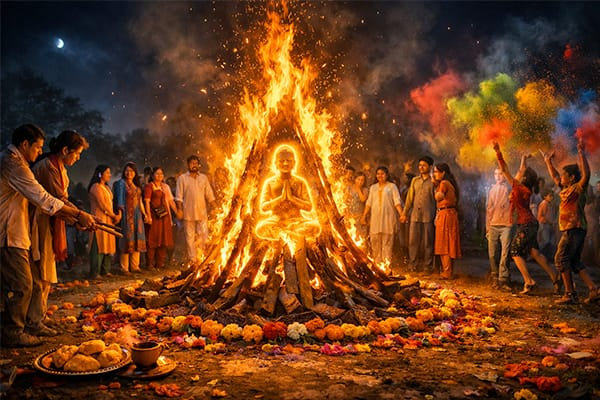
Every year, a day before Holi, neighborhoods come alive with the sight of children collecting dry twigs and branches. Families bring wood from their homes, and by evening, a large bonfire is ready. This is Holika Dahan-a ritual we’ve all witnessed since childhood, yet its profound story often remains half-remembered. Far more than a tradition, it is a powerful symbol of the destruction of ego and the victory of unwavering devotion. Rooted in ancient Puranic tales, the story of Hiranyakashyap, his sister Holika, and the young devotee Prahlad remains deeply relevant today, reminding us of the eternal battle between fear and faith.
The Tradition and Symbolic Meaning of Holika Dahan
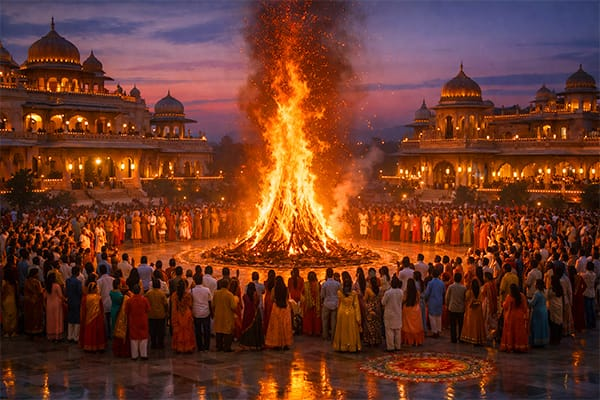
Holika Dahan, also known as Chhoti Holi or Small Holi, takes place on the full moon night of Phalgun (Falgun Purnima). It is not merely about lighting a fire -it is a symbolic act of burning away negativity, anger, jealousy, ego, and all inner impurities. People gather around the bonfire, perform parikrama (circumambulation), offer new crop ears (barley or wheat) to the flames, and believe it brings prosperity, health, and positivity to the home. Across villages and cities, this collective ritual strengthens community bonds and marks a fresh beginning-burning the old to welcome the new.
Hiranyakashyap’s Arrogance: When a King Declared Himself God
In ancient times, there lived a powerful demon king named Hiranyakashyap. Through severe penance, he obtained a boon from Lord Brahma that made him nearly invincible: he could not be killed by man or beast, neither during day nor night, neither inside nor outside a house, neither by weapon nor by any hand-held arms. Drunk on this power, he proclaimed himself God, forbade the worship of Lord Vishnu, and forced his subjects to worship only him.
Prahlad’s Unshakable Devotion: The Power of a Child’s Faith
Hiranyakashyap’s own son, Prahlad, was born a supreme devotee of Lord Vishnu (Narayana). Despite his father’s repeated warnings, threats, and attempts to brainwash him, Prahlad refused to abandon his devotion. He chanted “Narayana, Narayana” at every moment. Enraged by this defiance, the king subjected Prahlad to horrific tortures-throwing him from mountains, crushing him under elephants, poisoning him-but each time, by Lord Vishnu’s grace, Prahlad emerged unharmed.
The Episode of Holika Dahan: Misuse of a Boon and Divine Miracle
Finally, Hiranyakashyap sought help from his sister Holika, who had received a boon that fire could never burn her (in some versions, she possessed a divine shawl that protected her from flames). On the king’s orders, Holika sat on a blazing pyre with Prahlad in her lap, intending to burn him to death. But divine justice prevailed. Because Holika was misusing her boon to harm an innocent devotee, the fire turned against her. Holika was reduced to ashes, while Lord Vishnu miraculously transferred the protective power to Prahlad. A divine shawl flew over him, shielding him completely, and he walked out unscathed. This miraculous event is commemorated every year through Holika Dahan.
Lord Narasimha Avatar and the End of Tyranny
Furious and humiliated, Hiranyakashyap challenged Prahlad: “Where is your God now?” Prahlad calmly replied, “He is everywhere-even in this pillar.” In rage, the king struck the pillar. At that instant, Lord Vishnu emerged in the terrifying yet protective form of Narasimha-half-man, half-lion. To honor the boon yet defeat the demon, Narasimha killed Hiranyakashyap at twilight (neither day nor night), on the threshold of the palace (neither inside nor outside), placed on his lap (neither on ground nor in sky), and tore him apart with his claws (neither weapon nor tool). Thus, arrogance met its end, and devotion emerged victorious.
When It Will Be Celebrated in 2026
Holika Dahan will be observed on Tuesday, March 3, 2026, in the evening during the auspicious muhurat (approximately between 6:22 PM and 8:50 PM, depending on local panchang). The main Rangwali Holi / Dhulandi follows the next day on Wednesday, March 4, 2026.