

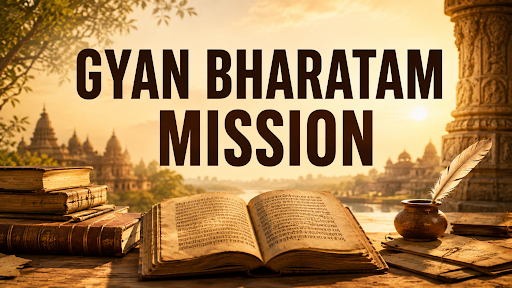
India’s ancient manuscripts hold centuries of knowledge, reflecting the country’s rich contributions to science, mathematics, medicine, philosophy, literature and culture. Recognising the importance of this intellectual heritage, the Government of India has introduced the Gyan Bharatam Mission to preserve, digitise and make historical manuscripts accessible to future generations.
Prime Minister Narendra Modi highlighted India’s vast manuscript heritage while addressing the International Conference on ‘Gyan Bharatam’ at Vigyan Bhawan in New Delhi. He stated that India possesses one of the world’s largest collections of manuscripts, with nearly one crore ancient works documenting different aspects of human civilisation and the evolution of knowledge.
Organised by the Ministry of Culture, the conference brought together scholars, historians, conservationists, technologists and policy experts to discuss the preservation, documentation and digitisation of India’s manuscript wealth.
Gyan Bharatam Portal: Making Ancient Knowledge Accessible
A major highlight of the conference was the launch of the Gyan Bharatam Portal, a digital platform aimed at accelerating the identification, documentation, preservation and digitisation of ancient manuscripts.
The portal seeks to bring scattered manuscript collections onto a common digital platform, allowing researchers, students, scholars and institutions worldwide to access India’s intellectual heritage.
Many historical manuscripts are preserved in libraries, temples, monasteries, universities and private collections. However, several remain vulnerable to deterioration due to age, environmental conditions and inadequate conservation facilities. Digitisation can help safeguard their contents while reducing the need to handle fragile original documents.
Addressing the gathering, Modi observed that although millions of manuscripts have been lost over time, the surviving collections continue to demonstrate India’s contributions to various fields of knowledge and learning.
Four Pillars of India’s Knowledge Tradition
During his address, the Prime Minister identified four fundamental pillars of India’s knowledge tradition: preservation, innovation, addition and adaptation.
Preservation ensures that traditional knowledge is protected and passed on to future generations, while innovation encourages the application of ancient ideas to new discoveries. Addition supports the continuous expansion of knowledge, and adaptation allows traditional wisdom to remain relevant in changing social and technological environments.
These principles highlight the importance of viewing ancient manuscripts not merely as historical records but as valuable resources capable of contributing to contemporary research and development.
Role of Artificial Intelligence and Digital Technology
Modi also emphasised the importance of modern technology in safeguarding India’s intellectual heritage. He noted that digitisation could help prevent intellectual piracy and unauthorised exploitation of traditional knowledge while creating opportunities for research and innovation.
Artificial intelligence could play a significant role in interpreting ancient manuscripts, identifying historical references, translating texts and making traditional knowledge accessible to a wider audience.
AI-powered technologies may also assist researchers in deciphering old scripts, connecting related manuscripts and exploring knowledge preserved across different languages and historical periods.
Such developments could encourage collaboration among historians, linguists, scientists, researchers and technology professionals, opening new avenues for interdisciplinary studies.
Encouraging Youth and Academic Participation
The Prime Minister urged universities, academic institutions and young people to actively participate in the mission, emphasising that preserving India’s knowledge heritage should be a collective responsibility.
Students, scholars and researchers can contribute through manuscript identification, documentation, translation, conservation and digital archiving. Their involvement could also help connect India’s traditional knowledge systems with modern scientific research and technological advancements.
The initiative presents opportunities for educational institutions to develop specialised research programmes and collaborative projects focusing on manuscript studies, cultural heritage and digital humanities.
Connecting India’s Ancient Wisdom with the Future
India’s manuscript heritage extends far beyond historical and literary records. Ancient texts contain valuable discussions on mathematics, astronomy, Ayurveda, architecture, agriculture, linguistics, philosophy and several other disciplines.
Preserving and studying these works can provide deeper insights into the development of human knowledge and the exchange of ideas across civilisations.
Through the Gyan Bharatam Mission, the government aims to combine traditional scholarship with modern technological capabilities to protect India’s intellectual legacy and make it accessible to a global audience.
The launch of the Gyan Bharatam Portal marks an important step towards creating a systematic digital record of the country’s manuscript collections. Beyond preservation, the initiative seeks to encourage research, innovation and greater public engagement with India’s knowledge traditions.
By bringing together conservation, technology and academic participation, the mission aims to ensure that India’s ancient wisdom continues to inspire learning, discovery and innovation for generations to come.