

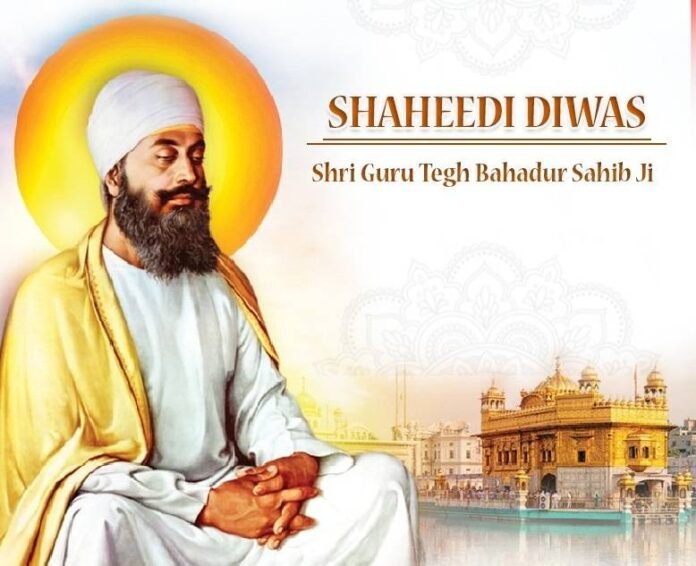
November 24 is observed as the Shaheedi Diwas of Guru Tegh Bahadur Ji, the ninth Sikh Guru, who laid down his life in 1675 while defending the freedom of religious belief and opposing forced conversions. Remembered as ‘Hind Di Chadar’, meaning the Shield of India, Guru Tegh Bahadur Ji’s martyrdom remains one of the most significant chapters in Indian history. His sacrifice was not only an expression of his faith but also a stand for the right of every individual to practise and follow their religion without fear or coercion. The 2026 observance holds particular importance as it marks the 350th anniversary commemorations of his martyrdom.
Born on April 1, 1621, in Amritsar, Punjab, Guru Tegh Bahadur Ji was the youngest son of the sixth Sikh Guru, Guru Hargobind Ji. Originally named Tyag Mal, he was given the title Tegh Bahadur, meaning Brave Sword, in recognition of his courage in battle. He was deeply influenced by his father’s teachings and grew up with a strong understanding of spirituality, courage and service. In 1664, he became the ninth Sikh Guru, succeeding Guru Har Krishan Ji. His teachings emphasised devotion to one God, compassion, humility, fearlessness and detachment from material possessions.
Guru Tegh Bahadur Ji travelled extensively across different parts of India, spreading the message of spirituality, equality and humanity. His journeys took him to regions including Punjab, Uttar Pradesh, Bihar and Assam. He also established the town of Chak Nanki in Punjab, which later became part of Anandpur Sahib, an important centre of Sikh history and spirituality. His compositions, including hymns and verses, form an integral part of the Guru Granth Sahib, the sacred scripture of Sikhism.
The circumstances surrounding his martyrdom are closely associated with the religious policies of Mughal emperor Aurangzeb. During this period, Kashmiri Pandits faced pressure to convert to Islam. According to Sikh historical tradition, a delegation of Kashmiri Pandits approached Guru Tegh Bahadur Ji seeking protection and support against religious persecution. Standing in defence of their right to practise their faith, the Guru opposed forced conversion and took a courageous stand against the imperial authorities.
Guru Tegh Bahadur Ji was subsequently arrested and brought to Delhi, where he was asked to embrace Islam. When he refused to abandon his faith, he was executed on November 24, 1675, in Chandni Chowk on the orders of Aurangzeb. His companions, Bhai Mati Das, Bhai Sati Das and Bhai Dayala Ji, also faced brutal martyrdom for refusing to give up their beliefs. Their sacrifice remains deeply respected in Sikh history.
The site of Guru Tegh Bahadur Ji’s execution is commemorated by Gurdwara Sis Ganj Sahib in Chandni Chowk, Delhi. His body was secretly cremated by Lakhi Shah Vanjara, a devoted follower, who reportedly set his own house on fire to perform the last rites without attracting the attention of Mughal authorities. The cremation site is today marked by Gurdwara Rakab Ganj Sahib in New Delhi. Both gurdwaras remain important places of pilgrimage and remembrance for the Sikh community.
Guru Tegh Bahadur Ji is widely remembered by the honorific ‘Hind Di Chadar’, symbolising his role as a protector of religious freedom and human dignity. His martyrdom demonstrated that defending another person’s right to follow their religion is a responsibility that goes beyond one’s own religious identity. His sacrifice also became a defining moment in Sikh history and had a lasting influence on the community. His son, Guru Gobind Singh Ji, later became the tenth Sikh Guru and founded the Khalsa in 1699.
On Shaheedi Diwas, gurdwaras across the country organise special prayers, Akhand Paths, religious discourses and Nagar Kirtans to honour his life and sacrifice. Devotees gather to listen to hymns from the Guru Granth Sahib, participate in community service and remember the values he stood for. Langars are also organised, reflecting the Sikh tradition of equality and selfless service.
The 350th martyrdom anniversary has also received national recognition through commemorative programmes organised by the Government of India. These observances highlight Guru Tegh Bahadur Ji’s contribution to India’s history and his enduring message of courage, tolerance and freedom of conscience.
More than three centuries after his martyrdom, Guru Tegh Bahadur Ji’s legacy continues to inspire generations. His life reminds us that true courage lies not only in defending one’s own beliefs but also in standing up for the rights and dignity of others. His sacrifice remains a powerful symbol of religious freedom, humanity and the importance of protecting the fundamental right to believe.