

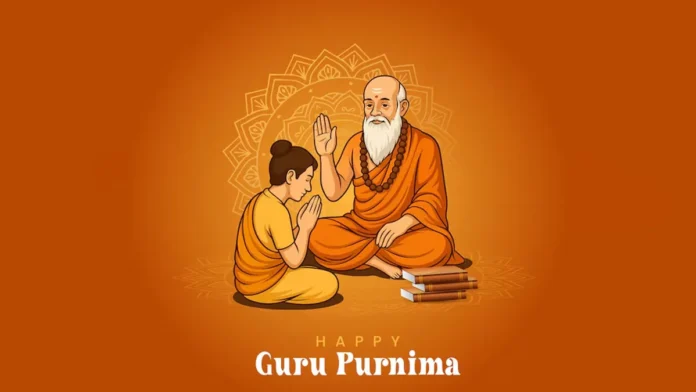
There are many festivals that celebrate relationships with parents, siblings, friends, and nature. Guru Purnima is unique because it honours the one relationship that transforms a person’s life from within, the bond between a guru and a disciple. Observed on the full moon day (Purnima) of the Hindu month of Ashadha (June–July), Guru Purnima is a timeless celebration of wisdom, gratitude, and the eternal pursuit of knowledge.
The word ‘Guru’ holds profound meaning. It is derived from two Sanskrit syllables: ‘Gu’, meaning darkness or ignorance, and ‘Ru’, meaning the remover of that darkness. A guru, therefore, is not merely a teacher but one who illuminates the path of truth, knowledge, and self-realisation. Whether in classrooms, homes, spiritual traditions, or everyday life, every mentor who shapes our character and broadens our understanding embodies the spirit of a guru.
Guru Purnima has deep roots in India’s spiritual heritage and is revered across multiple faiths.
In Hinduism, the day is celebrated as Vyasa Purnima in honour of Maharishi Veda Vyasa, one of India’s greatest sages. He is credited with compiling the four Vedas, authoring the Mahabharata, composing the Brahma Sutras, and compiling the eighteen Puranas. His monumental contribution preserved India’s spiritual and philosophical wisdom for generations, earning him the title of the Adi Guru of knowledge.
The day is also associated with Lord Shiva, revered as the Adi Guru, the first guru. According to tradition, it was on this auspicious full moon that Shiva began imparting the profound science of yoga to the Saptarishis (Seven Sages), laying the foundation of the guru-shishya tradition that has guided seekers for thousands of years.
For Buddhists, Guru Purnima commemorates the day when Lord Buddha delivered his first sermon at Sarnath after attaining enlightenment. By sharing the Four Noble Truths and the Noble Eightfold Path with his first five disciples, he set the Wheel of Dharma in motion, beginning a spiritual journey that would influence millions across the world.
In Jainism, the festival marks the occasion when Lord Mahavira accepted Gautam Swami as his first chief disciple, symbolising the sacred bond between a spiritual master and a sincere seeker.
Beyond its historical and religious significance, Guru Purnima carries a timeless message. It reminds us that knowledge is the greatest wealth, and gratitude is one of the noblest virtues. In an age overflowing with information, the role of a guru becomes even more valuable. A true guru does not simply provide answers; they inspire curiosity, cultivate wisdom, nurture values, and help individuals discover their highest potential.
Across India, devotees celebrate Guru Purnima by offering prayers, flowers, and respects to their gurus, teachers, parents, and mentors. Many visit temples, ashrams, and educational institutions to seek blessings. Spiritual aspirants dedicate the day to meditation, self-reflection, scriptural study, and acts of seva (selfless service), reaffirming their commitment to inner growth and righteous living.
The festival also reminds us that learning is a lifelong journey. Every experience, every challenge, and every individual who teaches us compassion, resilience, humility, or courage becomes a guide in our lives. In this sense, Guru Purnima is not only about honouring spiritual masters but also about expressing gratitude to everyone who has helped shape our thoughts and character.
The full moon, radiant and complete, symbolises the illumination that true knowledge brings. Just as moonlight gently dispels the darkness of night, the guidance of a guru removes the darkness of ignorance and leads one towards wisdom, purpose, and self-realisation.
In today’s fast-changing world, where material success often overshadows inner growth, Guru Purnima reminds us that the greatest education is not merely about acquiring skills but about becoming a better human being. It is a celebration of humility before knowledge, gratitude towards those who guide us, and faith in the transformative power of learning.
Guru Purnima is, therefore, far more than a festival, it is a tribute to the timeless tradition of wisdom that has enriched Indian civilisation for millennia. It reminds us that while books may provide information, it is a guru who awakens understanding, shapes character, and inspires us to walk the path of truth.