

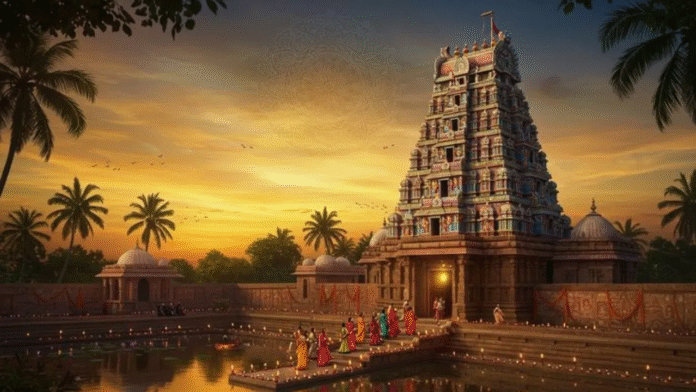
Prime Minister Narendra Modi inaugurated the Guru Bhairavaikya Mandira at Sri Kshetra Adichunchanagiri in Mandya district on April 15, 2026. The visit marked a significant spiritual and cultural occasion, during which the Prime Minister offered prayers and paid tribute to the legacy of a revered seer associated with the Adichunchanagiri Mahasamsthana Math.
Memorial Dedicated to a Revered Seer
The Guru Bhairavaikya Mandira has been built in honour of Sri Sri Sri Dr. Balagangadharanatha Mahaswamiji. The memorial reflects his immense contributions to society, particularly in the fields of education, healthcare, and social service. It is envisioned as both a place of reverence and a source of inspiration for future generations.
Architectural and Cultural Significance
Constructed in the traditional Dravidian architectural style, the Mandira stands as a symbol of India’s rich temple heritage. Known for features such as towering gopurams and intricate carvings, this style highlights the continuity of ancient artistic traditions. The structure blends spiritual symbolism with fine craftsmanship, making it a significant cultural landmark likely to attract devotees, scholars, and tourists alike.
Religious Rituals and Associated Visits
During his visit, the Prime Minister also offered prayers at important religious sites within the परिसर, including the Jwala Peeta and the Sri Kalabhairaveshwara Swamy Temple. According to local belief, Jwala Peeta is associated with the penance of Lord Shiva, adding deep spiritual significance to the visit. These rituals underscored the enduring traditions linked to the region.
Important Facts
- Adichunchanagiri Mahasamsthana Math is a prominent spiritual and educational institution
- Dravidian architecture is characterised by temple towers known as gopurams
- Balagangadharanatha Mahaswamiji was the 71st pontiff of the Math
- Mandya district is an important agrarian region in Karnataka
Book Release and Broader Significance
On the occasion, the Prime Minister also released the book Saundarya Lahari and Shiva Mahimna Stotram along with H. D. Deve Gowda.
The event highlighted the vital role of spiritual institutions in preserving cultural heritage, promoting social welfare, and contributing to nation-building in contemporary India.