

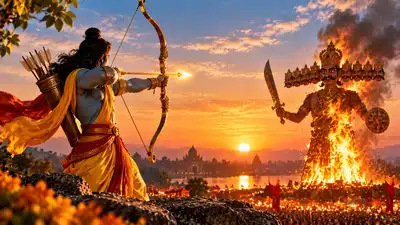
Dussehra, also known as Vijayadashami, is one of India’s most significant festivals, symbolising the victory of good over evil, truth over falsehood and righteousness over injustice. Celebrated with devotion, enthusiasm and cultural festivities across the country, the festival holds a special place in Hindu tradition. It marks the conclusion of Navratri and is associated with two important mythological events: Lord Rama’s victory over Ravana and Goddess Durga’s triumph over the demon Mahishasura. Together, these stories reflect the enduring belief that evil, however powerful it may appear, cannot prevail over truth and righteousness.
The Story Behind Dussehra
The most widely known story associated with Dussehra comes from the Hindu epic Ramayana. According to the epic, Lord Rama, the prince of Ayodhya and an incarnation of Lord Vishnu, embarked on a journey to rescue his wife, Sita, who had been abducted by Ravana, the powerful king of Lanka.
Ravana was a learned scholar, a devoted follower of Lord Shiva and a mighty ruler. However, his arrogance and misuse of power ultimately led to his downfall. After Sita was taken to Lanka, Lord Rama, accompanied by his brother Lakshmana and an army of vanaras led by Hanuman, prepared for a battle against Ravana.
The battle between Rama and Ravana continued until Rama ultimately defeated the ten-headed king. His victory symbolised the triumph of righteousness over arrogance, virtue over vice and justice over injustice. According to the popular tradition, this victory took place on the tenth day of the bright fortnight of the Hindu month of Ashwin, which is celebrated as Vijayadashami.
Ravana’s ten heads are often interpreted symbolically as representing human weaknesses and negative qualities, such as anger, pride, greed, jealousy, attachment and lust. The burning of his effigy during Dussehra serves as a reminder that these destructive tendencies must be recognised and overcome.
The Story of Goddess Durga and Mahishasura
Dussehra also commemorates the victory of Goddess Durga over Mahishasura, a powerful demon who had become a threat to the gods and the world. According to Hindu mythology, Mahishasura had obtained a boon that made him believe he could not be defeated by any man or god. Empowered by this protection, he challenged the gods and established his dominance over the heavens.
To defeat him, the divine energies of the gods came together to create Goddess Durga, who was bestowed with divine weapons and extraordinary strength. She fought Mahishasura in a fierce battle that continued for nine days and nights. On the tenth day, she finally defeated him, restoring peace and balance to the universe.
This victory is celebrated during Vijayadashami, particularly in West Bengal and several other eastern Indian states, where Durga Puja is observed with great devotion. The festival celebrates the strength of the feminine divine, the victory of justice and the restoration of harmony.
Although the stories of Rama and Durga differ, both convey a common message: no force of evil can remain undefeated when confronted with courage, wisdom and righteousness.
Why Is It Called Vijayadashami?
The word Vijayadashami is derived from two Sanskrit words: Vijaya, meaning victory, and Dashami, referring to the tenth day of the lunar fortnight. The name therefore signifies the victory celebrated on the tenth day.
Dussehra, also written as Dasara or Dashahara, is another widely used name for the festival. Its observance varies across regions, reflecting India’s diverse religious traditions, cultural practices and local histories.
The festival falls on the tenth day of the bright half of the Hindu lunar month of Ashwin, generally in September or October. It marks the culmination of the nine-day Navratri festival and, in many regions, the end of Durga Puja celebrations.
How Is Dussehra Celebrated Across India?
Dussehra is celebrated in different ways across the country, with each region adding its own customs, performances and rituals to the festival.
One of the most recognisable traditions is the organisation of Ramlila, a dramatic enactment of episodes from the Ramayana. Performed in towns and cities, Ramlila brings the story of Lord Rama to life through dialogue, music, costumes and theatrical performances. These events often take place over several days, culminating in the defeat of Ravana on Dussehra.
On the tenth day, large effigies of Ravana, often accompanied by those of his son Meghnad and brother Kumbhakarna, are set alight in public gatherings. The celebrations attract families and communities who come together to witness the spectacle. The burning symbolises the destruction of evil and the importance of choosing the path of truth.
In West Bengal, Vijayadashami marks the concluding day of Durga Puja. Devotees offer prayers to Goddess Durga before the ceremonial immersion of her idols in rivers or other designated water bodies. Married women in some Bengali communities participate in sindoor khela, a ritual involving the application of vermilion, as they bid farewell to the goddess and pray for well-being and prosperity.
In Mysuru, Karnataka, Dussehra is celebrated through the famous Mysuru Dasara festivities. The city is known for its illuminated Mysore Palace, cultural programmes, processions and traditional performances. The royal celebrations have a long history and reflect the region’s cultural heritage.
In Himachal Pradesh, Kullu Dussehra begins when celebrations in many other parts of India are drawing to a close. The festival brings together local deities from surrounding villages, accompanied by processions, music and traditional gatherings. It is a distinctive expression of the region’s religious and cultural identity.
In several parts of Rajasthan, Dussehra is marked by Ramlila performances, fairs, prayers and the burning of Ravana’s effigies. Communities gather to participate in festivities that combine religious observance with local customs and entertainment.
Rituals and Traditions Associated with Dussehra
Dussehra is observed through various religious rituals that express gratitude, devotion and the hope for prosperity. Many devotees begin the day by bathing, wearing clean clothes and offering prayers at home or in temples. Some perform special pujas dedicated to Lord Rama, Goddess Durga or other deities.
In several communities, the worship of weapons and tools is an important tradition. Known as Shastra Puja or Ayudha Puja, the practice involves offering prayers to weapons, agricultural implements, machinery, vehicles and tools used in daily work. It expresses respect for the instruments that support one’s livelihood and reflects the belief that work performed with dedication and integrity is sacred.
In many parts of India, Vijayadashami is considered an auspicious day to begin new ventures, purchase important items or undertake significant activities. Some families introduce young children to formal education through the ritual of Vidyarambham, particularly in Kerala and other southern regions. The ceremony marks the beginning of a child’s learning journey and highlights the importance of knowledge and education.
Another tradition associated with the festival is the exchange of greetings, sweets and gifts among family members, friends and neighbours. These gestures strengthen social bonds and bring communities together in a spirit of celebration.
The Deeper Significance of Dussehra
Beyond its mythological stories and public celebrations, Dussehra carries a message that remains relevant in contemporary life. Its central lesson is that the struggle between good and evil is not limited to ancient epics; it also exists within individuals and society.
Ravana’s defeat encourages people to reflect on the consequences of arrogance, greed and the misuse of power. Similarly, Goddess Durga’s victory represents courage, strength and the ability to confront injustice. Both stories remind people that knowledge and power are meaningful only when guided by wisdom, compassion and ethical conduct.
The festival also highlights the importance of standing up against wrongdoing, protecting the vulnerable and accepting responsibility for one’s actions. Its traditions encourage communities to come together, preserve cultural heritage and pass values from one generation to the next.
In a world facing social divisions, dishonesty and conflict, the message of Vijayadashami offers an opportunity for reflection. The symbolic destruction of evil can also be understood as a call to overcome prejudice, intolerance, hatred and selfishness in everyday life.
A Festival of Hope and Renewal
Dussehra is more than a celebration of a mythological victory. It represents hope, renewal and the enduring belief that righteousness ultimately prevails. Through the stories of Lord Rama and Goddess Durga, the festival celebrates courage, devotion, justice and the strength to overcome adversity.
As communities gather for prayers, cultural performances, fairs and traditional rituals, Vijayadashami reinforces a shared message that transcends regional boundaries. It reminds people that the real significance of victory lies not merely in defeating an external enemy, but also in overcoming the negative qualities within themselves.
Ultimately, Dussehra invites everyone to reflect on their choices, embrace truth and act with integrity. Its timeless message is simple yet powerful: the triumph of good over evil begins with the decisions individuals make in their own lives.