

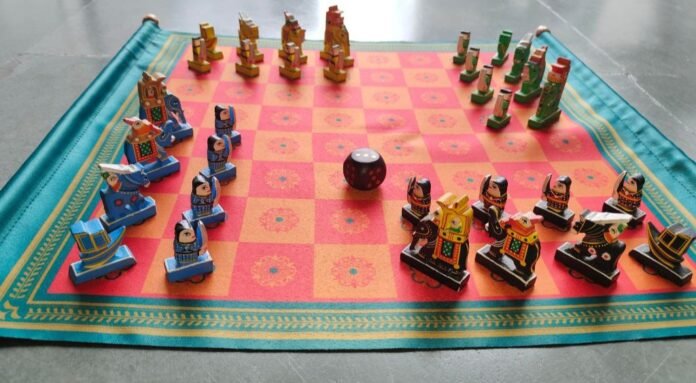
Long before international chess championships, grandmasters, and digital chess platforms, there existed an ancient Indian board game that laid the foundation for one of the world’s most celebrated intellectual pursuits. Known as Chaturanga, this strategic game is widely regarded by historians as the earliest known ancestor of modern chess. Originating in India around the 6th century CE, Chaturanga not only shaped the game of chess but also influenced other strategy games such as Shogi in Japan and Xiangqi in China.
The name Chaturanga comes from the Sanskrit words chatur (four) and anga (limbs), referring to the four divisions of an ancient Indian army- infantry, cavalry, elephantry, and chariots. These military units formed the basis of the game’s pieces, making Chaturanga a symbolic representation of battlefield strategy rather than merely a recreational pastime.
The Birthplace of Chess
Most historians believe that Chaturanga was first played during the Gupta Empire, often regarded as the Golden Age of ancient India. From India, the game spread westward to Persia, where it evolved into Shatranj. Following the Islamic expansion and cultural exchanges with Europe, Shatranj gradually transformed into the modern game of chess. Over the centuries, several rules changed, new movements were introduced, and the game evolved into the version played across the world today.
Because of this remarkable journey, India is proudly recognised as the birthplace of chess.
How Was Chaturanga Played?
Like modern chess, Chaturanga was played by two players on an 8×8 board known as the Ashtapada. However, unlike today’s alternating black-and-white chessboard, the Ashtapada was uncheckered, with all 64 squares appearing identical.
Each player controlled an army consisting of:
●Raja (King): Moved one square in any direction, much like the modern king.
●Mantri (Minister): The predecessor of today’s queen, but far less powerful. It could move only one square diagonally.
●Ratha (Chariot): Functioned exactly like the modern rook, moving any number of squares horizontally or vertically.
●Ashva (Horse): Moved in the familiar L-shaped pattern of the modern knight and could jump over other pieces.
●Gaja (Elephant): Unlike the modern bishop, it moved exactly two squares diagonally and could leap over intervening pieces.
●Padati (Foot Soldiers): The pawns advanced one square forward and captured diagonally. Unlike modern chess, they could not move two squares on their first move, and therefore the en passant rule did not exist.
When a pawn reached the opposite end of the board, it was promoted only to a Minister, unlike modern chess, where promotion to various pieces is possible.
Rules That Differed from Modern Chess
Although Chaturanga shared many strategic elements with chess, several important differences existed.
There was no castling, meaning the king and rook could not perform the special defensive move seen in modern chess. Victory was generally achieved by capturing the opponent’s king, rather than simply placing it in unavoidable checkmate.
Another fascinating difference involved stalemate. In modern chess, a stalemate results in a draw. In traditional Chaturanga, however, a player who had no legal moves remaining was often considered the winner, depending on the version being played. Some historical variants also allowed victory if a player reduced the opponent to a “bare king” by capturing all other pieces.
A Lasting Legacy
More than 1,500 years after its creation, Chaturanga continues to fascinate historians, archaeologists, and chess enthusiasts. It stands as a remarkable example of ancient India’s contributions to strategic thinking, mathematics, and intellectual culture. Modern chess may have evolved significantly over the centuries, but its roots remain firmly embedded in this ingenious Indian invention.
Today, Chaturanga is remembered not only as the precursor to chess but also as a symbol of India’s rich civilisational heritage. As the world celebrates International Chess Day, it is also an opportunity to acknowledge the timeless legacy of Chaturanga, the ancient game that transformed military strategy into one of humanity’s greatest games of skill, logic, and imagination.