

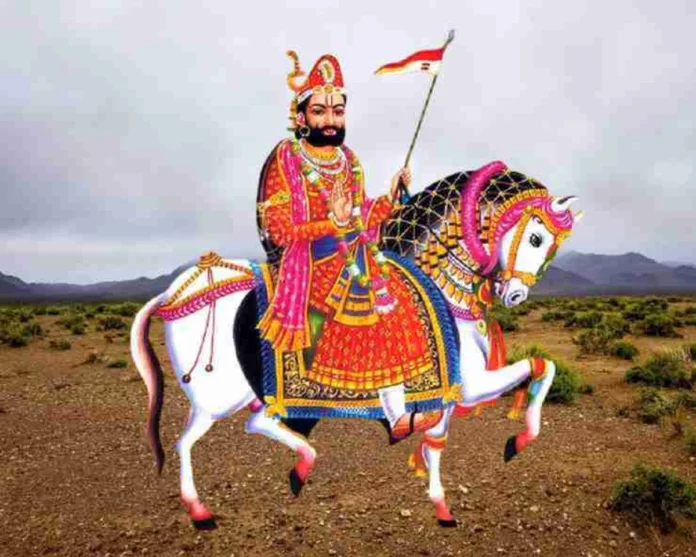
In the vast cultural landscape of Rajasthan, where history, folklore and faith often exist side by side, few figures command as distinctive a place as Baba Ramdevji, revered as Ramdev Pir or Ramsa Pir. His principal shrine at Ramdevra, near Pokaran in present-day Jaisalmer district, draws devotees from different communities and regions, making it one of western Rajasthan’s most important pilgrimage centres.
Ramdevji is remembered in Hindu tradition as a divine incarnation associated with Lord Krishna, while Muslim devotees revere him as Ramsa Pir or Ramshah Pir. The continuing popularity of his shrine and annual fair reflects a religious tradition that has crossed boundaries of caste and community for centuries. Rajasthan Tourism itself describes Ramdevji as a folk deity worshipped by people of different faiths and identifies Ramdevra as a place associated with Hindu-Muslim unity.
A saint of the desert
The historical details of Ramdevji’s life are difficult to establish with the certainty possible for better-documented medieval rulers. Much of what is known comes from oral traditions, devotional literature, community histories and later accounts. Rajasthan’s official cultural material associates him with the Tanwar or Tomar Rajput tradition and with the region around Pokaran and Runicha, the old name associated with present-day Ramdevra.
His father is traditionally identified as Ajmalji, with his mother remembered as Minaldevi. Accounts of his birth and life vary, and even the chronology is not uniform. A commonly circulated tradition places his birth around 1352 CE, while dates associated with his samadhi also vary significantly. The Rajasthan government’s Devasthan Department, for example, gives 1458 CE for his samadhi, while other traditions give 1385 CE. The discrepancy is important because the biography of Ramdevji has been transmitted through both historical and sacred traditions rather than through a single contemporary historical record.
For this reason, dates such as 1352–1385 should be treated as traditional chronology rather than firmly established historical dates.
From ruler to revered folk deity
Ramdevji’s importance does not rest only on the stories surrounding his birth or royal lineage. His enduring place in Rajasthan’s popular religious culture is closely connected with the belief that he stood for equality, service and the dignity of the marginalised.
He is especially revered among communities that historically faced social exclusion. The Rajasthan government’s detailed development plan for Ramdevra notes that Ramdevji’s worship cuts across caste distinctions and that he has a particularly strong following among the Meghwal community, among others.
The social dimension of his tradition is significant. Rather than presenting spiritual worth as something restricted by birth or social status, the devotional traditions associated with Ramdevji emphasise the equality of human beings. His following subsequently spread far beyond the Rajput communities with which his traditional biography connects him.
Scholarship has also explored the complex interaction of Hindu, Muslim and Ismaili traditions in the development of the Ramdev Pir cult. Historian and anthropologist Dominique-Sila Khan, in her study Conversions and Shifting Identities: Ramdev Pir and the Ismailis in Rajasthan, examines the historical evolution of these overlapping traditions through ethnographic research, shrine practices and religious literature.
Why is Ramdev Pir revered by Muslims too?
One of the most enduring stories associated with Ramdevji concerns five pirs who are said to have travelled from Mecca to test his spiritual powers.
According to the tradition preserved by the Rajasthan Devasthan Department, Ramdevji invited the visitors to share a meal. They reportedly declined, saying that they could eat only from their own utensils, which had been left behind in Mecca. Ramdevji then summoned the utensils, which, according to the legend, arrived miraculously. Impressed by the demonstration, the pirs are said to have accepted him and bestowed upon him the name Rama Shah Pir.
The story belongs to the realm of religious tradition rather than independently verifiable medieval history. Yet its cultural significance is considerable. It helps explain why Ramdevji came to be remembered not merely as a Hindu folk deity but also as Ramsa Pir, a figure revered within Muslim devotional traditions. The samadhis associated with the five pirs are also traditionally said to be located near Ramdevji’s shrine.
The horse that became an enduring symbol
Walk into a Ramdevji shrine and one image appears repeatedly: Baba Ramdevji riding a horse.
The horse has become one of the defining visual symbols associated with him. Rajasthan Tourism describes the traditional image of Ramdevji as that of a king-like figure mounted on a horse.
Alongside this image are numerous parchas, or miracle stories, preserved through oral tradition. These include accounts of miraculous events associated with his childhood and adult life. Such stories are an important part of Rajasthan’s folk religious culture, although they should be understood as devotional narratives rather than historical evidence.
Ramdevra: the sacred centre
About 12 kilometres from Pokaran, on the Jodhpur–Jaisalmer route, lies Ramdevra, the principal pilgrimage centre associated with Baba Ramdevji. The shrine is regarded as the place of his final resting place or samadhi.
The name can sometimes cause confusion because of its similarity to Lord Ram. Rajasthan Tourism specifically points out that the shrine at Ramdevra is not a temple dedicated to Lord Rama, but is associated with the saint Baba Ramdevji.
The shrine attracts devotees from Rajasthan and neighbouring states, while the wider tradition has travelled as far as Gujarat, Madhya Pradesh, Haryana, Punjab and Sindh. The Rajasthan government’s cultural documentation describes his following as extending across caste and religious boundaries.
The famous Ramdevra fair
Every year, Ramdevra transforms into a vast pilgrimage centre during the Bhadrapada season, when the famous Ramdevra Mela, also known as Baba Ramdev Mela, is held.
The Rajasthan government’s Devasthan Department records that the major fair traditionally takes place during the bright fortnight of Bhadon and attracts lakhs of devotees from different regions and communities.
The atmosphere is marked by devotional singing, bhajans, night-long gatherings, processions and offerings at the shrine. The fair is also a celebration of Rajasthan’s living folk culture, bringing together religious devotion with local music, crafts, food and traditional dress. India’s official tourism portal describes the fair as a meeting point of spirituality, folk heritage and desert culture.
In 2026, Ramdev Jayanti falls on Monday, September 21, while the associated Ramdevra festivities have been observed during September.
A legacy beyond a single religion
Perhaps the most remarkable aspect of Ramdev Pir’s legacy is not any individual miracle story, but the way his memory has travelled across social and religious boundaries.
A Rajput saint in one tradition, a divine incarnation in another, and Ramsa Pir in Muslim devotional memory, Ramdevji occupies a distinctive space in Rajasthan’s cultural imagination. His shrine at Ramdevra continues to bring together people whose religious and social identities may otherwise be very different.
His story also illustrates an important feature of India’s folk traditions: saints and local deities are often remembered not through one fixed historical narrative but through generations of songs, oral histories, pilgrimage practices and community traditions.
Today, as devotees gather at Ramdevra and sing in praise of Runicha Ra Dhaniya, the centuries-old memory of Ramdevji remains alive. His story belongs simultaneously to history, folklore and faith, and it is this layered legacy that has allowed Ramdev Pir to remain one of Rajasthan’s most enduring folk saints.