

Chandra Shekhar Azad, originally named Chandra Shekhar Sitaram Tiwari and born on 23 July 1906 in Bhabhra, emerged as a legendary figure in the Indian independence movement. His extraordinary courage and inspirational leadership at a remarkably young age motivated countless youths and revolutionaries nationwide.
Unlike others of his generation who focused on careers, family, or personal goals, Azad devoted himself entirely to India’s freedom struggle. He confronted British rule head-on, displaying unwavering resolve and ultimately achieving martyrdom for the nation.
To this day, Azad’s bravery and ultimate sacrifice are honored in his hometown of Bhabhra, a tranquil village in Madhya Pradesh that proudly preserves the legacy of this remarkable revolutionary.
Living up to his chosen name ‘Azad’-meaning “free”-he pledged that the British would never capture him alive, a promise he kept until his final breath.
Chandra Shekhar Azad spent his formative years in Bhabhra, surrounded by an atmosphere of patriotism. His parents, Sitaram Tiwari and Jagrani Devi, instilled in him the importance of education and strong moral values. Sent to Varanasi at an early age to study Sanskrit, Azad was profoundly influenced by the growing wave of nationalism and the ideals of freedom.
Believing that peaceful protests alone were not enough to secure India’s independence, Azad joined the Hindustan Socialist Republican Association (HSRA). Working closely with Bhagat Singh and other revolutionaries, he became a key member of the organization, known for his sharp intellect, marksmanship, courage, and leadership. After the death of Ram Prasad Bismil, Azad played a crucial role in rebuilding and strengthening the HSRA, organizing important events and operations.
In 1921, inspired by Mahatma Gandhi’s Non-Cooperation Movement, Azad actively participated in protests against British rule. During one such protest, he was arrested by the authorities. When brought before the judge, he defiantly stated his name as “Azad” (meaning free), his father’s name as “Swatantrata” (freedom), and his residence as “Jail.”
This bold declaration resonated with many and marked the beginning of his legacy as Chandra Shekhar Azad-a name that would forever symbolize his unwavering dedication to the cause of freedom.
Azad worked closely with young revolutionaries such as Bhagat Singh, Sukhdev Thapar, and Shivaram Rajguru. He guided and supported them in planning revolutionary activities against British rule.
One of the major events connected to their movement was the Assassination of J. P. Saunders in 1928. This act was carried out to avenge the death of Lala Lajpat Rai, who had died after being injured during a police lathi charge while protesting against the Simon Commission.
Although Azad did not directly fire the shot, he played a crucial role in planning the operation and protecting the revolutionaries during its execution. He later helped Bhagat Singh and his companions evade arrest for some time.
Azad continued to lead and support revolutionary activities until his martyrdom in 1931, becoming a powerful symbol of courage and sacrifice in India’s struggle for independence.
On 27 February 1931, at Chandra Shekhar Azad Park (then called Alfred Park), Azad was surrounded by British police during a secret meeting of the revolutionary organization. The police discovered the location and quickly encircled the area.
A heavy exchange of gunfire followed. Azad refused to surrender and fought bravely against the police, even though they greatly outnumbered him. Despite the overwhelming forces, he resisted them fiercely and held his ground for a long time.
However, when only one bullet remained in his pistol, Azad chose to use it on himself rather than be captured by the British forces, remembering his promise to remain “Azad.” True to his name, he chose death over surrender and remained free even in his final moment.
His words echoed his spirit:
“Dushman ki goliyon ka hum samna karenge,
Azad hi rahe hain, Azad hi rahenge.”
Chandra Shekhar Azad was not merely a revolutionary who fought for India’s independence; he remains a timeless symbol of fearless courage, unwavering determination, and supreme sacrifice for the nation.
Legacy Preserved in Bhabhra
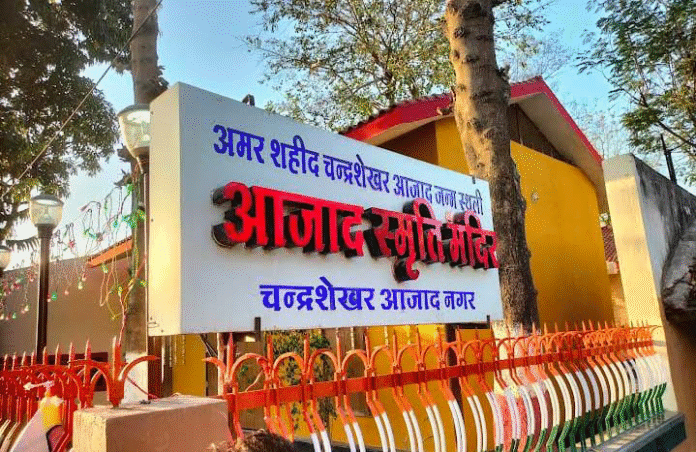
Recently I had the time to visit the birthplace of Chandra Shekhar Azad in Bhabhra which has been preserved as a memorial to honor his life and sacrifice. The site marks the place where this great revolutionary was born on 23 July 1906. Today, a statue and a memorial structure stand there, reminding visitors of the humble origins of a man who later became one of the bravest fighters of India’s independence movement. The memorial proudly preserves his legacy and serves as a source of inspiration for future generations.
During the Malwa Media Fest 3.0, we visited the memorial of Chandra Shekhar Azad in Bhabhra. It was a truly inspiring experience. The place had a calm and respectful atmosphere, and it almost felt as if the walls and statues were silently telling the stories of Azad’s courage and sacrifice.
The surroundings of Bhabhra were peaceful, which made the experience even more special. There was a quiet sense of pride and patriotism in the air. Walking through the memorial, every statue and display seemed to carry a message about his bravery, determination, and dedication to the nation. The simple yet powerful ambiance of the place made the visit feel meaningful and reflective.
While observing the exhibits, I also noticed that during the British era, a bounty had been placed on Azad. The British government had announced a reward of 50,000 rupees, which was considered a very large amount at that time, for anyone who could capture him. A poster showing this bounty notice was also preserved and displayed at the memorial.
Visiting the memorial in Bhabhra gave a deeper understanding of Azad’s life and reminded us of the courage and sacrifice that played an important role in India’s freedom struggle.
(The writer of this article is Lakshya Govani, a class X student of APS, Jaipur)