

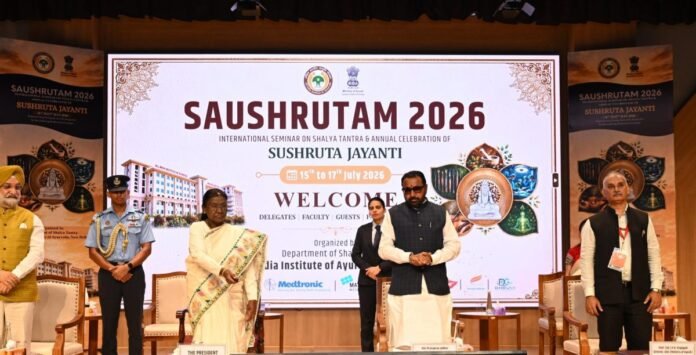
An international seminar at the All India Institute of Ayurveda brought together global experts to explore how ancient surgical wisdom can complement modern medicine.
India’s rich medical heritage took centre stage with Saushrutam 2026, an international seminar dedicated to Ayurvedic surgery (Shalya Tantra), held from 15 to 17 July 2026 at the All India Institute of Ayurveda (AIIA), New Delhi. Organised by the Ministry of Ayush, the three-day event celebrated the timeless contributions of Acharya Sushruta, regarded as the “Father of Surgery,” while exploring how traditional Ayurvedic surgical knowledge can be integrated with modern healthcare practices.
The seminar was inaugurated by President Droupadi Murmu, who emphasised the need to preserve India’s traditional systems of medicine through scientific research, innovation and global collaboration. She noted that Ayurveda, when supported by evidence-based research and modern technology, has the potential to make significant contributions to holistic healthcare worldwide.
Saushrutam 2026 brought together an impressive gathering of Ayurveda practitioners, surgeons, researchers, academicians, policymakers and healthcare professionals from India and abroad. Experts from countries including Thailand, Israel and the United Kingdom participated in the discussions, reflecting the growing international interest in India’s traditional medical systems.
The central objective of the seminar was to promote Shalya Tantra, one of the eight classical branches of Ayurveda that deals with surgery and para-surgical procedures. Through scientific sessions, panel discussions and research presentations, participants examined how ancient Ayurvedic principles can work alongside modern surgical techniques to improve patient care. The event also encouraged interdisciplinary collaboration between Ayurvedic institutions and leading modern medical centres.
One of the major highlights of the seminar was the inauguration of a ₹14.5-crore AI-enabled 3 Tesla MRI facility at AIIA. Equipped with advanced imaging technology, the facility is expected to strengthen diagnostic capabilities, improve clinical research and support evidence-based Ayurvedic practice. The inauguration symbolised the institute’s commitment to combining cutting-edge technology with traditional knowledge.
Another important development during the seminar was the release of a National Commission for Indian System of Medicine (NCISM) study on the career progression of female Ayurveda graduates. The report provides valuable insights into women’s participation in Ayurvedic education and professional practice, offering data that can help shape future policy and strengthen opportunities within the sector.
The conference also featured expert deliberations involving renowned academicians from institutions such as the Institute of Medical Sciences, Banaras Hindu University (IMS-BHU), along with surgeons from premier hospitals including AIIMS New Delhi and Sir Ganga Ram Hospital. Discussions covered topics such as evidence-based Ayurvedic surgery, innovation in surgical education, clinical research, technology integration and future directions for collaborative healthcare.
Beyond academic discussions, Saushrutam 2026 reflected India’s broader vision of positioning Ayurveda as a globally recognised and scientifically validated system of medicine. The seminar reinforced the importance of preserving classical knowledge while encouraging rigorous research, innovation and international cooperation to address contemporary healthcare challenges.
As Ayurveda continues to gain acceptance across the world, initiatives such as Saushrutam 2026 demonstrate that India’s ancient medical traditions are not merely part of its cultural heritage but also a valuable resource for the future of global healthcare. By building bridges between traditional wisdom and modern science, the seminar highlighted a path towards more integrated, evidence-based and patient-centric healthcare systems.