

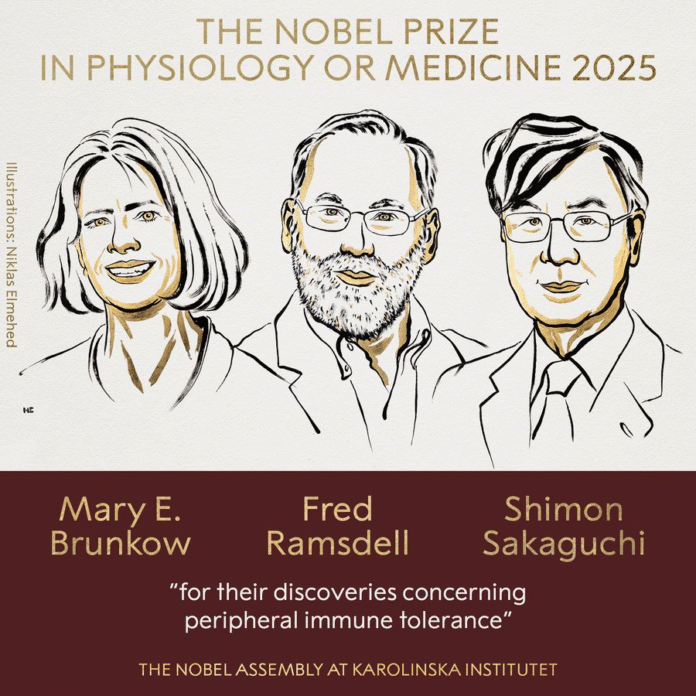
The 2025 Nobel Prize in Physiology or Medicine has been awarded to three scientists who uncovered how the immune system protects us from infections — without turning against our own bodies.
The prestigious award goes to Shimon Sakaguchi from Japan, and Mary Brunkow and Fred Ramsdell from the United States. Their research led to the discovery of regulatory T-cells, often described as the immune system’s “security guards,” which prevent immune cells from attacking healthy tissue.
Their work has paved the way for new therapies targeting autoimmune diseases like type 1 diabetes and multiple sclerosis, as well as some forms of cancer.
“Their discoveries have been decisive for our understanding of how the immune system functions and why we do not all develop serious autoimmune diseases,” said Olle Kämpe, chair of the Nobel Committee.
How Does the Immune System Know What to Attack?
The human immune system is built to recognize and destroy threats like viruses and bacteria. It does this using white blood cells equipped with sensors (receptors) that can identify foreign invaders — even those it’s never encountered before.
However, this randomness also means the body occasionally produces immune cells that could attack its own tissues.
Scientists already knew that some of these self-attacking cells are eliminated in the thymus, where immune cells mature. But the Nobel-winning discovery revealed an additional, critical layer of protection: regulatory T-cells that circulate through the body, suppressing any rogue immune responses that escape the thymus.
When this system fails, it can lead to autoimmune diseases.
Impact on Medicine: Autoimmunity and Cancer
The discovery has had a major impact on medical research.
- In autoimmune diseases, like rheumatoid arthritis or multiple sclerosis, boosting regulatory T-cells may help prevent the immune system from attacking the body.
- In cancer, regulatory T-cells can work against us — suppressing the immune response against tumours. In this case, treatments may aim to reduce or block them.
- Research is also exploring how enhancing these cells might reduce organ transplant rejection.
The Scientists Behind the Discovery
- Prof. Shimon Sakaguchi (Osaka University, Japan) showed that mice lacking a thymus developed autoimmune disease. But injecting them with specific immune cells from healthy mice stopped the disease — pointing to a protective mechanism.
- Mary Brunkow and Fred Ramsdell, working in the U.S., discovered a key gene involved in the function of regulatory T-cells by studying inherited autoimmune conditions in both mice and humans.
“This work is a striking example of how fundamental research can have far-reaching implications for human health,” said Prof. Annette Dolphin, president of the UK’s Physiological Society.
The trio will share the 11 million Swedish kronor prize (around £870,000).