

Every year, as Navratri approaches, the same question lands in my inbox: “Is vrat food actually healthy, or are we just replacing rice with sabudana and calling it a detox?” It’s a fair question, and a timely one, because Navratri fasting, when done right, is one of the most beautifully designed nutritional traditions we have. Done wrong, it can leave you fatigued, bloated, and reaching for a second plate of fried puris. The difference lies entirely in how we fast, not whether we fast.
The Misconceptions We Need to Retire
The biggest myth about vrat food is that “fasting” means eating less. In practice, most people eat more during Navratri, just differently. Sabudana khichdi, deep-fried kuttu puris, potato chaat, and makhana kheer often add up to more calories than a regular day’s meals, just wrapped in a festive label. Fasting was never meant to be an excuse to indulge in fried, starchy food all day; it was designed as a seasonal reset, with lighter, simpler, more mindful eating.
Another misconception is that fasting foods are automatically “cleansing.” Grains like kuttu (buckwheat) and singhara (water chestnut flour) are genuinely nutritious, but frying them in ghee or oil twice a day cancels out much of that benefit. The wisdom was in the ingredients, not necessarily in how we’ve come to cook them.
What a Balanced Vrat Thali Actually Looks Like
A well-designed fasting meal isn’t about restriction. It’s about balance, just built from a different set of ingredients than usual.
●Base: Kuttu, singhara, samak (barnyard millet) or rajgira (amaranth), all genuinely nutrient-dense, gluten-free grains.
●Protein: Paneer, dahi (curd), makhana or peanuts.
●Vegetables: Lauki, arbi, pumpkin and cucumber, which are cooling, fibre-rich and easy to digest.
●Fats: A small amount of ghee or nuts, rather than deep-fried preparations.
●Fruit: At least one seasonal fruit through the day.
The rule of thumb I give clients is that your vrat plate should still have all the components of a regular balanced meal, just made from fasting-friendly swaps.
Don’t Forget Protein
This is the piece most vrat meals miss entirely. A day built around sabudana, potatoes and fruit is mostly starch and sugar, with very little protein to keep you full or energised. Without protein, you’ll feel hungry faster, and by evening, you’re more likely to overeat fried snacks.
Easy fixes include adding curd to every meal, snacking on roasted makhana or peanuts, and including paneer at least once a day. Even a bowl of curd with roasted makhana covers a surprising amount of ground.
Hydration Is Half the Battle
Many people unconsciously cut back on water during a fast, along with food. This is where fatigue, headaches and low energy usually come from, not the fasting itself. Add coconut water, buttermilk (chaas), fresh lime water or herbal teas throughout the day. If you’re fasting from grains but not water, there’s no reason to be under-hydrated.
The Fried Food Trap
Kuttu puri, sabudana vada and aloo tikki are festival favourites, and completely fine occasionally. The problem arises when they become the only options available, three meals a day, for nine days straight. Frying isn’t the enemy; frequency is. Try roasting, steaming or shallow-frying kuttu and sabudana preparations instead of deep-frying, and keep the fried options for one meal rather than every meal.
What Our Ancestors Got Right
Navratri fasting has genuine roots in seasonal eating wisdom. It falls at the change of season, when digestion is traditionally considered more sluggish, so the diet shifts to lighter grains, cooling foods and simpler cooking methods, giving the gut a break from heavier everyday staples. The exclusion of onion and garlic, the emphasis on fresh rather than stored food, and the shift towards fruit and dairy weren’t arbitrary rules. They were an intuitive, pre-scientific way of realigning eating with the season.
The Modern Twist
Today’s fasting trends have taken this further, and mostly for the better. We’re seeing more people treat Navratri as an opportunity for intermittent eating windows, mindful portions, and even using the nine days to reset sugar and processed-food habits. Millets like samak and rajgira, once seen as “just fasting food,” are now recognised as genuinely excellent grains for everyday health, high in fibre, naturally gluten-free and slow-releasing in energy.
The Real Benefit of Navratri Fasting
Done thoughtfully, Navratri fasting can genuinely reset digestion, reduce reliance on processed food, and reintroduce naturally nutrient-dense grains into your diet. It’s less about restriction and more about intentional eating, a rare, built-in nine-day pause to ask, “What am I actually putting on my plate, and why?” That’s a habit worth carrying well beyond the festival.
Recipes to Make This Navratri Healthier
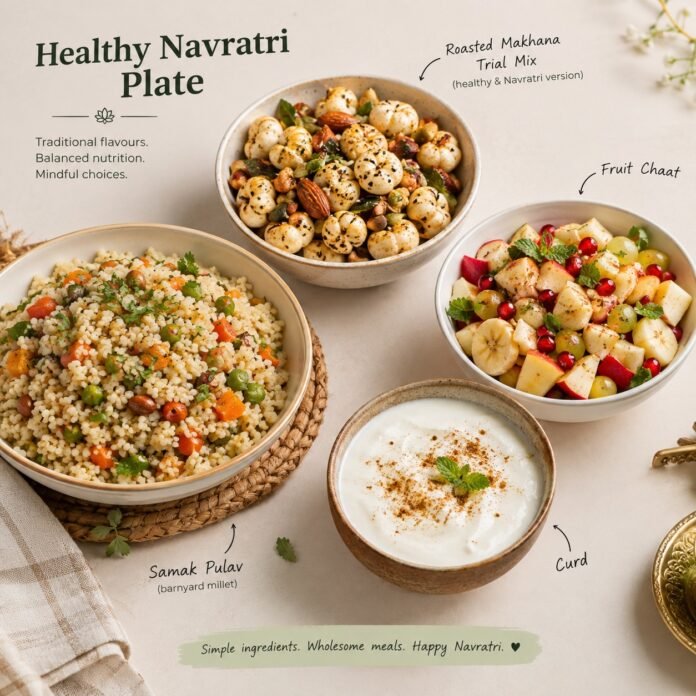
1. Roasted Makhana and Peanut Trail Mix
A protein-rich snack to replace fried chips.
Ingredients:
1 cup makhana (fox nuts), roasted dry until crisp
2 tbsp peanuts, roasted
1 tsp ghee
Rock salt, roasted cumin powder and a pinch of black pepper
Method:
Toss the roasted makhana and peanuts in warm ghee, sprinkle with the spices, and store in an airtight jar. A satisfying, protein-and-fibre-rich snack for between meals.
2. Samak Rice and Vegetable Pulao
A wholesome base meal, with no frying required.
Ingredients:
1 cup samak (barnyard millet) rice, soaked for 20 minutes
1 tbsp ghee
1 tsp cumin seeds
Chopped lauki, carrot and beans
Rock salt, ginger and green chilli
Fresh coriander to garnish
Method:
Sauté cumin in ghee, add ginger and vegetables, and cook until softened. Add the soaked samak with water and simmer until done. Garnish with coriander. Light, filling and full of fibre.
3. Curd and Fruit Chaat with Roasted Makhana
Protein, hydration and freshness in one bowl.
Ingredients:
1 cup fresh dahi (curd), whisked smooth
Diced seasonal fruit, such as banana, pomegranate and apple
A handful of roasted makhana, lightly crushed
Rock salt and roasted cumin powder
A drizzle of honey (optional)
Method:
Layer the curd, fruit and makhana just before eating so the makhana stays crisp. A cooling, protein-and-probiotic-rich dish perfect for a light evening meal.
Festival food doesn’t have to choose between tradition and health. The wisdom was already there. We just need to cook it the way it was meant to be.
(The writer of this article is Dimple Arora, Nutritionist and Founder, The Health Lens)