

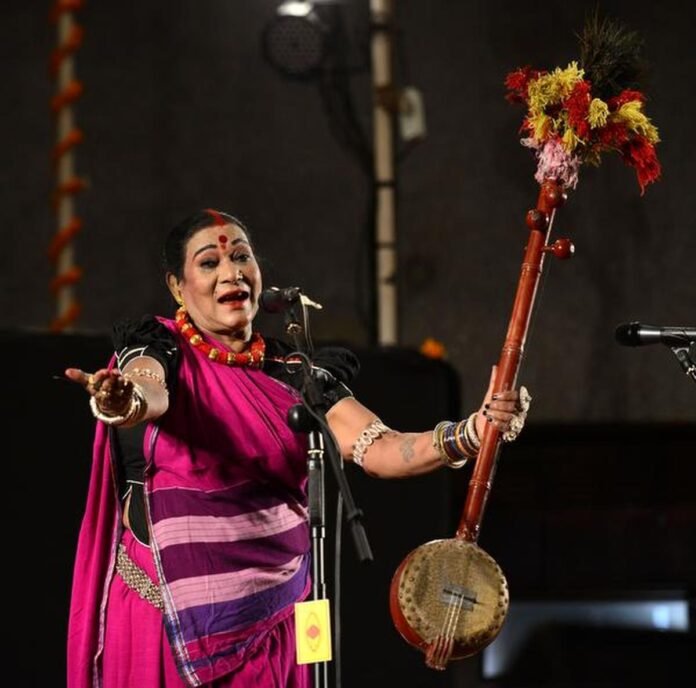
India has lost one of its greatest folk artists with the passing of legendary Pandavani exponent Teejan Bai, who died on July 5 at the All India Institute of Medical Sciences (AIIMS) in Raipur after a prolonged illness. She was 69 according to official records, though some reports mention her age as 70. With her demise, the country bids farewell to a cultural icon who transformed a centuries-old storytelling tradition into a globally celebrated performing art.
Born on August 8, 1956, in Ganiyari village of present-day Chhattisgarh’s Durg district, Teejan Bai belonged to the Pardhi community. She developed an interest in Pandavani, the traditional narrative art based on stories from the Mahabharata, by listening to her grandfather recite the epic. She gave her first public performance at the age of 13, beginning a remarkable artistic journey that would span more than five decades.
Teejan Bai revolutionised Pandavani by performing in the Kapalik style, a dramatic, expressive form traditionally reserved for male performers. At a time when women were expected to sing only in the seated Vedamati style, she broke social barriers by performing standing, using a tambura as a symbolic prop to portray characters, weapons, and emotions from the Mahabharata. Her commanding voice, expressive gestures, and theatrical narration captivated audiences and redefined the art form.
Her extraordinary talent caught the attention of renowned theatre personality Habib Tanvir, who introduced her to wider audiences. From village stages, she went on to perform across India and in countries including France, Japan, the United Kingdom, Germany, and Switzerland, becoming one of the foremost ambassadors of Chhattisgarh’s folk heritage. She also appeared in filmmaker Shyam Benegal’s acclaimed television series Bharat Ek Khoj, further popularising Pandavani among national audiences.
Over the years, Teejan Bai received numerous honours for her invaluable contribution to Indian folk culture. She was awarded the Padma Shri in 1988, the Sangeet Natak Akademi Award in 1995, the Padma Bhushan in 2003, Japan’s prestigious Fukuoka Prize in 2018, and the Padma Vibhushan, India’s second-highest civilian award, in 2019. She also received the Sangeet Natak Akademi Fellowship, recognising her lifetime contribution to the performing arts.
Following her demise, tributes poured in from across the country. Prime Minister Narendra Modi described her passing as an “irreplaceable loss” to India’s world of art and culture, while political leaders, artists, and cultural organisations remembered her as a pioneer who dedicated her life to preserving India’s rich folk traditions.
Teejan Bai’s legacy extends far beyond awards and accolades. She ensured that Pandavani, once confined to rural communities, found a place on international stages while inspiring generations of artists, particularly women, to challenge convention and embrace their talent. Though her powerful voice has fallen silent, the stories she narrated and the tradition she preserved will continue to resonate for generations to come.