

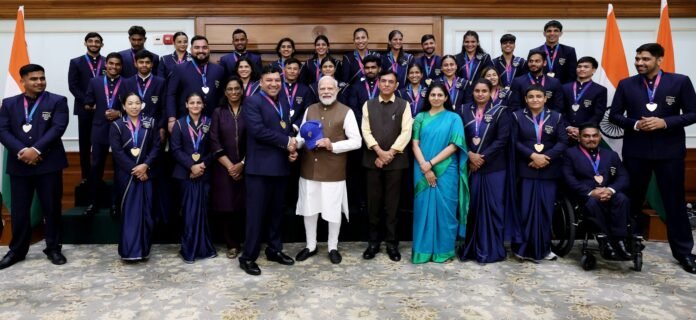
New Delhi: The pride of India’s Commonwealth Games 2026 campaign came alive once again as Prime Minister Narendra Modi hosted the country’s medal-winning athletes at his residence at 7, Lok Kalyan Marg on August 9. The interaction was not merely a felicitation ceremony, but a celebration of the determination, discipline and perseverance that carried India’s athletes to the podium in Glasgow.
Prime Minister Modi interacted with the sportspersons and heard about their experiences at the Games. He congratulated them for their exceptional performances and highlighted the larger significance of their achievements, saying their success would inspire and motivate many youngsters across the country.
India concluded its Commonwealth Games 2026 campaign in fourth position with 39 medals: 13 gold, 17 silver and 9 bronze. The performance reflected the growing depth of Indian sport, with athletes making their mark across several disciplines.
For the athletes, however, every medal represented a journey far longer than the few minutes spent on the podium. Behind the victories were years of rigorous training, injuries, setbacks, sacrifices and the unwavering support of families, coaches and sporting institutions. The meeting at Lok Kalyan Marg provided an opportunity to recognise not just the medals, but the stories behind them.
The Prime Minister’s interaction also carried a larger message for India’s sporting culture. His emphasis on young people taking up sports underlines the importance of creating a generation that sees sporting excellence as an achievable aspiration rather than an exception. The achievements of the Glasgow contingent can therefore serve as powerful examples for children and young athletes watching from across the country.
Modi also urged citizens to continue cheering for Indian sportspersons, reinforcing the idea that support for athletes extends beyond major tournaments. A strong sporting culture is built not only inside stadiums and training centres, but also through the encouragement athletes receive from society.
The significance of the moment is heightened by India’s preparations to host the Commonwealth Games in Ahmedabad in 2030. The Glasgow campaign, therefore, becomes more than a chapter in India’s sporting record, it offers momentum for the next phase of the country’s sporting ambitions.
Every medal won in Glasgow carries two stories: one of achievement and another of possibility. The first belongs to the athlete who stood on the podium; the second belongs to the youngster who watched, believed and may now decide to step onto a sporting field.
As India celebrates its Commonwealth Games heroes, the real legacy of their success may ultimately be measured not only in medals, but in the number of young Indians they inspire to play, compete and dream bigger.