

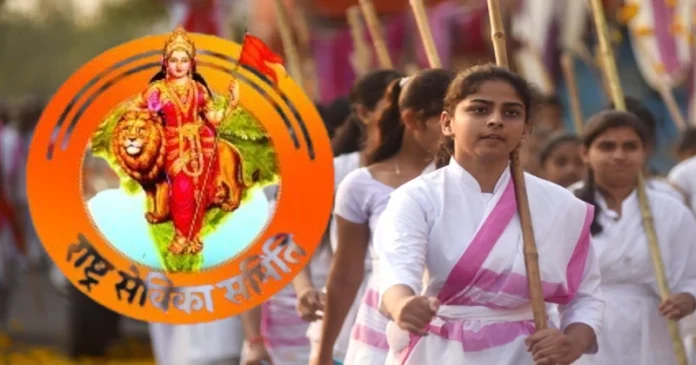
Founded on Vijayadashami in 1936, the organisation has spent nine decades nurturing women’s leadership, cultural awareness and social responsibility through its guiding ideals of Matritva, Kartritva and Netritva.
On the auspicious occasion of Vijayadashami, when India celebrates the triumph of good over evil and honours the power of Shakti, the Rashtra Sevika Samiti commemorates a milestone deeply connected with its own history. Founded on Vijayadashami in 1936, the organisation marks 90 years of its journey in 2026, reflecting on a legacy shaped by women’s participation in nation-building, cultural consciousness and community service.
At a time when women’s public participation was constrained by prevailing social conventions, the Samiti emerged with a vision of preparing women to become confident, disciplined and active contributors to society. Over the decades, it has developed an organisational network built around regular gatherings, physical training, intellectual development and social engagement, placing women at the centre of its understanding of national progress.
The Beginning: A Vision of Lakshmibai Kelkar
The story of the Rashtra Sevika Samiti begins with Lakshmibai Kelkar, affectionately known as Mausiji. Born in 1905, she was an educationist and social organiser who believed that the progress of the nation could not be separated from the development and active participation of its women.
Her interactions with Dr Keshav Baliram Hedgewar, the founder of the Rashtriya Swayamsevak Sangh (RSS), helped shape her thinking about organised social work. Recognising the need for a dedicated platform through which women could receive training and assume responsibilities, she established the Rashtra Sevika Samiti in Wardha, Maharashtra, on Vijayadashami, October 25, 1936.
Although inspired by the RSS’s organisational approach and sharing its broad ideological outlook, the Samiti developed as an independent organisation with its own leadership and activities. It is not simply a women’s wing of the RSS. Its structure and programmes are specifically designed around the participation, development and leadership of women.
Mausiji led the organisation until her death in 1978, laying the foundation for its gradual expansion across the country. Her legacy continues to inform the Samiti’s emphasis on discipline, cultural identity, collective responsibility and women’s contribution to society.
Matritva, Kartritva and Netritva: Three Guiding Ideals
At the heart of the Samiti’s philosophy lie three principles: Matritva, Kartritva and Netritva. Together, they express its understanding of women’s roles in family life, society and public leadership.
Matritva, or motherhood, is understood as a spirit of nurturing, compassion and responsibility that extends beyond biological motherhood to care for society and humanity. The principle emphasises the importance of empathy, emotional strength and the ability to nurture future generations.
Kartritva, meaning the capacity to act and accomplish, encourages women to develop initiative, competence and a sense of social responsibility. It reflects the belief that women should not remain passive observers of social change but should actively participate in addressing challenges within their communities.
Netritva, or leadership, focuses on developing women’s ability to guide, organise and inspire others. Through collective activities, training and social initiatives, the organisation seeks to prepare women to take responsibility in different spheres of life.
These principles are reflected in the Samiti’s motto that women are a foundational strength of the nation. Its understanding of empowerment combines personal development with service to family, community and country.
Building Confidence Through Organisation and Service
The Samiti’s activities are organised through daily and weekly shakhas, where women and girls participate in physical exercises, yoga, intellectual discussions, cultural programmes and leadership-oriented activities. These gatherings aim to cultivate discipline, confidence, teamwork and a sense of belonging.
Its programmes also include traditional arts, patriotic songs, discussions on social issues and training in physical fitness and self-defence. By bringing together participants from different age groups, the organisation seeks to create an environment in which younger members can learn from experienced women and develop their own abilities.
Social service is another important dimension of its work. According to the organisation’s published information, its initiatives include educational support, community welfare and projects aimed at assisting women and children from disadvantaged backgrounds. Such activities reflect its belief that national development requires sustained participation at the grassroots level.
The Samiti also draws inspiration from historical figures such as Jijabai, Ahilyabai Holkar and Rani Lakshmibai, whose lives represent courage, administrative ability, determination and leadership. Through these examples, it encourages women to connect India’s historical traditions with their own aspirations and responsibilities.
Leadership and a Continuing Legacy
After Lakshmibai Kelkar, successive leaders continued to develop the organisation’s structure and expand its reach. Saraswati Apte, Usha Chati and Pramila Medhe were among those who guided the Samiti through different phases of its growth.
V. Shantha Kumari, popularly known as Shantakka, has served as its Pramukh Sanchalika, or chief guide, since 2013. Under successive leaderships, the organisation has continued to conduct training programmes, expand its activities and engage with questions affecting women and society.
The Samiti’s institutional journey reflects the importance of continuity in voluntary organisations. Its emphasis on local participation, regular training and collective responsibility has helped sustain its activities across generations.
Vijayadashami and the Significance of 2026
Vijayadashami holds a special place in the Samiti’s calendar because it marks the day of its establishment. The festival’s symbolism of strength, courage and the victory of righteousness resonates with the organisation’s emphasis on awakening women’s capabilities and encouraging their participation in national life.
The annual celebrations commonly include Shastra Pujan, or the ceremonial worship of weapons, along with physical demonstrations, cultural presentations and path sanchalan, in which groups of women march in formation. These events showcase discipline, coordination and collective commitment.
In October 2026, the Samiti’s 90th-year celebrations brought renewed attention to its history and continuing mission. At its Vijayadashami gathering in Nagpur on October 16, Pramukh Sanchalika Shantakka addressed participants on social responsibility and the importance of strengthening women’s role in society. The programme included demonstrations of yoga, physical exercises, traditional stick techniques and a marching band, reflecting the organisation’s approach to physical and collective development.
The Samiti’s official updates also reported that, by August 2026, its activities extended across 852 districts, with 4,886 shakhas, 1,173 milans and 1,332 service initiatives. These figures indicate the scale of its organisational network as reported by the Samiti.
Relevance in Contemporary India
As India undergoes rapid social and economic change, the question of women’s empowerment remains central to conversations about education, employment, leadership and social equality. The Rashtra Sevika Samiti approaches this question through its emphasis on personal development, cultural identity, physical confidence and collective service.
Its philosophy offers one particular framework for women’s participation, rooted in Indian cultural traditions and the relationship between individual responsibility and national progress. At the same time, contemporary discussions on empowerment encompass a wide range of perspectives, including equal opportunities, economic independence, safety, education and representation in decision-making. The continuing relevance of any organisation working in this field depends in part on how its programmes respond to these evolving needs.
The Samiti’s 90-year milestone therefore offers an opportunity not only to revisit its founding vision but also to consider the responsibilities that accompany its continued growth. Developing confident women, encouraging meaningful social participation and translating ideals into practical community initiatives remain important measures of its contribution.
Nine decades after Mausiji established the organisation in Wardha, the Rashtra Sevika Samiti continues to draw upon its founding belief that women are essential to the nation’s progress. Its journey, marked by successive generations of leadership and grassroots activity, reflects a sustained effort to connect personal development with collective responsibility.
As it enters its tenth decade, the larger challenge is to ensure that the ideals of Matritva, Kartritva and Netritva continue to find meaningful expression in the lives of women and the communities they serve.