

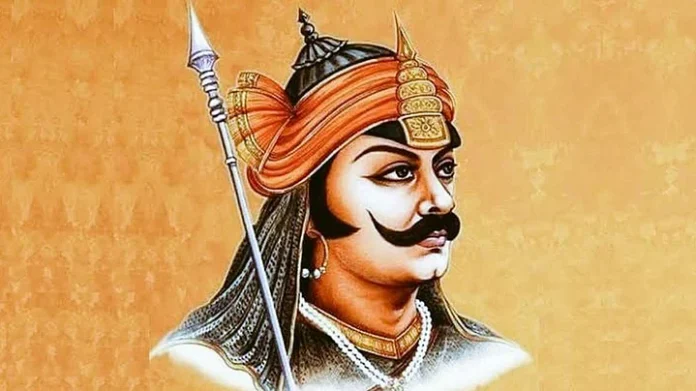
Few names in Indian history evoke as much admiration and respect as Maharana Pratap, the legendary ruler of Mewar. Known for his indomitable spirit, military courage, and refusal to bow before the might of the Mughal Empire, he has become a symbol of freedom, self-respect, and unwavering determination. More than four centuries after his death, Maharana Pratap continues to inspire generations with his commitment to his people and his principles.
Born on 9 May 1540 at Kumbhalgarh Fort in present-day Rajasthan, Maharana Pratap was the eldest son of Maharana Udai Singh II, the founder of Udaipur, and Maharani Jaiwanta Bai. He ascended the throne of Mewar in 1572, at a time when Emperor Akbar was consolidating Mughal power across northern India.
Many Rajput kingdoms had entered into alliances with the Mughals, but Maharana Pratap chose a different path. For him, the sovereignty of Mewar was non-negotiable.
This conviction led to one of the most famous battles in Indian history, the Battle of Haldighati, fought on 18 June 1576. Facing a much larger Mughal force commanded by Raja Man Singh of Amber, Maharana Pratap and his soldiers fought with remarkable bravery. Although the battle was a tough military resistance, Maharana Pratap did not stop. He regrouped, strengthened and continued his struggle for nearly two decades.
The years that followed tested his endurance like never before. Forced to leave his palaces, he lived in the rugged hills and forests of the Aravallis with his family and loyal supporters. Historical traditions recount the hardships they faced, including shortages of food and shelter. Yet Maharana Pratap remained steadfast. Rather than accepting Mughal suzerainty, he chose hardship over submission.
His perseverance eventually bore fruit. Through a series of strategic campaigns and guerrilla warfare tactics, he regained much of Mewar’s lost territory, including important regions such as Kumbhalgarh, Gogunda, and Dewair. By the end of his life, he had restored the authority of Mewar across a significant part of his kingdom, although Chittorgarh remained under Mughal control.
No account of Maharana Pratap is complete without mentioning his loyal horse, Chetak. According to popular tradition, Chetak carried the wounded ruler to safety during the Battle of Haldighati before succumbing to his own injuries. Whether viewed through the lens of history or folklore, the story of Chetak has become a powerful symbol of loyalty and sacrifice.
What makes Maharana Pratap relevant today is not merely his role as a warrior but the values he represented. He demonstrated that leadership is rooted in integrity and courage. He remained committed to his ideals even when compromise may have brought personal comfort or political advantage. His life underscores the importance of resilience, self-respect, and responsibility toward one’s people.
The renowned historian and author Jadunath Sarkar described Maharana Pratap as “the indomitable Rajput” whose resistance became a lasting chapter in India’s history. While modern historians examine his life through different perspectives, there is broad agreement that his steadfast defence of Mewar’s independence made him one of the most remarkable rulers of sixteenth-century India.
Maharana Pratap died on 19 January 1597 at Chavand, then the capital of Mewar. Yet his legacy has only grown stronger with time. He is remembered not simply because he fought battles, but because he refused to surrender his principles. In an age when power often dictated choices, Maharana Pratap chose honour, duty, and freedom above all else. That is why he remains not just a hero of Rajasthan, but an enduring icon of courage and leadership for all of India.