

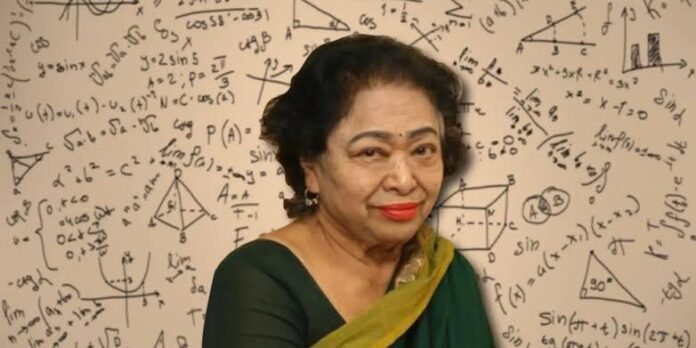
Long before computers became an essential part of everyday life, an Indian woman amazed the world by performing complicated mathematical calculations entirely in her head, often faster than machines. From multiplying enormous numbers within seconds to finding the roots of numbers containing hundreds of digits, Shakuntala Devi demonstrated an extraordinary command over mathematics that earned her the title of the ‘Human Computer’.
Born on November 4, 1929, Shakuntala Devi was an Indian mental calculator, author and public personality whose remarkable abilities brought her international recognition. Her life was an extraordinary journey of curiosity, determination and an unusual relationship with numbers. On her birth anniversary, her achievements continue to inspire generations and challenge conventional ideas about learning and intelligence.
An Extraordinary Talent Discovered in Childhood
Shakuntala Devi was born in Bengaluru, Karnataka, into a family that faced financial difficulties. Her father, C. V. Sundararaja Rao, worked as a circus performer, performing activities such as trapeze, tightrope walking and magic tricks.
Her extraordinary ability with numbers reportedly became apparent when she was just three years old. While playing a card game with her father, she demonstrated an unusual ability to remember numbers and identify patterns. Her father soon recognised her talent and began showcasing her mathematical abilities during public performances.
Unlike most children who develop mathematical skills through years of classroom education, Shakuntala Devi did not receive formal schooling. She developed her abilities through observation, practice and an exceptional interest in numbers. At the age of six, she demonstrated her calculating skills at the University of Mysore, attracting attention for her remarkable mental abilities.
Her talent gradually took her beyond India, where she travelled extensively and performed mathematical demonstrations before audiences at universities and institutions across different countries.
The Mind That Could Calculate Faster Than Computers
What made Shakuntala Devi extraordinary was not simply her ability to solve mathematical problems but the speed and complexity with which she could perform calculations mentally.
She could multiply large numbers, calculate cube roots and higher roots, solve complicated arithmetic problems and determine the day of the week for a given date. Her ability to process enormous numerical figures without using paper, calculators or computers left audiences amazed.
One of her most remarkable demonstrations took place in 1977 at Southern Methodist University in Dallas, United States. She mentally calculated the 23rd root of a 201-digit number in approximately 50 seconds. The answer was subsequently verified using a UNIVAC 1101 computer, which took approximately 62 seconds to complete the calculation.
Another historic achievement came on June 18, 1980, at Imperial College London. The Computer Department selected two random 13-digit numbers for her to multiply. Shakuntala Devi correctly calculated the product of 7,686,369,774,870 and 2,465,099,745,779 in just 28 seconds.
The result was 18,947,668,177,995,426,462,773,730.
This achievement earned her a place in the Guinness Book of World Records. Guinness World Records officially awarded her the title of ‘Fastest Human Computation’ in July 2020, recognising the historic 1980 performance.
What Made Her Mathematical Mind So Extraordinary?
Shakuntala Devi’s abilities were not merely about memorising multiplication tables or performing familiar arithmetic tricks. Her mind demonstrated an exceptional capacity to recognise numerical patterns, process large figures and arrive at complex answers almost instantaneously.
Her calculating abilities were studied by American psychologist Arthur Jensen at the University of California, Berkeley, in 1988. During these tests, she performed several complicated calculations, including finding cube roots and higher mathematical roots within seconds.
Jensen documented her performance in a research paper published in the journal Intelligence in 1990. Although the study examined her abilities, it did not establish a definitive explanation for how she performed calculations at such extraordinary speeds.
Her mental processes remained an exceptional and relatively unexplained ability. The psychologist suggested that extensive practice and the development of highly automated mental operations during childhood could have played an important role.
Her extraordinary talent demonstrated that the human mind could achieve remarkable levels of numerical processing through specialised abilities and sustained practice.
Beyond Mathematics: An Author and a Multifaceted Personality
Shakuntala Devi was not limited to mathematical performances. She was also an author who wanted to make mathematics more interesting and accessible, particularly for children.
Her books, including Figuring: The Joy of Numbers and Puzzles to Puzzle You, introduced readers to mathematical concepts through interesting problems, puzzles and calculation techniques. She believed that mathematics should be approached with curiosity rather than fear.
She also explored subjects beyond mathematics. In 1977, she published The World of Homosexuals, an important early Indian book that discussed homosexuality at a time when the subject received very little public attention. Her literary interests also included astrology, numerology, fiction and cookery.
Her diverse interests reflected a personality that extended well beyond the identity of a mathematical performer.
Awards, Recognition and Lasting Legacy
Shakuntala Devi received international recognition for her extraordinary mathematical abilities. Her achievements were documented in the Guinness Book of World Records, and she became a globally recognised figure through her public demonstrations and performances.
She passed away on April 21, 2013, in Bengaluru, at the age of 83, following respiratory and other health complications.
In 2020, Guinness World Records formally presented her record certificate to her daughter, Anupama Banerji, acknowledging the extraordinary calculation she had performed four decades earlier.
Her life was also brought to the screen through the 2020 biographical film Shakuntala Devi, directed by Anu Menon and starring Vidya Balan in the lead role.
Shakuntala Devi’s legacy goes beyond the numbers she calculated or the records she established. She challenged the conventional understanding of mathematical ability and showed how curiosity, practice and an extraordinary interest in learning could take an individual to remarkable heights.
Her journey remains a reminder that intelligence can express itself in different forms and that the human mind still holds extraordinary possibilities waiting to be explored. Even years after her passing, the woman known as India’s ‘Human Computer’ continues to be remembered for making the world look at mathematics with wonder.