

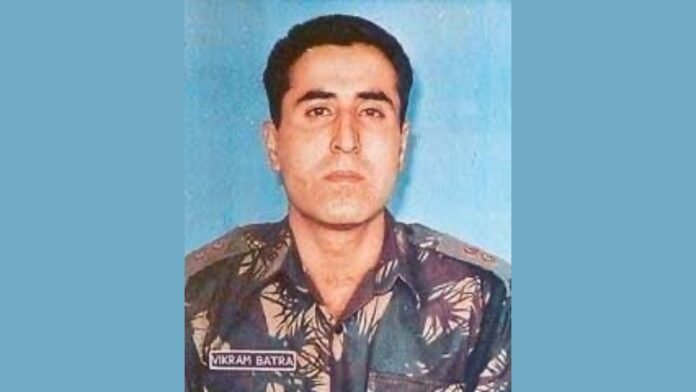
Every year on July 7, India pays tribute to Captain Vikram Batra, PVC, one of the nation’s most celebrated war heroes, who laid down his life during the 1999 Kargil War. Twenty-seven years after his supreme sacrifice, Captain Batra continues to inspire generations with his extraordinary courage, selfless leadership, and unwavering commitment to the nation.
Born on September 9, 1974, in Palampur, Himachal Pradesh, Vikram Batra joined the Indian Military Academy after completing his education and was commissioned into the 13 Jammu and Kashmir Rifles (13 JAK Rifles) in December 1997. Just two years later, he would become one of the defining heroes of the Kargil conflict.
During Operation Vijay, Captain Batra played a pivotal role in recapturing strategic peaks occupied by Pakistani intruders. His first major success came with the capture of Point 5140, one of the most heavily defended enemy positions. After the mission was successfully completed, his now-famous radio message “Yeh Dil Maange More!” captured the nation’s imagination and became synonymous with the spirit of the Indian Army.
Soon after, Captain Batra volunteered for another critical mission to recapture Point 4875 in the Drass sector. On July 7, 1999, while leading his men under intense enemy fire, he rescued an injured fellow officer and continued fighting despite grave danger. In the fierce battle, he was fatally wounded while confronting Pakistani soldiers at close range. He was just 24 years old.
For his conspicuous bravery, exceptional leadership, and supreme sacrifice beyond the call of duty, Captain Vikram Batra was posthumously awarded the Param Vir Chakra, India’s highest wartime gallantry award. His fearless actions were instrumental in India’s victory during the Kargil War and remain a shining example of military valour.
Known as the “Tiger of Drass” by his comrades, Captain Batra’s legacy extends far beyond the battlefield. His life has inspired books, documentaries, and the acclaimed film Shershaah, introducing his remarkable story to a new generation of Indians.
On his death anniversary, the Indian Army, veterans, government leaders, and citizens across the country paid heartfelt tributes to the fallen hero. Wreath-laying ceremonies were held at memorials, while social media was filled with messages remembering his courage and sacrifice. The Army described him as an enduring symbol of patriotism whose legacy continues to motivate every soldier in uniform.
Captain Vikram Batra once said, “Either I will come back after hoisting the Tricolour, or I will come back wrapped in it—but I will come back for sure.” He fulfilled that promise with unmatched courage.
As India remembers one of its bravest sons, Captain Vikram Batra’s story remains a timeless reminder that true heroes never die—they live on in the nation’s history, in the Tricolour they defended, and in the hearts of millions who continue to salute their sacrifice.