

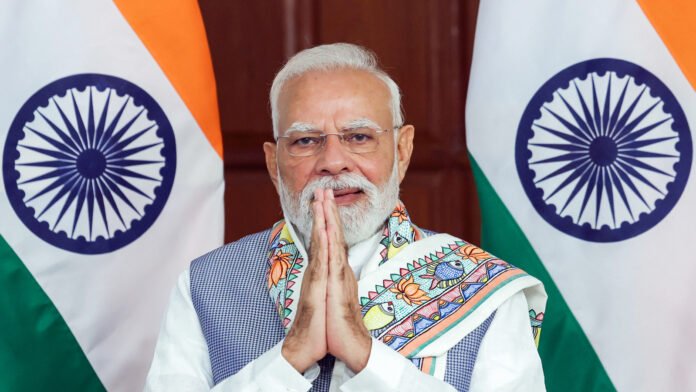
Prime Minister Narendra Modi turns 76 today, September 17, 2026. Born on September 17, 1950, in Vadnagar, Gujarat, Modi is the first Prime Minister of India to have been born after the country’s Independence. His journey from a small town in Gujarat to the country’s highest elected executive office has spanned grassroots organisational work, state-level governance and more than a decade at the centre of national politics.
Narendra Modi was born to Damodardas Mulchand Modi and Hiraben Modi and grew up in a modest family in Vadnagar. According to the Prime Minister’s official biography, his childhood included helping his family at its tea stall while continuing his education. He developed an early interest in reading, debates and public activities. These formative years are frequently cited in accounts of his later political journey, particularly his early association with organisational and community work.
His early adulthood took him into a period of travel and spiritual exploration before he became more deeply involved with the Rashtriya Swayamsevak Sangh (RSS). He subsequently worked as a full-time organiser and built experience in political organisation. His association with the Bharatiya Janata Party eventually brought him into increasingly important organisational responsibilities at the state and national levels.
A major turning point came in 2001, when Modi became Chief Minister of Gujarat. He remained in the position until 2014, overseeing the state during a period marked by emphasis on infrastructure, investment, industrial development and administrative reforms. His tenure also attracted substantial political criticism and controversy, particularly over the 2002 Gujarat riots and questions concerning governance and communal relations. These remain an important part of assessments of his political record and are viewed differently by supporters, opponents and independent observers.
In 2014, Modi moved from state politics to national leadership. The BJP won a majority in the Lok Sabha elections, and he took oath as India’s Prime Minister on May 26, 2014. He returned to office after the 2019 general election and began a third consecutive term in June 2024. On June 10, 2026, the Union Cabinet noted that Modi had become the longest-serving elected Prime Minister in India in terms of continuous service, surpassing Jawaharlal Nehru’s previous record.
Over his years as Prime Minister, several programmes have become closely associated with his government. Jan Dhan Yojana expanded access to formal banking, while Swachh Bharat Mission focused on sanitation and cleanliness. Make in India sought to strengthen manufacturing, Digital India promoted digital infrastructure and services, and the rapid expansion of digital payments, particularly through UPI, transformed everyday financial transactions for millions of Indians. Ayushman Bharat became a major government health-insurance initiative, while programmes such as PM-KISAN focused on income support for farmers.
His government’s policy agenda has also included major structural and constitutional changes, including the implementation of the Goods and Services Tax, the abrogation of the special constitutional status of Jammu and Kashmir under Article 370, and the passage of the Citizenship Amendment Act. His tenure has also seen major infrastructure expansion, increased emphasis on domestic defence production, renewable energy and India’s technology and space sectors.
India’s international profile has been another defining feature of the Modi era. During India’s G20 presidency in 2023, New Delhi hosted the summit of G20 leaders and promoted issues including the priorities of developing countries and the interests of the Global South. Modi has also promoted initiatives such as the International Solar Alliance and International Day of Yoga, which has become an annual global observance following a United Nations resolution supported by 177 countries.
His diplomatic engagements have kept him at the centre of India’s relations with major powers and developing economies. In September 2026, New Delhi hosted the BRICS summit, bringing together leaders from major emerging economies. Modi’s meetings with leaders including China’s Xi Jinping, Russia’s Vladimir Putin and Iran’s Masoud Pezeshkian during the summit reflected India’s increasingly active engagement across different geopolitical groupings.
Modi’s international visibility is also reflected in the scale of his engagement with foreign governments, global institutions and international audiences. His social-media presence has made him one of the most visible political leaders online, while his frequent participation in major international summits has kept him prominent in global diplomatic coverage. His supporters view this visibility as evidence of India’s growing influence; critics, meanwhile, have raised questions about aspects of his government’s domestic policies, democratic institutions and civil liberties. Both perspectives form part of the wider public debate surrounding his leadership.
At home, his political longevity has been equally significant. Since becoming Prime Minister in 2014, Modi has remained one of the central figures in Indian politics and has led the country through major economic, social, technological and geopolitical developments. His third consecutive term following the 2024 general election extended his tenure into a period in which India is seeking to position itself as a major economic and strategic power.
At 76, Narendra Modi’s political journey is therefore a story that stretches from the lanes of Vadnagar to the international stage. From an early life shaped by modest circumstances and organisational work to more than two decades in executive government, his career has become closely connected with some of the most consequential political and policy developments in contemporary India.
His birthday in 2026 comes at another significant point in that journey. With India playing an increasingly active role in global affairs and Modi having crossed the milestone of becoming the country’s longest-serving elected Prime Minister in continuous office, his political career remains an important part of India’s contemporary story.