

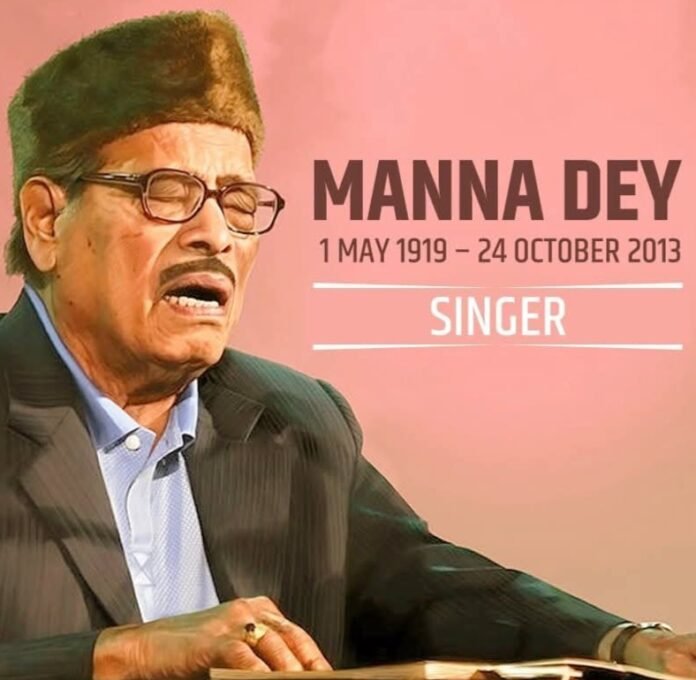
Every year on May 1, music lovers across India and beyond celebrate the birth anniversary of Manna Dey—one of the most versatile and technically gifted playback singers in the history of Indian cinema. Born as Prabodh Chandra Dey in 1919 in Kolkata, his voice became synonymous with depth, classical brilliance, and timeless emotion.
A Journey Rooted in Classical Excellence
Manna Dey’s musical foundation was deeply rooted in Indian classical traditions. He trained under stalwarts like Ustad Aman Ali Khan of the Bhendibazaar Gharana, which gave him an extraordinary command over complex ragas and intricate compositions.
He began his playback singing career in the early 1940s with the film Tamanna, marking the beginning of a journey that would span decades and thousands of songs.
What set him apart was his ability to seamlessly blend classical purity with mainstream film music—a rare skill that earned him immense respect among composers and fellow singers.
A Voice Across Genres and Generations
Unlike many singers who became associated with a particular style, Manna Dey mastered a wide range of genres:
●Classical and semi-classical compositions
●Romantic melodies
●Devotional songs
●Patriotic anthems
●Humorous and light-hearted numbers
He recorded over 3,500 songs in multiple languages including Hindi, Bengali, Marathi, and Malayalam, making him a truly pan-Indian artist.
His contemporaries included legends like Mohammed Rafi, Kishore Kumar, and Mukesh, yet Manna Dey carved his own unique niche with technically demanding songs that required exceptional skill.
Iconic Songs That Define His Legacy
Manna Dey’s songs continue to resonate across generations, each carrying a distinct emotional and musical richness. Some of his most celebrated tracks include:
●Zindagi Kaisi Hai Paheli (Anand)
●Ae Mere Pyare Watan (Kabuliwala)
●Laga Chunari Mein Daag (Dil Hi To Hai)
●Yeh Dosti Hum Nahi Todenge (Sholay)
●Aye Meri Zohra Jabeen (Waqt)
●Ek Chatur Naar (Padosan)
These songs highlight his versatility—from philosophical reflections to playful duets and classical masterpieces.
Awards and Recognition
Manna Dey’s immense contribution to Indian music earned him numerous prestigious honours:
●Padma Shri (1971)
●Padma Bhushan (2005)
●Dadasaheb Phalke Award (2007)
These accolades reflect not just his popularity, but also his artistic excellence and influence on generations of musicians.
The Underrated Genius
Despite his immense talent, Manna Dey was often considered an “underrated” legend. While other singers became the regular voice for leading actors, Dey was frequently chosen for technically complex or unconventional songs.
Ironically, this very distinction elevated his status among musicians and connoisseurs, who admired his flawless technique and ability to bring classical music into popular cinema.
A Timeless Legacy
Manna Dey passed away on October 24, 2013, but his voice continues to live on—echoing through radios, playlists, and the hearts of millions.
On his birth anniversary, we are reminded not just of a singer, but of an artist who redefined musical boundaries. His songs are not merely melodies; they are lessons in discipline, passion, and artistic integrity.
Conclusion
The birth anniversary of Manna Dey is more than a tribute—it is a celebration of musical brilliance that transcends time. In an era where trends come and go, his voice remains eternal, reminding us that true artistry never fades.
As his iconic song asks, “Zindagi kaisi hai paheli…”—perhaps the answer lies in the enduring magic of his music.