

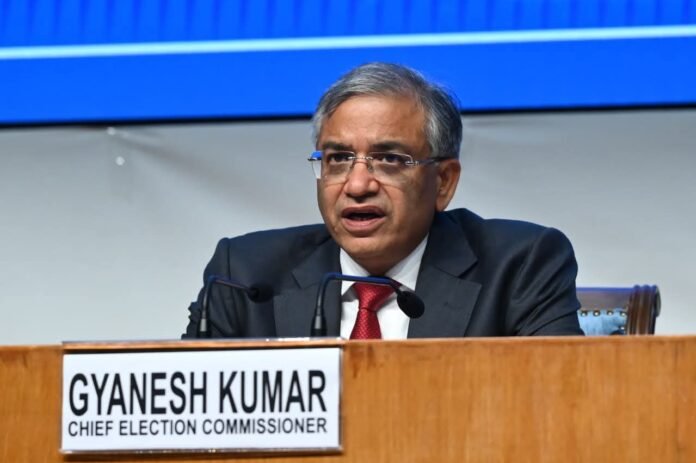
Gyanesh Kumar currently serves as the 26th Chief Election Commissioner (CEC) of India, having assumed office on 19 February 2025. A seasoned bureaucrat and former Indian Administrative Service (IAS) officer, his journey reflects decades of experience in governance, policy-making, and institutional leadership.
Early Life and Education
Born on 27 January 1964 in Agra, Uttar Pradesh, Gyanesh Kumar has a strong academic foundation. He completed his B.Tech from IIT Kanpur, followed by studies in Business Finance from ICFAI, and further specialized in Environmental Economics at Harvard University.
This combination of technical, financial, and policy education helped shape his analytical approach to governance and administration.
Civil Services Career and Administrative Journey
Gyanesh Kumar is a 1988-batch IAS officer of the Kerala cadre, with a distinguished career spanning both state and central governments.
Over the years, he held several key positions, including:
●Joint Secretary in the Ministry of Defence (2007–2012)
●Secretary, Ministry of Parliamentary Affairs (2021–2022)
●Secretary, Ministry of Cooperation (2022–2024)
He was also associated with important national-level policy initiatives, including involvement in the Jammu and Kashmir Reorganisation Act and administrative processes linked to the Shri Ram Janmabhoomi Teerth Kshetra Trust.
His administrative style has often been described as detail-oriented and policy-driven, shaped by years of handling complex governance issues.
Journey in the Election Commission
Gyanesh Kumar entered the Election Commission of India as an Election Commissioner on 14 March 2024. Within less than a year, he rose to the top post, becoming the Chief Election Commissioner in February 2025.
Notably, he is the first CEC appointed under the Chief Election Commissioner and Other Election Commissioners Act, 2023, marking a new phase in the appointment process of India’s top election body.
Upon assuming office, he emphasized the importance of voter participation, stating that “voting is the first step in nation-building.”
Role in Conducting Elections and Electoral Reforms
As Chief Election Commissioner, Gyanesh Kumar oversees one of the world’s largest democratic exercises—the conduct of elections in India. His tenure has focused on:
●Strengthening electoral rolls: Through initiatives like the Special Intensive Revision (SIR), aimed at eliminating duplicate or ineligible voters and ensuring accuracy.
●Enhancing transparency: Measures such as webcasting at polling stations and improved monitoring systems have been highlighted.
●Ensuring smooth elections: Electoral exercises under his leadership, including state elections, have been conducted with emphasis on efficiency and minimal disputes, with reports of zero repolls in some cases.
These steps underline the Election Commission’s efforts to maintain credibility, inclusiveness, and fairness in the electoral process.
Leadership Style and Challenges
Gyanesh Kumar’s tenure has not been without challenges. His appointment and certain electoral processes have sparked political debates and scrutiny. However, such challenges are not uncommon for the office, given its critical role in safeguarding democracy.
Despite this, his focus has remained on institutional integrity, voter participation, and technological improvements in election management.
Conclusion
Gyanesh Kumar’s journey—from an IIT graduate to a senior IAS officer and now the Chief Election Commissioner—reflects a career built on administrative depth and national service. As he leads the Election Commission of India, his role is pivotal in ensuring that the democratic process remains transparent, inclusive, and robust.
In a country as vast and diverse as India, the responsibility of conducting free and fair elections is enormous—and under his stewardship, the Election Commission continues to uphold the foundations of the world’s largest democracy.