

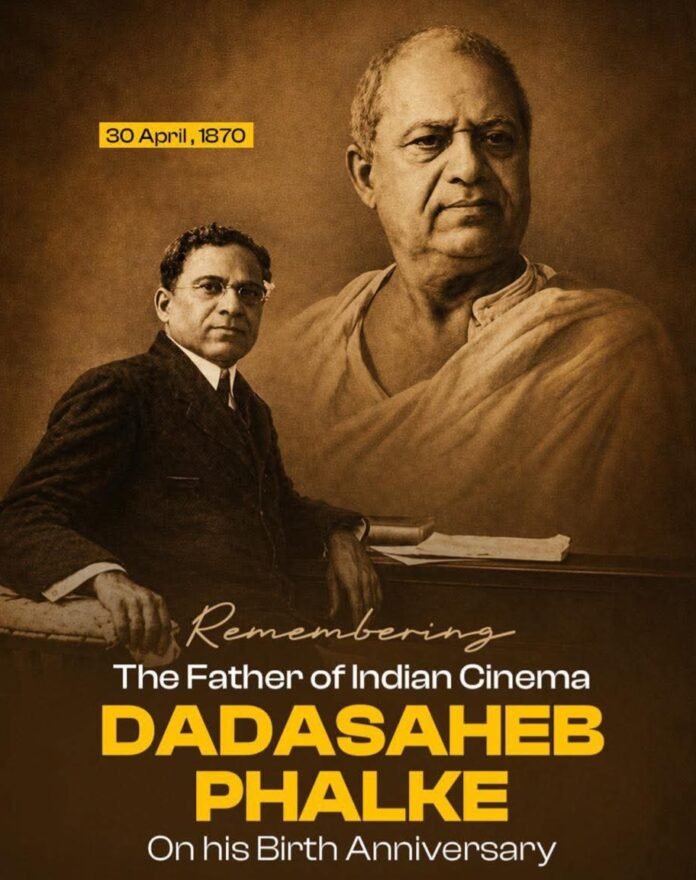
Every year on April 30, India pays tribute to a visionary who transformed storytelling forever—Dadasaheb Phalke, revered as the “Father of Indian Cinema.” Born as Dhundiraj Govind Phalke in 1870 in Trimbakeshwar, Maharashtra, his pioneering spirit laid the foundation of what would become one of the world’s largest film industries.
At a time when cinema itself was a nascent medium globally, Phalke dared to imagine its possibilities in India. With relentless determination and creativity, he brought to life India’s first full-length feature film, Raja Harishchandra in 1913. Rooted in Indian mythology, the film was more than just entertainment—it was a cultural awakening. It proved that Indian stories could be told through the powerful medium of cinema, sparking the birth of a new artistic era.
Phalke’s journey into filmmaking was not accidental. A student of the prestigious Sir J.J. School of Art in Mumbai, he had mastered multiple disciplines including painting, photography, and printing technology. This diverse skill set enabled him to handle every aspect of filmmaking—from set design and cinematography to direction and editing—at a time when resources were scarce and technical knowledge limited.
Over a career spanning just 19 years, Phalke created an astonishing body of work: 95 feature films and 27 short films. Among his notable works are Lanka Dahan and Kaliya Mardan, both of which drew heavily from Indian epics and mythology. His films not only entertained but also connected audiences with their cultural roots, bridging tradition with innovation.
Phalke’s contribution goes far beyond numbers. He established the grammar of Indian filmmaking—introducing narrative techniques, visual storytelling, and production practices that continue to influence cinema today. At a time when acting in films was socially frowned upon, especially for women, he overcame societal barriers to bring his cinematic vision to life.
In recognition of his monumental contribution, the Government of India instituted the Dadasaheb Phalke Award in 1969. Today, it remains the highest honour in Indian cinema, awarded for lifetime achievement and excellence, symbolising the enduring legacy of the man who started it all.
As India celebrates his birth anniversary, Dadasaheb Phalke is remembered not just as a filmmaker, but as a pioneer who transformed imagination into reality. His work bridged mythology and modernity, art and technology, vision and execution. In doing so, he gave India not just its first film—but an entire cinematic identity.
His legacy lives on in every frame of Indian cinema, reminding us that great revolutions often begin with a single dream.