

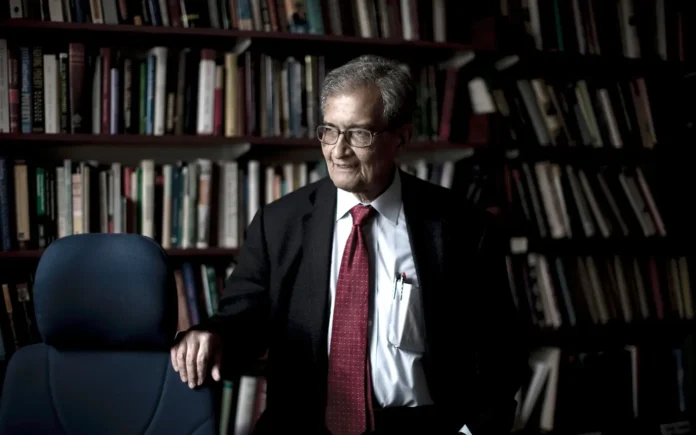
Renowned Indian economist, philosopher and Nobel laureate Amartya Sen is widely recognised for changing the way the world understands poverty, inequality, economic development and human welfare. His work brought together economics, philosophy and social justice, highlighting that a country’s progress should not be measured merely through income or economic growth but also through the opportunities, freedoms and quality of life available to its people.
Born on November 3, 1933, Amartya Kumar Sen has made remarkable contributions to economic thought and public policy. On his birth anniversary, his life journey and achievements offer an opportunity to revisit the ideas that have influenced discussions on poverty, hunger, education, healthcare and human development across the world.
Early Life and Education
Amartya Sen was born in Santiniketan, Bengal, in a family with an academic background. His father, Ashutosh Sen, was a professor of chemistry, while his maternal grandfather, Kshiti Mohan Sen, was a distinguished scholar of Sanskrit and Indian culture. Growing up in Santiniketan, an educational and cultural centre associated with Rabindranath Tagore, Sen was exposed to literature, philosophy and intellectual discussions from an early age.
His childhood experiences also played an important role in shaping his understanding of social and economic inequalities. As a young boy, he witnessed the Bengal Famine of 1943, which caused widespread hunger and loss of life. The experience left a lasting impression on him and contributed to his interest in understanding the causes of poverty, hunger and deprivation.
Sen completed his early university education at Presidency College in Calcutta, where he studied economics. He later moved to the University of Cambridge in the United Kingdom and joined Trinity College. He completed his doctoral studies in economics in 1959, laying the foundation for a distinguished academic career.
An Academic Journey Across the World
Sen began his teaching career in India and went on to work at several prestigious academic institutions around the world. He served as a professor at Jadavpur University and later taught at the Delhi School of Economics. His academic journey also took him to the London School of Economics and the University of Oxford.
He subsequently became a leading academic figure at the University of Cambridge, where he served as Master of Trinity College from 1998 to 2004. He has also been associated with Harvard University as Thomas W. Lamont University Professor and Professor of Economics and Philosophy.
Over the decades, Sen’s research has covered a wide range of subjects, including welfare economics, social choice theory, development economics, public health, gender inequality, ethics and political philosophy. His ability to connect economic questions with human experiences has made his work influential beyond the academic world.
Transforming the Understanding of Poverty and Hunger
One of Amartya Sen’s most significant contributions has been his research on poverty and famines. His influential 1981 book, Poverty and Famines: An Essay on Entitlement and Deprivation, challenged the conventional understanding that famines occur simply because there is not enough food available.
Sen explained that people can face starvation even when food exists in the market. The problem may lie in their inability to access or purchase it because of unemployment, falling wages, rising prices or the loss of livelihoods. His research highlighted the importance of understanding how people gain access to food and essential resources.
His work also emphasised the relationship between democracy, public accountability and food security. He argued that a free press, political participation and an accountable government play important roles in preventing large-scale famines.
The Capability Approach and Human Development
Another major contribution of Sen is the Capability Approach, which changed the way economists and policymakers assess human well-being. According to this approach, development should not be judged only by a person’s income or a country’s gross domestic product (GDP). Instead, it should also consider what people are actually able to do and become.
This includes having access to education, healthcare, adequate nutrition, employment opportunities and the freedom to make meaningful choices about one’s life.
His ideas significantly influenced the development of the Human Development Index (HDI), introduced by the United Nations Development Programme in 1990 under the leadership of Pakistani economist Mahbub ul Haq. The index measures development through three broad dimensions: health, education and standard of living. Sen’s intellectual contributions helped shape this broader understanding of development.
Nobel Prize and Major Achievements
In 1998, Amartya Sen received the Sveriges Riksbank Prize in Economic Sciences in Memory of Alfred Nobel for his contributions to welfare economics. He became the first Asian to receive this prestigious economics prize.
In 1999, the Government of India honoured him with the Bharat Ratna, the country’s highest civilian award, in recognition of his outstanding contributions. He has also received several international honours, including the National Humanities Medal from the United States in 2011 and the Honorary Companion of Honour from the United Kingdom.
Some of his widely recognised books include Development as Freedom (1999), The Argumentative Indian (2005), Identity and Violence: The Illusion of Destiny (2006) and The Idea of Justice (2009). Through these works, he explored the connections between freedom, identity, democracy, social responsibility and justice.
A Legacy Beyond Economics
Amartya Sen’s contribution extends far beyond economic theories and academic research. His ideas have encouraged governments, institutions and researchers to look at development from the perspective of ordinary people, particularly those facing poverty, discrimination and limited opportunities.
His work reminds the world that economic progress has little meaning if people continue to struggle for basic necessities, education, healthcare and equal opportunities. By placing human freedom and dignity at the centre of development, Sen has helped shape a more inclusive understanding of progress.
As he celebrates his birth anniversary, his intellectual legacy continues to inspire conversations on building societies where economic growth goes hand in hand with equality, justice and human well-being.