

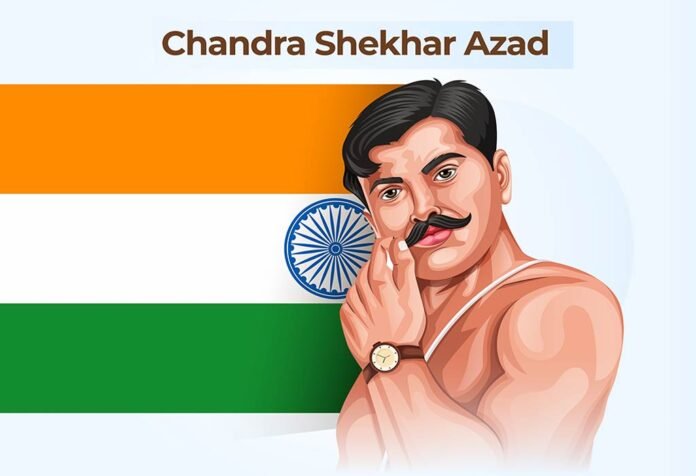
Chandra Shekhar Azad is remembered as one of India’s bravest freedom fighters, but beyond his famous slogan and supreme sacrifice lies a fascinating life filled with remarkable stories. On his birth anniversary, here are 10 lesser-known facts about the legendary revolutionary that reveal his extraordinary personality and unwavering commitment to India’s freedom.
1. His original name wasn’t Azad.
He was born as Chandra Shekhar Tiwari on July 23, 1906, in Bhabhra village (present-day Madhya Pradesh). The name “Azad,” meaning “Free,” became his identity only after a memorable courtroom incident.
2. He earned the name ‘Azad’ at just 15.
During the Non-Cooperation Movement, he was arrested by the British. When asked his name, he replied “Azad,” his father’s name as “Swatantrata,” and his address as “Jail.” The fearless response made him famous across the country.
3. His mother wanted him to become a Sanskrit scholar.
Unlike his revolutionary image, Azad’s mother, Jagrani Devi, dreamed of seeing him as a learned Sanskrit scholar. He was sent to Varanasi to study at a Sanskrit school before he joined the freedom movement.
4. He was an excellent archer.
Growing up in a tribal region, Azad learnt archery from the Bhil community. His exceptional aim later helped him become a skilled marksman during revolutionary operations.
5. He used a secret alias.
Apart from “Azad,” he often used the pseudonym “Balraj” while issuing revolutionary pamphlets as the commander of the Hindustan Socialist Republican Association (HSRA), helping him evade British authorities.
6. He mentored Bhagat Singh.
Azad was not just a revolutionary but also a mentor. After the Kakori case, he rebuilt the revolutionary organisation and guided young revolutionaries, including Bhagat Singh, Sukhdev, and Rajguru.
7. He believed in a socially just India.
Beyond political freedom, Azad envisioned an India free from social and economic inequality. This belief led to the reorganisation of the Hindustan Republican Association into the Hindustan Socialist Republican Association (HSRA).
8. He remained one of the British Empire’s most wanted revolutionaries.
Despite constant surveillance and large rewards announced for his capture, Azad managed to evade arrest for years through careful planning, disguises and a strong underground network.
9. He kept his promise till his last breath.
Azad had vowed that the British would never capture him alive. On February 27, 1931, when surrounded by police at Alfred Park in Allahabad, he fought bravely and used his last bullet on himself rather than surrender.
10. His legacy lives on across India.
The park where he made his final stand is now known as Chandra Shekhar Azad Park, and numerous schools, universities, roads and public institutions across the country bear his name, ensuring that generations continue to remember his sacrifice.
More than nine decades after his martyrdom, Chandra Shekhar Azad remains an enduring symbol of courage, determination and patriotism. His life reminds us that true freedom demands conviction, sacrifice and an unwavering commitment to the nation.