

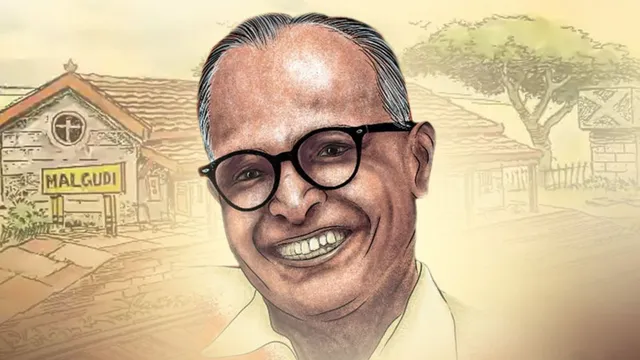
May 13 marks the death anniversary of R. K. Narayan, one of the most celebrated figures in Indian English literature. Even decades after his passing in 2001, Narayan continues to be remembered for his simple yet deeply insightful storytelling that captured the everyday life, emotions and social realities of ordinary Indians with warmth, humour and humanity.
Born as Rasipuram Krishnaswami Iyer Narayanaswami in 1906 in Madras (now Chennai), R.K. Narayan emerged as one of the pioneers of Indian writing in English alongside writers like Mulk Raj Anand and Raja Rao. At a time when Indian English literature was still finding its identity, Narayan’s works stood out for their simplicity, relatability and distinctly Indian setting.
Narayan is best remembered as the creator of Malgudi, the fictional South Indian town that became the backdrop for many of his novels and short stories. Introduced in his first novel, Swami and Friends, Malgudi evolved into one of the most iconic fictional settings in Indian literature. Through its streets, schools, markets and railway station, Narayan portrayed India in transition — balancing tradition, colonial influence, modernity and changing social values.
Among his most famous works are Malgudi Days, The Guide, The English Teacher, The Financial Expert and The Man-Eater of Malgudi. His novel The Guide received the Sahitya Akademi Award in 1960 and was later adapted into a critically acclaimed Hindi film starring Dev Anand.
What made R.K. Narayan unique was his ability to find extraordinary depth in ordinary life. His stories did not rely on dramatic events or grand heroes; instead, they focused on schoolboys, teachers, shopkeepers, astrologers and middle-class families navigating daily struggles and aspirations. Literary critics often praised his subtle humour, irony and compassionate understanding of human nature.
Narayan also played a major role in bringing Indian literature to international readers. British writer Graham Greene, who became Narayan’s mentor and friend, helped him find publishers in the West. Over time, his books gained recognition worldwide for authentically portraying Indian society without exoticism or stereotypes.
One of the biggest reasons Narayan remains relevant even today is the timeless appeal of his storytelling. The television adaptation of Malgudi Days in the 1980s introduced his stories to an entirely new generation and became a cherished part of Indian popular culture. Even today, many readers associate Narayan’s works with nostalgia, simplicity and childhood memories. Recent online discussions continue to reflect the emotional connection readers feel with characters like Swami and the world of Malgudi.
During his long literary career spanning more than six decades, Narayan received numerous honours including the Padma Bhushan, Padma Vibhushan and the Sahitya Akademi Fellowship. He was also nominated to the Rajya Sabha for his contributions to literature.
On his death anniversary, readers, writers and literature lovers continue to pay tribute to R.K. Narayan not just as a novelist, but as a storyteller who gave Indian literature a voice rooted in everyday life. Through Malgudi and its unforgettable characters, he created a literary universe that remains timeless, relatable and deeply human.