

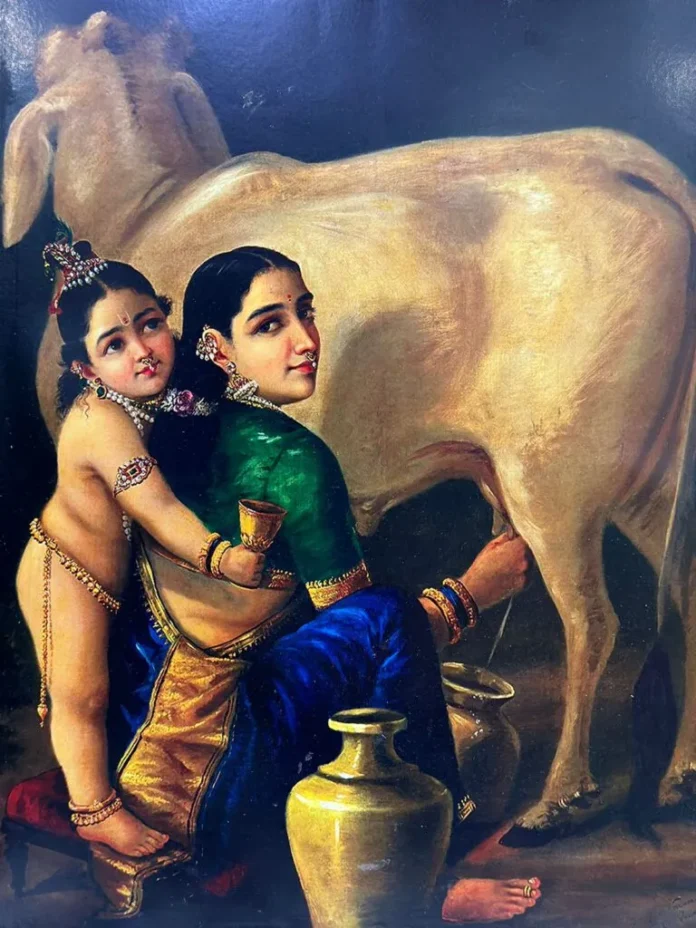
In a historic moment for the Indian art market, an iconic painting by Raja Ravi Varma —Yashoda and Krishna—has reportedly been sold for a staggering ₹167 crore, setting a new benchmark for modern Indian art. Acquired by industrialist Cyrus S. Poonawala , the sale underscores not just the monetary value of art, but its enduring cultural and civilizational significance.
The Painting: Where Mythology Meets Realism
Yashoda and Krishna is among the most celebrated works of Raja Ravi Varma, an artist often credited with bridging the gap between traditional Indian aesthetics and European academic realism.
The painting portrays a tender, intimate moment between Yashoda and Krishna —a mother and child bond that resonates deeply across Indian culture. Yashoda is depicted milking a cow while young Krishna clings to her, a composition that reflects both domestic simplicity and divine symbolism.
Varma’s mastery lies in humanizing divine figures—rendering gods not as distant celestial beings but as relatable, emotional presences within everyday life. This approach revolutionized Indian visual culture in the late 19th century.
Why This Sale Matters
This record-breaking transaction is significant on multiple levels:
1. A New Benchmark for Indian Art
The ₹167 crore valuation places Indian art firmly on the global high-value art map. While works by Western masters routinely fetch astronomical sums, Indian art has historically been undervalued in comparison. This sale challenges that perception.
2. Cultural Capital Over Market Speculation
Unlike purely speculative art purchases, this acquisition reflects the growing importance of cultural capital. Collectors are increasingly investing in works that embody heritage, identity, and narrative depth.
3. Renewed Interest in Ravi Varma
Though Raja Ravi Varma has long been revered, this sale could trigger a renewed academic and commercial interest in his oeuvre. It also reinforces his position as one of India’s most influential artists—often described as the father of modern Indian art.
The Legacy of Raja Ravi Varma
Ravi Varma’s contribution goes beyond canvas. Through his pioneering use of oleographic prints, he made art accessible to the masses, bringing mythological imagery into ordinary Indian homes.
His depictions of Hindu deities shaped popular imagination—many contemporary visualizations of gods are still influenced by his style. In essence, he democratized art long before mass media.
Art, Identity, and the Indian Market
The sale also signals a broader shift in India’s art ecosystem:
●Rising domestic collectors: Wealthy Indian buyers are increasingly reclaiming cultural artifacts.
●Institutional interest: Museums and private collections are investing in historically significant works.
●Global recognition: Indian art is gaining traction in international auction houses and exhibitions.
Moreover, such high-value transactions often have a ripple effect—boosting the valuation of other Indian artists and encouraging preservation efforts.
Beyond the Price Tag
While ₹167 crore is a headline-grabbing figure, the true value of Yashoda and Krishna lies in its emotional, cultural, and historical resonance.
It captures:
●The universality of motherhood
●The blending of divine and human realms
●The artistic evolution of a nation in transition
In a rapidly modernizing world, such works serve as anchors to tradition, reminding us of the narratives that shape collective identity.
A Defining Moment for Indian Art
This landmark sale is more than a record—it is a statement. It signals that Indian art, rooted in mythology yet universal in appeal, is finally receiving the global recognition it deserves.
As collectors, historians, and audiences revisit the legacy of Raja Ravi Varma, one thing becomes clear:
India’s artistic heritage is not just surviving—it is thriving, commanding attention, and redefining its place on the world stage.