

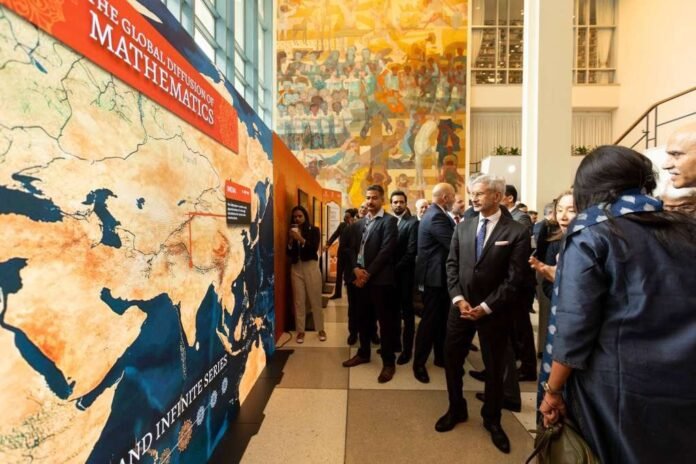
India’s ancient mathematical wisdom took centre stage at the United Nations headquarters in New York as External Affairs Minister S. Jaishankar inaugurated a special exhibition titled “From Shunya to Ananta (Zero to Infinity): The Indian Civilisation’s Contribution to Mathematics.” The exhibition, organised by the Permanent Mission of India to the UN, highlights India’s historic and foundational role in shaping the world of mathematics and scientific thought.
Held at the UN headquarters from May 11 to May 15, the exhibition traces over two millennia of mathematical developments originating in India — from the invention of shunya (zero) and the decimal place value system to algebra, geometry, combinatorics, binary enumeration and astronomical calculations.
Speaking at the inauguration, Jaishankar said that the history of scientific progress has often been viewed through a “narrow lens” that overlooked contributions from many civilisations, including India. He stressed the need for a more balanced understanding of global scientific heritage. According to him, the exhibition reflects not only India’s intellectual traditions but also the interconnected nature of human knowledge across cultures and centuries.
The exhibition also showcases the work of legendary Indian mathematicians and scholars such as Aryabhata, Brahmagupta and Bhaskara II, along with contributions of the Kerala School of astronomy and mathematics. Their pioneering work laid the foundation for several concepts that later influenced mathematics in the Arab world and Europe.
One of the central themes of the exhibition is how ideas born in ancient India continue to shape the modern world. Digital panels demonstrate how early Indian mathematical concepts, including binary logic and numerical systems, form the basis of today’s computing technologies, algorithms, GPS systems and artificial intelligence. Jaishankar remarked that the very code powering the modern technological age was conceptualised in India centuries ago.
India’s Permanent Representative to the UN, Parvathaneni Harish, described mathematics as a universal language that unites humanity rather than divides it. He noted that India historically treated knowledge as a shared global resource, comparing the country’s ancient knowledge traditions to the modern idea of “open source.”
The exhibition has been organised under the India International Centre’s SAMHiTA initiative in collaboration with the Indian Council for Cultural Relations (ICCR). It is part of India’s broader cultural diplomacy efforts to present its civilisational heritage and scientific achievements on international platforms. In recent years, India has increasingly highlighted its contributions in fields such as yoga, Ayurveda, philosophy and traditional knowledge systems at global forums.
More than just a display of historical achievements, “From Shunya to Ananta” serves as a reminder that scientific progress has always been the result of shared human endeavour. By bringing India’s mathematical legacy to the United Nations, the exhibition seeks to encourage a more inclusive understanding of world history — one that recognises the diverse civilisations that helped shape modern science and technology.